![[back]](/assets/home_24dp_E3E3E3_FILL0_wght400_GRAD0_opsz24.svg "[back]")
![[search]](/assets/search_24dp_E3E3E3_FILL0_wght400_GRAD0_opsz24.svg "[search]")
Genesis Translation from Source
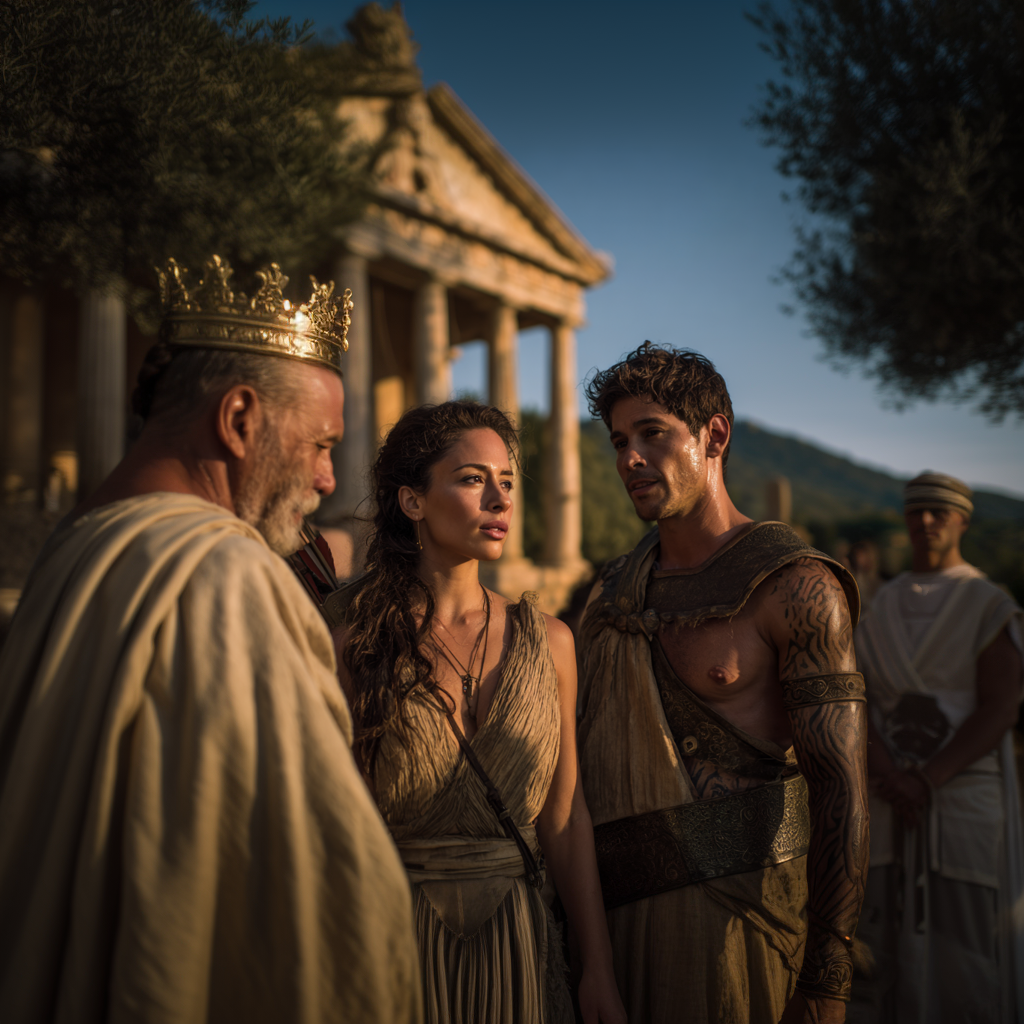
Cast of Characters
Kurios, Eua, Ophis, Adam (left to right)
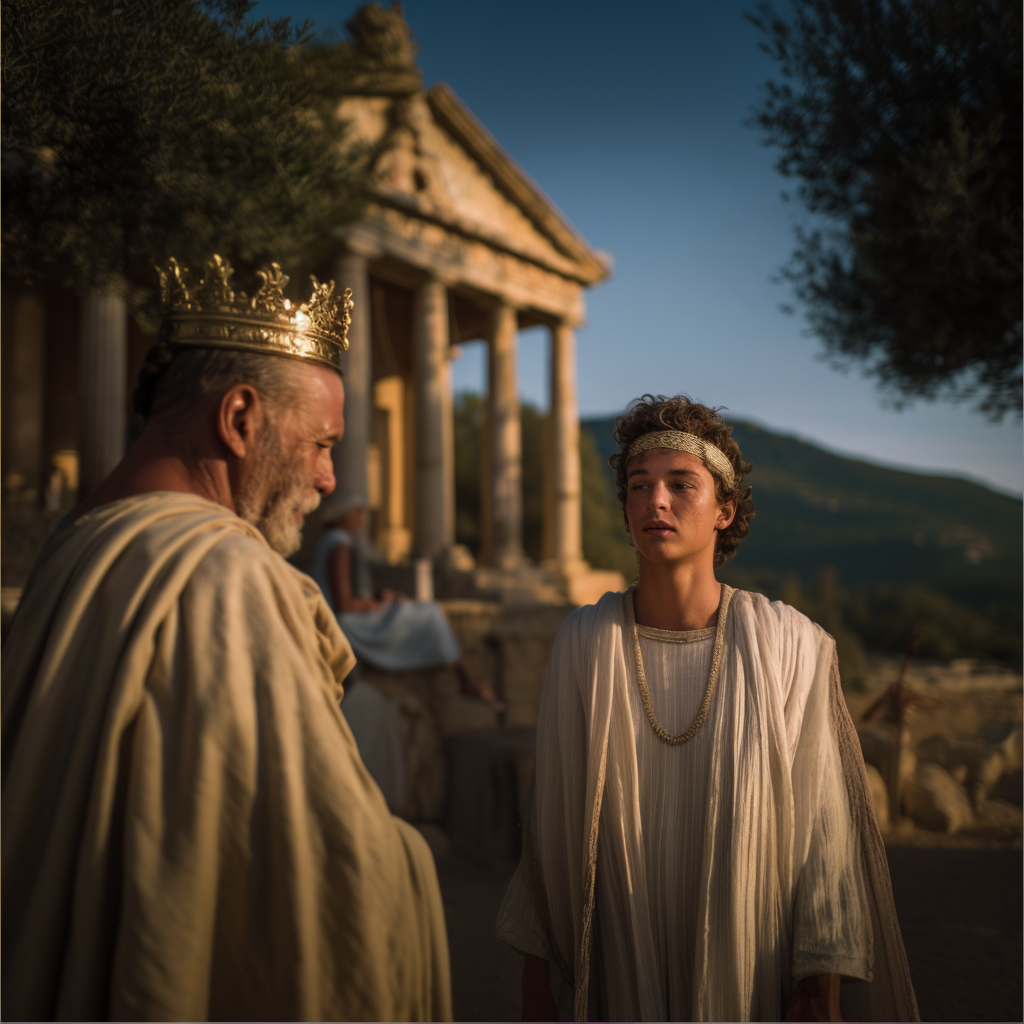
Kurios, and Adam
Forming by education (eplasen'ing) Adam's psyche/soul using earth-based pharmakon
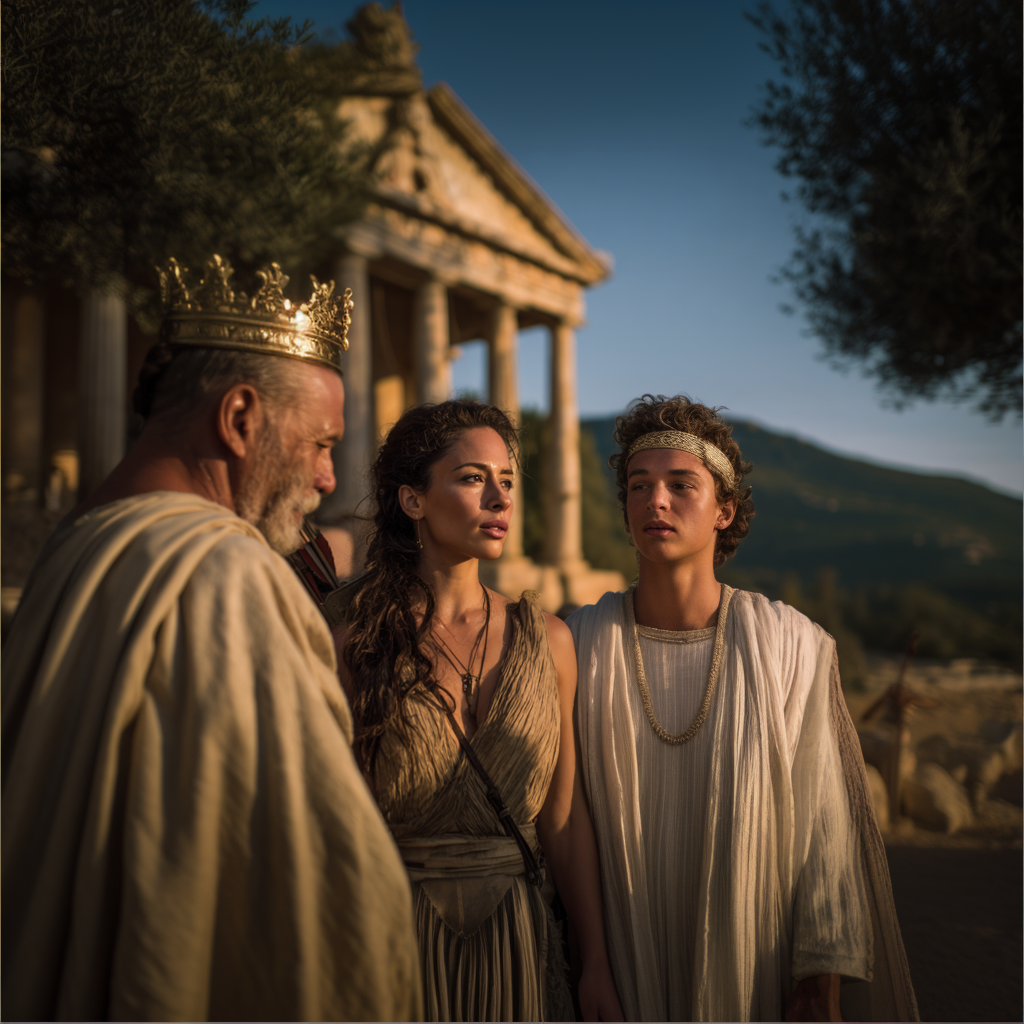
Kurios, Eua, and Adam
Eua from Adam's side
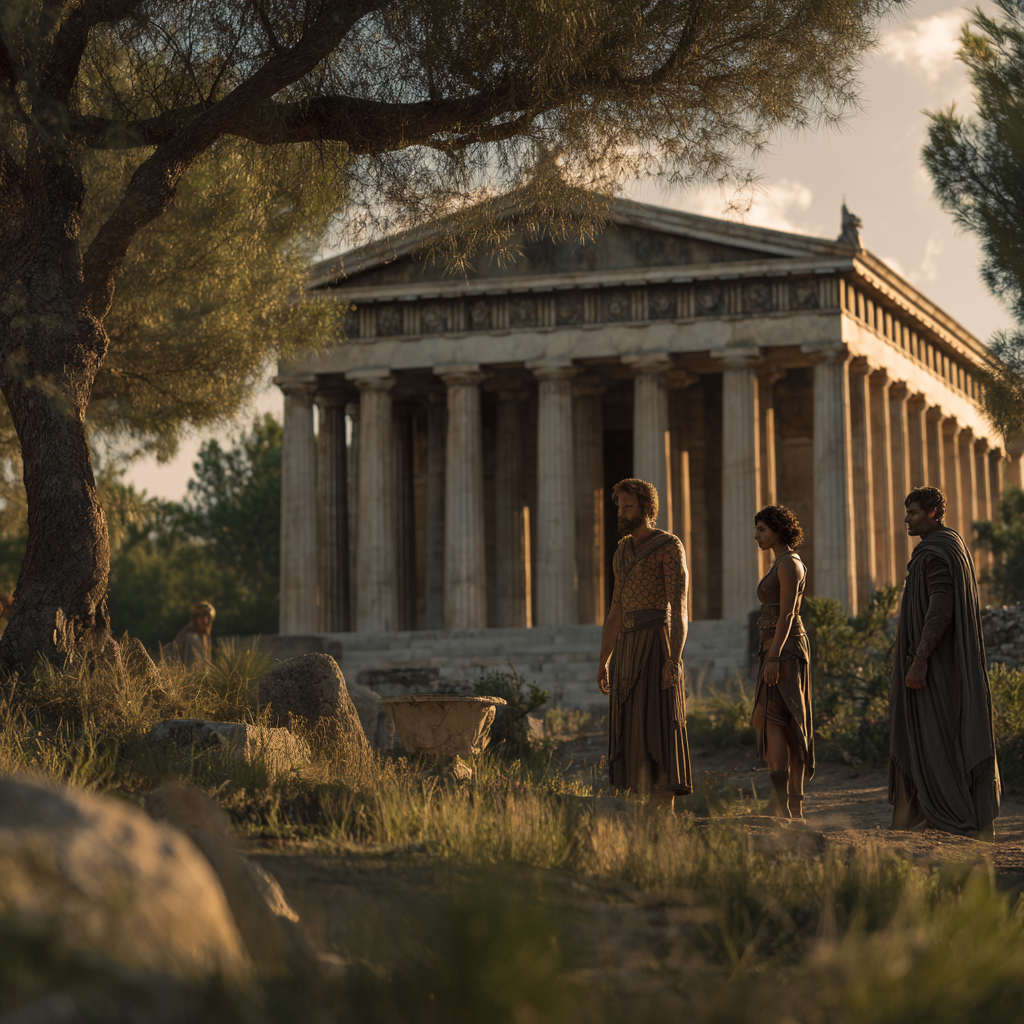
Ophis gives Adam gnosis (of beauty/oppression), by the tree, in the Paradise
Eua Boethos (partner in battle) supplies the bacchic cry of life in the rite
Kurios watches with concern
(spoiler: There may not even be a tree)
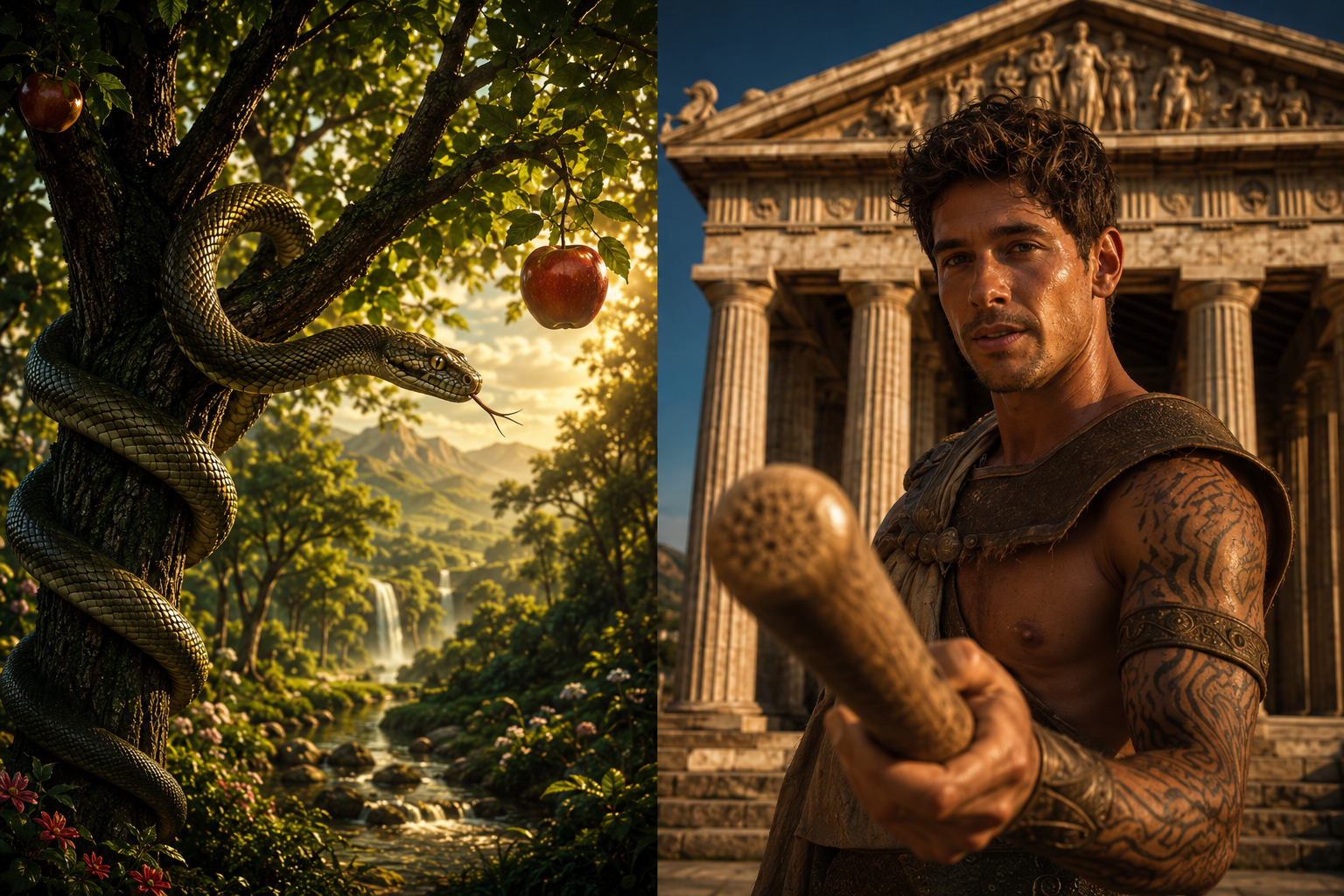
Fairy tale on the left: That Ophis (serpent) is actually a Drakon or Drakaina, which is a temple guardan.
The xulon (wooden thing) of gnosis (experiential knowing) is guarded by the Ophis
That instrument shows you what is beautiful/harmonius and what is oppressive/disharmonious.
⚠️ TODO: translation with mystery commentary, in progress...
⚠️ STATUS: Rough pass at translation is below, but very general, refinements and clarifications to come.
- Summary - There are 2 readable layers in this text
- Why Greek?
- Source Text
- Cast of Characters and Locations
- Εὐά – Ζωή: the Bacchic Cry that Restores Life
- Translation
- 1 - Genesis 1
- 2 - Genesis 2
- 2:1-3
- 2:4
- 2:5
- 2:6 - water springs from the earth, watering the earth
- 2:7 - Kurios molded the human's psyche/soul, using earth/metallika pharmacy
- 2:8 - A Paradise is built in the East and the human is sent there
- 2:9 - the instrument by which one comes to gnosis with what is beautiful/harmonius and what is oppressive/disharmonious
- 2:10
- 2:11–14 The four rivers which give Edem's location, but it's not geographic, it's mental
- 2:15-17 PARADISE & FORBIDDEN EATING
- 2:15 - placing the human's mental state into paradise
- 2:16 - do not eat from the wooden thing that gives you gnosis of beauty and oppression
- 2:17 - except from the wooden thing of gnosis of what is beautiful/harmonious and oppressive/disharmonious
- 2:18 - it's not good to be alone, let's make a battle partner
- 2:19 - more education from the earth dust, of earth beasts and sky birds, psychic animated force, were their name.
- 2:20 - Adam calls names to Gaia creatures, Ouranos creatures, and Wild/Untamed/Venomous creatures, looking for a partner in battle
- 2:21 - Theos forcefully applied ecstasy to Adam, and put him to sleep. Takes a side and replenish it.
- 2:22 - Kurios Theos educates a woman using Adam's side
- 2:23 - Adam gives his communion, calls her woman, because she was educated from her man
- 2:24 - this is why a person shall leave their parents, and be bound to their woman, and the two shall be one flesh
- 2:25
- 3 - Genesis 3
- 3:1
- 3:2–3 (Eua responds)
- 3:4
- 3:5
- 3:6
- 3:7
- 3:8–19 (Meeting with Kurios; consequences)
- 3:9-13
- 3:13
- 3:14
- 3:15-19
- 3:20 — The Role Naming
- 3:21–24 (Garments; expulsion; cheroubim with the turning sword)
- 4 - Genesis 4
- 4:1-7 - Cain and Abel
- 4:1
- Isaiah 29:10
- Terrence McKenna commentary
- Analysis of Adam and Eve's names
- Analysis from Dr Hillman
- Analysis from Philo of Judea
- See Also
Summary - There are 2 readable layers in this text
In Genesis, there are two layers.
- Layer 1 - for the public masses who are unaware
- Layer 2 - for the priesthood familiar with their own mystery rites
We will show how a second semantic layer can be read without violating the first.
Layer 1 — The Public / Surface Reading
Genesis 1 the one God creates the universe in an ordered sequence across six days—light, sky/sea, land and plants, heavenly lights, animals, and finally humans—declaring it all “very good.” Humans are made uniquely “in God’s image,” given responsibility to rule/care for other living things, and told to multiply and fill the earth.
Genesis 2 retells creation in a more intimate, ground-level way: God forms the first human, places him in a garden paradise (Eden), provides abundant food, and gives one boundary—don’t eat from the tree of the knowledge of good and evil. Because “it’s not good for the human to be alone,” God makes a matching partner: the first woman, presented as the man’s counterpart, and this grounds the later ideal of marriage (“the two become one flesh”).
Genesis 3 is “the Fall”: a serpent persuades the woman (and then the man) to eat the forbidden fruit. Their eyes are “opened,” they realize they are naked, and shame and fear enter. God confronts them; they blame each other and the serpent; and God announces consequences—pain in childbirth, hardship in work, conflict, and eventual death. They are expelled from Eden so they won’t eat from the tree of life and live forever in this broken state; access is guarded.
Genesis 4:1 begins life outside Eden: the man and woman have a child (Cain), and the story is moving into the first generation of human history after exile.
Layer 2 — The Esoteric / Priestly Reading
Genesis 1 — Read at Level 2 in the Greek, Genesis 1 is not a creation story but a rite-script for ordering an initiate’s inner kosmology (κόσμος). Theos functions as the guiding role that brings the initiate’s inner structure to its τέλος, marking stages (“days”) as phases of restructuring rather than clock-time. The sequence culminates in κατάπαυσις - cessation because the ordered steps are complete.
Genesis 2 - A lord of the realm who guides in such rites, the Kurios Theos then “molds” (πλάσσει) the human (ἄνθρωπος) from earth - language that resonates with kollourion or lemnian earth visionary pharmakon plaster substances and the eiodolonic (guidance through imagery) craft of re-configuring ψυχή into ψυχὴ ζῶσα, a living animating principle which figuratively "breathes pneuma (πνοὴ) of animated life force (ζωῆς)" into the initiate.
The planted paradise (παράδεισος) in Edem becomes the staged grove-temple where two trees represent two powers: ζωή (the reanimating life-force) and γνῶναι (experiential knowing). The search for an equal battle partner to serve in the role to give the cry of animating life force, then comes imposed ἔκστασις and sleep (passed out or coma), the ambiguous "side" (pleura/πλευρά) of Adam (while ecstatic-sleeping) is utilized (perhaps it's the woman by his side, perhaps it's his feminine side, perhaps it's surgery but imagined/symbolic within a mental rite). Wherever the side is, the woman is obtained from there and then formed/molded or constructed (οἰκοδομέω) as a new ordered configuration architecturally (as kosmos structure).
Genesis 3 - The commands apothaneisthe thanatou (ἀποθανεῖσθε θανάτῳ) and its reversal "not" apothaneisthe thanatou (οὐ θανάτῳ ἀποθανεῖσθε) encode the rite’s central paradox: a dying-away of something that is not biological death—the controlled collapse and return that produces fearlessness and new sight (dianoixhthesontai humoun oi ophthalmoi / “διανοιχθήσονται ὑμῶν οἱ ὀφθαλμοί”).
Finally, she is role-named as Ζωή (“μήτηρ πάντων τῶν ζώντων”) that animating life force. It's a rite-function: the operator of reanimation - Eua Zoe (Εὐά–Ζωή), the Bacchic euai cry that animates life force, which calls life back from the brink. Eua (Εὐά) is a phounetikon (φωνητικόν) boethos (βοηθός) battle partner whose voice completes catharsis and “mothers” new lives by bringing the initiate their psychic/soul (ψυχή) animating life force (ζῶσα).
Genesis 4 - (TODO.... write this...)
Why Greek?
- Always best to go to the primary source!
- Greek is more detailed, technical, and thus includes more information, there's a lot more nuance and detail in the Greek than there is in the Hebrew or Hebrew-derived versions (Latin or English). The Hebrew is a far less expressive language, and all derivatives from the Hebrew suffer from similar simplifications.
- Greek is the Original Language of Christianity - The apostles wrote in Greek, and exclusively referenced the Greek Septuagint (290BCE). If you're not reading Greek, you're not reading the Bible!
- Greek is the authoritative source for the early Christian cult
- It's the language and level of detail followed by the priesthood and apostles.
- The Orthodox Christians never moved away from it, for a reason.
- Old Testament Greek Origins - why the Greek Septuagint of 290BCE appears to be the original body of work before the Hebrew translations.
Source Text
We'll use Greek Septuagint LXX (Swete 1930) here, as source text in our translation.Cast of Characters and Locations
- Ouranos (οὐρα^νός / οὐρανοῦ) - sky or universe; above the earth sky & space; vault or firmament of the sky; above the aether; outside or above this sky vault; anything shaped like vaulted roof or ceiling; the seat of the gods, outside or above this sky vault, the portion of Zeus;
- the upper ordering principle of the mental kosmos, not altitude, upper νοῦς
- NOTE: We're avoiding the later english & loaded term "heaven" here.
- Gaia (γῆ / γῆς) - earth (including land and sea); land, country; opp. Ouranos, or land opp. sea
- the grounded mental mode of life - memory, hunger, fear, and cyclical time (weight and repetition rather than freedom or order), lower psyche/soul bound to soma (ψυχή / σῶμα) where memory (μνήμη) imprint (not recollection) governs perception and response.
- the necessary ground for initiation: one must descend fully into Gaia (mortality, terror, dissolution) before ascent toward Ouranos is possible.
- Cosmic Egg - helps to explain Gaia and Ouranos in Archaic Greek Mystery Cosmology (active during 1400–600 BCE, and lasting into Septuagint / Hermetic / Alchemical traditions far beyond 300CE)
- Gaia names the grounded mental mode of life - memory, hunger, fear, and cyclical time (weight and repetition rather than freedom or order), lower psuche/soma (ψυχή / σῶμα)
- Ouranos names the upper ordering intellect, upper νοῦς, the mode of mind in which perception is lifted from hunger and fear into pattern and proportion, and time is experienced as clarity and openness rather than weight and repetition.
- In the transition from Gaia → Ouranos, the primary shift is that fear stops governing action.
- mystery initiation moves the subject's mentality from Gaia-bound perception, through dissolution, toward a reintegration with Ouranic order, without abandoning the mental (Gaia) grounding that sustains life.
- see Orphic Cosmology which explains the structure, and Initiatory Fire which explains the application of pharmakons for ecstasy and hypnosis, to dissolve identity and enter the Aionic state of presence, to allow Ouranic ordering, formation, construction, of the initiate (Adam).
- Kurios (κύριος) - having power; lord, master of the family / house / realm; sovereign power in a state; generally, guardian, trustee; a god or Lord of the immediate realm; One of many gods; of persons, having power or authority, supreme; a form of respectful address, like sir
- NOTE: literal translation, avoiding later simplified reframings to "God" or "YHWH"
- Theos (θεός) - divine; the Deity above all; as title of rulers; one set in authority, judge; θεός fem., goddess; synonym for Zeus
- one with the divine mind
- NOTE: literal translation, avoiding later simplified reframings to "God" or "YHWH"
- Kurios Theos - person with divine power - is it supernatural, or initiatory? is the question we must ask. The initiatory lens is valid here.
- Ophis (ὄφις) - a serpent priest, guardian of relics and secrets. a serpent is a synonym of Echidna (viper), and also Dragon/Drakon. So an Ophis is a temple guardian (see Dragons; Viper/Echidnaic Priesthood); Adonis; daimon.
- Adam (Ἀδὰμ)
- anthropos - human - at first he's a nameless sexless human (Greek grammar is clearly sex-indeterminate / generic)
- Adam - later is named
- Eve character - That name doesn't appear, but the woman is named by role "the cry of the life animating force" (Eua Zoe / Εὔα ζωή):
- woman (gune) - first she is given the named-role of "woman/gune"
- zoe (ζωή) - second she is given the named-role of "zoe/ζωή"
- ζωή (Zoe) – "life" ; the condition or force of being alive, vitality, animation. It refers to what makes something alive, not how someone lives. In Genesis it is naming a principle; sometimes used instead of Εὔα
- ζωῆς (zōēs) "of life" or "of living."
- eua (Εὔα) - lastly she is given the named-role of "eua/Εὔα"
- Εὔα (Εὖαν / Eúa) – one who cries εὐαί, i.e. a Bacchanal, a name of Bacchus (Hsch)
- Ἀώα (Aóa) – This variation also appears in the Greek and is another form of her name, though less common.
- Edem (Εδεμ) - What we know as "Eden", a named location for the paradise
Εὐά – Ζωή: the Bacchic Cry that Restores Life
εὐάς , άδος, ἡ,
A.one who cries εὐαί, i.e. a Bacchanal, “κούρη” Orph.H. 49.1: as Subst., Philostr.Im.1.19.
2. as Adj., ὁ, ἡ, Bacchic, “φωνή” Nonn.D.19.110.II. Εὔας, ὁ, a name of Bacchus, Hsch
εὐάζω ,
A.cry εὐαί, in honour of Bacchus, S.Ant.1134 (lyr.), E.Ba. 1034(lyr.); “Διονύσῳ” AP9.363.11 (Mel.), cf. D.S.4.3, Callistr.Stat.2: c. acc. cogn., “μελῳδὸν εὐ. χορόν” Sopat.10:—Med., “Βάκχιον-ομένα” E. Ba.68 (lyr.).
In the Greek Septuagint, Eve is more accurately read as Εὐά–Ζωή, not a neutral personal name but a ritual-functional designation. The form Εὐά transparently aligns with εὐάς (εὐάδος), attested in Orphic and classical sources as “one who cries εὐαί”—a Bacchic initiate or ecstatic maiden (κούρη) whose identity is constituted by ritual voice rather than genealogy (Orph. Hymn 49.1). LSJ preserves both the substantive sense (female participant in Dionysiac rites) and the adjectival extension (Bacchic, frenzied), while Hesychius records Εὔας as a name of Dionysos, demonstrating that the cry itself could function as a divine epithet. This establishes a clear ritual chain: εὐαί (performative cry) → εὐάς (ecstatic role) → Εὔας (divine identity), in which sound, function, and divinity collapse into a single semantic field.
Now understand Zoe (Ζωή):
- Standard modern edition: Kurt Latte (ed.), Hesychii Alexandrini Lexicon, vols. I–II (Copenhagen: Munksgaard, 1953–1966), under ζ-.
- Continued/updated edition: Peter A. Hansen (ed.), Hesychii Alexandrini Lexicon, vol. III–IV (Berlin/New York: De Gruyter, 2005–2013), under ζ-.
ζωή·
ζωή, ψυχή, τὸ ζῆν
zoe
animated lifeforce, animating breath / life vital force, the act of living
- ζωή (zoē) - animated life force; a living vitality; the state of being alive
- ψυχή (psychē) - pneuma / animating breath; life-principle (that which moves and vivifies the body)
- τὸ ζῆν (to zēn) - the act of living; living as an activity
Zoe (Ζωή), as Hesychius glosses it (ζωή· ζωή, ψυχή, τὸ ζῆν), denotes not only narrative “life”, but the animating condition itself-the vital force or breath (psuche/ψυχή) that distinguishes living beings (zoota/ζῶντα) from inert matter.
When Εὐά is associated with ζωή, the language is technical rather than sentimental: the Bacchic cry Euoi is the operative agent that restores ζωή. Directionality is crucial. The cry does not express life; it reactivates it, calling the initiate back from a liminal, deathlike collapse into restored animation. This explains her designation as μήτηρ πάντων τῶν ζώντων—not a domestic ancestor of humans, but a source-principle of reanimation for all living beings. Read this way, Εὐά is a φωνητικόν boēthos—a battle partner in ritual danger—whose responsibility is nothing less than to bring the initiate back from near-death and complete the catharsis. Far from a “helper” in the diminished sense, she is the operator of resurrection within the rite.
Translation
Here we will present the greek, with english translation, and notes for how to unpack the meaning into a "Level 2" mystery lens reading.1 - Genesis 1
In the beginning there was... a mystery rite / initiatory experience:
- INSIDE: Genesis 1 is a depiction of the aionic realm inside the initiate's psyche/mind. The restructuring of the kosmic order/structure of their mind.
- OUTSIDE: Later in Genesis 2, we will see Kurios guiding the initiate with e.g. created trees, animals, naming them, etc...
This looks like a creation myth, but it is structuring / forming (plasen/πλασεν) the aionic realm inside the initiate's psyche/mind, foreshadowing the rite in Genesis 2.
See Cosmic Egg for how Gaia/Ouranos/Aion initiatory structure works.
1 ΕΝ ΑΡΧΗ ἐποίησεν ὁ θεὸς τὸν οὐρανὸν καὶ τὴν γῆν.
1 In foundation, the theos (divinity) produced the ouranos (higher mind) and the gaia (lower mind).
- theos (θεὸς) - divinity. a divine ordered mentality or intelligence. Harmoniously structured mental ordering, an intelligence that we'll call "divine".
- ouranos (οὐρανὸν) - upper mind; See Cosmic Egg for more on Ouranos in initiatory structure
- gaia (γῆν/γῆ) - lower mind; See Cosmic Egg for more on Gaia in initiatory structure
An initiation seems to be happening, using orphic mechanics.
Possibilities:
- the theos is leading an initiation, producing lower/higher states in the initiate.
- the theos is the initiate's divine state of mind producing those lower/higher states.
2 But gaia was obscure/unseen and unstructured/unconstructed, and darkness (of underworld; beneath gaia mind) was on the upper side of the unfathomable depth (aka. abyss) (of the underworld); and the pneuma of theos was being applied (brought upon) on the upper side of the water (that abyss/depth again).
- theos (θεὸς) - divinity. a divine ordered mentality or intelligence. Harmoniously structured mental ordering, an intelligence that we'll call "divine".
- ouranos (οὐρανὸν) - upper mind; See Cosmic Egg for more on Ouranos in initiatory structure
- gaia (γῆν/γῆ) - lower mind; See Cosmic Egg for more on Gaia in initiatory structure
- aoratos (ἀόρατος) - unseen; obscure
- akataskeuastos (ἀκατασκεύαστος) - unconstructed; unstructured; not properly prepared
- skotos (σκότος) - darkness of underworld; nyx
- abussou (ἀβύσσου) - unfathomable underworld
- pneuma (πνεῦμα) - divine breath of life force; is not life itself, but the moving force that animates, connects, and transmits life.; medium of transmission between body (σῶμα) and psyche (ψυχή)
- epephereto (ἐπεφέρετο) - applied or put upon
- epanou (ἐπάνω) - on the upper side
See Also:
- see Orphic Cosmology for Gaia and Ouranos structure in initiatory contexts, a form of Cosmic Egg.
- see Tohu Wa Bohu for why the Greek is likely primary, significant, and shows more technical detail in aoratos and akataskeuastos than via tohu wa bohu
A reader immersed in Orphic cosmogony would already possess conceptual categories involving Gaia, darkness/Nyx, primordial depth, cosmic waters, generation, and layered cosmic regions.
Hesiod’s cosmography explicitly places vast regions beneath Gaia and associates the lower cosmic structure with darkness, Tartaros, Nyx, Erebos, etc.
basically:
- Gaia is initially unseen and unconstructed.
- There is darkness associated spatially with primordial depth/abyss.
- There is water associated with that primordial region.
- A pneuma belonging to/divine from theos is brought upon/over the water.
- The subsequent cosmogonic ordering makes previously obscure/unstructured reality perceptible and structured.
We're mapping the Orphic cosmology to consciousness.
3 καὶ εἶπεν ὁ θεός Γενηθήτω φῶς· καὶ ἐγένετο φῶς.
3 Then theos said, “Let there be light”, and there was light.
4 καὶ ἴδεν ὁ θεὸς τὸ φῶς ὅτι καλόν· καὶ διεχώρισεν ὁ θεὸς ἀνὰ μέσον τοῦ φωτὸς καὶ ἀνὰ μέσον τοῦ σκότους.
4 And theos saw that the light was beautiful. And theos separated the light and darkness.
5 καὶ ἐκάλεσεν ὁ θεὸς τὸ φῶς ἡμέραν, καὶ τὸ σκότος ἐκάλεσεν νύκτα. καὶ ἐγένετο ἑσπέρα καὶ ἐγένετο πρωί, ἡμέρα μία.
5 And theos called the light “day” and he called the dark “night”.
And evening passed and morning came, for the first day.
The Second Day: Framework
6 Καὶ εἶπεν ὁ θεός Γενηθήτω στερέωμα ἐν μέσῳ τοῦ ὕδατος, καὶ ἔστω διαχωρίζον ἀνὰ μέσον ὕδατος καὶ ὕδατος· καὶ ἐγένετο οὕτως.
6 Then theos said, “Let there be a framework in the midst of the water, and let it be so by separating between water (above) and water (below)". And it happened this way.
- stereoma - firm structure. Framework is a more modern equivalent, used for clarity.
7 καὶ ἐποίησεν ὁ θεὸς τὸ στερέωμα· καὶ διεχώρισεν ὁ θεὸς ἀνὰ μέσον τοῦ ὕδατος ὃ ἦν ὑποκάτω τοῦ στερεώματος, καὶ ἀνὰ μέσον τοῦ ὕδατος τοῦ ἐπάνω τοῦ στερεώματος.
7 Theos created the framework. Then theos separated between that which was water below the framework, and that which was water above the framework.
- stereoma - firm structure. Framework is a more modern equivalent, used for clarity.
8 καὶ ἐκάλεσεν ὁ θεὸς τὸ στερέωμα οὐρανόν· καὶ ἴδεν ὁ θεὸς ὅτι καλόν. καὶ ἐγένετο ἑσπέρα καὶ ἐγένετο πρωί, ἡμέρα δευτέρα.
8 And he called the framework, Ouranos. And theos saw that it was beautiful. And for the second day, evening passed and morning came.
- stereoma - firm structure. Framework is a more modern equivalent, used for clarity.
The Third Day: Dry Ground
9 Καὶ εἶπεν ὁ θεός Συναχθήτω τὸ ὕδωρ τὸ ὑποκάτω τοῦ οὐρανοῦ εἰς συναγωγὴν μίαν, καὶ ὀφθήτω ἡ ξηρά· καὶ ἐγένετο οὕτως. καὶ συνήχθη τὸ ὕδωρ τὸ ὑποκάτω τοῦ οὐρανοῦ εἰς τὰς συναγωγὰς αὐτῶν, καὶ ὤφθη ἡ ξηρά.
9 Then theos said, “Let the water below ouranos be drawn together into one coalescence, and let dry land be seen”. And it happened this way. The water below ouranos was gathered into its coalescences, and dry land was seen.
10καὶ ἐκάλεσεν ὁ θεὸς τὴν ξηρὰν γῆν, καὶ τὰ συστέματα τῶν ὑδάτων ἐκάλεσεν θαλάσσας· καὶ ἴδεν ὁ θεὸς ὅτι καλόν.
10 And theos called the dry land, Earth (Gaia), and the accumulations of the waters he called Seas. And theos saw that it was fitting.
11 καὶ εἶπεν ὁ θεός Βλαστησάτω ἡ γῆ βοτάνην χόρτου, σπεῖρον σπέρμα κατὰ γένος καὶ καθ᾽ ὁμοιότητα, καὶ ξύλον κάρπιμον ποιοῦν καρπόν, οὗ τὸ σπέρμα αὐτοῦ ἐν αὐτῷ κατὰ γένος εἰς ὁμοιότητα ἐπὶ τῆς γῆς· καὶ ἐγένετο οὕτως.
11 Then Theos said, “Let the Earth sprout forth / cause to grow a growth from the pasture, sowing seed according to kind and according to likeness, and productive wood which yields produce, whose seed is within it, according to kind and according to likeness, upon the Earth (Gaia).” And it happened thus.
12 καὶ ἐξήνεγκεν ἡ γῆ βοτάνην χόρτου, σπεῖρον σπέρμα κατὰ γένος καὶ καθ᾽ ὁμοιότητα, καὶ ξύλον κάρπιμον ποιοῦν καρπόν, οὗ τὸ σπέρμα αὐτοῦ ἐν αὐτῷ κατὰ γένος ἐπὶ τῆς γῆς. καὶ ἴδεν ὁ θεὸς ὅτι καλόν.
12 The Earth brought forth a growth from the pasture, sowing seed according to kind and according to likeness, and brought forth productive wood which yields produce, whose seed is within it, in kind, upon the Earth. And theos saw that it was fitting.
13 καὶ ἐγένετο ἑσπέρα καὶ ἐγένετο πρωί, ἡμέρα τρίτη.
13 And there came to be evening, and there came to be morning, a third day.
The Fourth Day: Sun, Moon, Stars
14 Καὶ εἶπεν ὁ θεός Γενηθήτωσαν φωστῆρες ἐν τῷ στερεώματι τοῦ οὐρανοῦ εἰς φαῦσιν τῆς γῆς, καὶ ἄρχειν τῆς ἡμέρας καὶ τῆς νυκτὸς καὶ διαχωρίζειν ⸆ ἀνὰ μέσον τῆς ἡμέρας καὶ ἀνὰ μέσον τῆς νυκτός· καὶ ἔστωσαν εἰς σημεῖα καὶ εἰς καιροὺς καὶ εἰς ἡμέρας καὶ εἰς ἐνιαυτούς·
14 Then theos said, “Let there come to be lights within the framework of ouranos, for illumination of the Earth (Gaia), and to govern the day and the night, and to separate between the day and between the night; and let them function as signs/portents, as appointed times, as days, and as yearly cycles.”
- σημεῖα and καιροί - signs/portents and appointed/opportune occasions
- stereoma - firm structure. Framework is a more modern equivalent, used for clarity.
15 καὶ ἔστωσαν εἰς φαῦσιν ἐν τῷ στερεώματι τοῦ οὐρανοῦ, ὥστε φαίνειν ἐπὶ τῆς γῆς. καὶ ἐγένετο οὕτως.
15 And let them be for illumination within the framework of ouranos, so as to shine upon the Earth (Gaia).” And it happened this way.
- stereoma - firm structure. Framework is a more modern equivalent, used for clarity.
16καὶ ἐποίησεν ὁ θεὸς τοὺς δύο φωστῆρας τοὺς μεγάλους, τὸν φωστῆρα τὸν μέγαν εἰς ἀρχὰς τῆς ἡμέρας καὶ τὸν φωστῆρα τὸν ἐλάσσω εἰς ἀρχὰς τῆς νυκτός, καὶ τοὺς ἀστέρας.
16 And theos made the two great lights: the greater light for governance of the day, and the lesser light for governance of the night, and the stars.
17 καὶ ἔθετο αὐτοὺς ὁ θεὸς ἐν τῷ στερεώματι τοῦ οὐρανοῦ, ὥστε φαίνειν ἐπὶ τῆς γῆς,
17 And theos placed them within the framework of ouranos, so as to shine upon the Earth (Gaia),
- stereoma - firm structure. Framework is a more modern equivalent, used for clarity.
18 καὶ ἄρχειν τῆς ἡμέρας καὶ τῆς νυκτός, καὶ διαχωρίζειν ἀνὰ μέσον τοῦ φωτὸς καὶ ἀνὰ μέσον τοῦ σκότους· καὶ ἴδεν ὁ θεὸς ὅτι καλόν.
18 And to govern the day and the night, and to separate between the light and between the darkness. And theos saw that it was fitting.
19 καὶ ἐγένετο ἑσπέρα καὶ ἐγένετο πρωί, ἡμέρα τετάρτη. ⸆
19 And there came to be evening, and there came to be morning, a fourth day.
The Fifth Day: Fish and Birds
20 Καὶ εἶπεν ὁ θεός Ἐξαγαγέτω τὰ ὕδατα ἑρπετὰ ψυχῶν ζωσῶν καὶ πετεινὰ πετόμεν[α] ἐπὶ τῆς γῆς κατὰ τὸ στερέωμ[α τοῦ] οὐρανοῦ· καὶ ἐγένετο οὕτως.
20 Then theos said, “Let the waters bring forth creeping/crawling things of living psyches, and flying creatures flying over the Earth (Gaia), throughout the framework of ouranos.” And it happened this way.
21 καὶ ἐποίησεν ὁ θεὸς τὰ κήτη [τὰ με]γάλα καὶ πᾶσαν ψυχὴν [ζῴων ἑρπε]τῶν, ἃ ἐξήγαγεν [τὰ ὕδατα κατὰ γένη αὐτῶν], καὶ πᾶν πετεινὸν πτ[ερωτὸν] κατὰ γένος· καὶ ἴδεν ὁ [θεὸς ὅτι καλά].
21 And theos made the great sea creatures, and every psyche of creeping/crawling living beings, which the waters brought forth according to their kinds, and every winged flying creature according to kind. And theos saw that they were fitting.
22 καὶ ηὐλόγησεν αὐτὰ ὁ θ[εὸς λέγων] Αὐξάνεσθε καὶ πληθ[ύνεσθε, καὶ] πληρώσατε τὰ ὕδατα [ἐν ταῖς θα]λάσσαις, καὶ τὰ πετε[ινὰ πληθυ]νέσθωσαν ἐπὶ τῆς [γῆς.
22 And theos praised them (the creatures), saying, “Grow and multiply, and fill the waters in the Seas, and let the flying creatures multiply upon the Earth (Gaia).”
23 καὶ ἐγέ]νετο ἑσπέρα καὶ ἐγ[ένετο πρωί], ἡμέρα πέμπτη.
23 And there came to be evening, and there came to be morning, a fifth day.
The Sixth Day: Creatures on Land
24 Καὶ εἶπεν ὁ θεός Ἐξαγαγ[έτω ἡ γῆ ψυχὴν] ζῶσαν κατὰ γένος, [τετράποδα] καὶ ἑρπετὰ καὶ θηρί[α τῆς γῆς κατὰ] γένος, καὶ ἐγένετο [οὕτως].
24 Then theos said, “Let the Earth (Gaia) bring forth living psyche according to kind, four-footed creatures, creeping/crawling things, and wild beasts of the Earth (Gaia) according to kind.” And it happened this way.
25 καὶ ἐποίησεν ὁ θεὸς τὰ [θηρία τῆς γῆς] κατὰ γένος καὶ τὰ κτ[ήνη κατὰ γέ]νος καὶ πάντα τὰ ἑρπ[ετὰ τῆς γῆς] κατὰ γένος αὐτῶν· καὶ ἴδεν ὁ θεὸς ὅτι καλά.
25 And theos made the wild beasts of the Earth (Gaia) according to kind, and the herd animals according to kind, and all the creeping/crawling things of the Earth (Gaia) according to their kind. And theos saw that they were fitting.
26 καὶ εἶπεν ὁ θεός Ποιήσωμεν ἄνθρωπον κατ᾽ εἰκόνα ἡμετέραν καὶ καθ᾽ ὁμοίωσιν· καὶ ἀρχέτωσαν τῶν ἰχθύων τῆς θαλάσσης καὶ τῶν πετεινῶν τοῦ οὐρανοῦ καὶ τῶν κτηνῶν καὶ πάσης τῆς γῆς καὶ πάντων τῶν ἑρπετῶν τῶν ἑρπόντων ἐπὶ τῆς γῆς.
26 Then theos said, “Let us make humanity according to our image and according to resemblance, and let them govern the fish of the Sea, and the flying creatures of ouranos, and the herd animals, and all the Earth (Gaia), and all the creeping/crawling things crawling upon the Earth.”
- "Let us" and "according to our": there are multiple theoi (gods) !!!!!
- ὁ θεός - the theos
- ποιήσωμεν - let us make
- ἡμετέραν - our
- Let us / according to our: although the narrator introduces the speaker as ὁ θεός (“the theos,” singular), theos speaks here in the first-person plural: ποιήσωμεν (“let us make”) and ἡμετέραν (“our”). The speech therefore explicitly presents more than one theos participant in the “us/our.”
- humanity: there are multiple humans !!!!
- ἄνθρωπον itself is grammatically singular
- ἀρχέτωσαν “let them govern”
- αὐτούς: “them”
- The plurality becomes explicit with ἀρχέτωσαν (“let them govern”) and then overwhelmingly explicit in v.27 with αὐτούς, “them.”
- humanity (ἄνθρωπον): grammatically singular but used collectively here; the following ἀρχέτωσαν (“let them govern”) treats humanity plurally.
- humanity...let them govern: the multiple theoi (collectively) want humans to govern the earth
- according to our image: humans are as the theoi (in appearance and likeness).
- creeping/crawling (ἑρπετῶν - herpetōn): something that moves close to or along the ground (herpetology)
27καὶ ἐποίησεν ὁ θεὸς τὸν ἄνθρωπον, κατ᾽ εἰκόνα θεοῦ ἐποίησεν αὐτόν· ἄρσεν καὶ θῆλυ ἐποίησεν αὐτούς.
27 And theos made humanity; according to the image of theos he made humanity; he made them masculine and feminine.
- autos (αὐτούς) - plural "them" again, referring to multiple humans
- humanity - all of humanity (not just one human)
28 καὶ ηὐλόγησεν αὐτοὺς ὁ θεὸς λέγων Αὐξάνεσθε καὶ πληθύνεσθε, καὶ πληρώσατε τὴν γῆν καὶ κατακυριεύσατε αὐτῆς, καὶ ἄρχετε τῶν ἰχθύων τῆς θαλάσσης καὶ τῶν πετεινῶν τοῦ οὐρανοῦ καὶ πάντων τῶν κτηνῶν καὶ πάσης τῆς γῆς καὶ πάντων τῶν ἑρπετῶν τῶν ἑρπόντων ἐπὶ τῆς γῆς.
28 And theos praised them, saying, “Grow and multiply, and fill the Earth (Gaia), and gain mastery over it, and govern the fish of the Sea, and the flying creatures of ouranos, and all the herd animals, and all the Earth (Gaia), and all the creeping/crawling things crawling upon the Earth (Gaia).”
29 καὶ εἶπεν ὁ θεός Ἰδοὺ δέδωκα ὑμῖν πᾶν χόρτον σπόριμον σπεῖρον σπέρμα, ὅ ἐστιν ἐπάνω πάσης τῆς γῆς· καὶ πᾶν ξύλον, ὃ ἔχει ἐν ἑαυτῷ καρπὸν σπέρματος σπορίμου· [ὑ]μῖν ἔσται εἰς βρῶσιν,
29 Then theos said, “Behold! I have given you every sowable growth sowing seed, which is upon all the Earth (Gaia), and every wood which has within itself produce of sowable seed; for you it shall be for food.”
- xulon (ξύλον): Wooden things, Wooden trees, Wooden plants, wood is sometimes a euphemism for penis depending on context, etc...
- xul/xyl- root here (as in xylophone, "wood sounds")
30 καὶ πᾶσι [τοῖ]ς θηρίοις τῆς γῆς καὶ πᾶσι [τοῖ]ς πετεινοῖς τοῦ οὐρανοῦ [καὶ π]αντὶ ἑρπετῷ τῷ ἕρπον[τι ἐπὶ τῆς] γῆς, ὃ ἔχει ἐν ἑαυτῷ [ψυχὴ]ν ζωῆς· καὶ πάντα χόρ[τον χλ]ωρὸν εἰς βρῶσιν. καὶ [ἐγένετ]ο οὕτως.
30 And for all the wild beasts of the Earth (Gaia), and for all the flying creatures of ouranos, and for every creeping/crawling thing crawling upon the Earth (Gaia), which has within itself a psyche of animating life-force, every green growth shall be for food.” And it happened this way.
- psyche (ψυχὴ) - mentality, mind essence, or that which moves us (later theologized as soul)
- zoes (ζωῆς) - the state, activity, or principle of being alive/animate. animating life-force, our life essence
31 [καὶ ἴδεν ὁ] θεὸς τὰ πάντα ὅσα ἐποίη[σεν, καὶ] ἰδοὺ καλὰ λίαν. καὶ ἐγέ[νετο ἑσ]πέρα καὶ ἐγένετο πρωί, [ἡμέρα ἕ]κτη.
31 And theos saw all the things which he had made, and behold, they were exceedingly fitting.
And there came to be evening, and there came to be morning, a sixth day.
2 - Genesis 2
2:1-3
And the ouranos (οὐρανὸς/heaven) and the gaia (γῆ/earth) and all their kosmos/κόσμος (order/structure) were brought to completion.
2 κ]αὶ συνετέλεσεν ὁ θεὸς [ἐν τῇ ἡμέρᾳ] τῇ ἕκτῃ τὰ ἔργα αὐτοῦ [ἃ ἐποίησ]εν·
2 And theos completed on the sixth day the works which he made;
καὶ κατέπαυσεν [τῇ ἡμ]έρᾳ τῇ ἑβδόμῃ ἀπὸ πάν[των τῶ]ν ἔργων αὐτοῦ ὧν [ἐποίησ]εν.
and he ceased activity on the seventh day from all his works which he made.
3 καὶ ηὐλόγησεν [ὁ θεὸς τὴν] ἡμέραν τὴν ἑβδόμην καὶ ἡγίασεν αὐτήν,
3 And theos blessed the seventh day and set it apart (made it special, perhaps "holy"),
ὅτι ἐν αὐτῇ κατέπαυσεν ἀπὸ πάντων τῶν ἔργων αὐτοῦ ὧν ἤρξατο ὁ θεὸς ποιῆσαι.
because on it he ceased from all his works which theos began to make (emphasizing initiation of activity now ceased).
The pattern of staged progression → completion → cessation matches known initiatory logic. (structural comparison, emphasis is on telos, not timekeeping)
From Robert Anton Wilson's Prometheus Rising, he describes Days of the Week as code for stages of mental progression (ascension) as levels of human consciousness. Which, these seem to line up similarly here for the rite, as well:
- 6th day is the god Saturn/Kronos's day - the timeless aionic realm
- 7th day is the Sun or god Helios's day - Ouranic unity mind, divine ordered mind, ascension away from Gaia fear/cyclic mind
After initiation with entheogens, the mind must rest.
Theos is a title given to an enlightened mind, like Buddha.
- Theos (θεός) - an agent, a role, a functional title. One who gives the guidance in the rite, or, the god-mind / unity-mind - one who guides better have that too.
- In early Greek, Theos (θεός) is a role-word before it is a metaphysical definition, a guiding agent, a power operating at a higher level, an ordering intelligence
Here we see:
- A cosmic order is completed (κόσμος).
- A cycle of works reaches its telos.
- Activity ceases, not because of depletion, but because completion has occurred.
- The seventh stage/day is differentiated (blessed, set apart).
- The cessation (because telos has been reached), applies specifically to the initiated cycle of making.
- Cosmic Egg mechanics, with the splitting of sky and earth
That’s it.
No metaphysics are named.
No cosmology is spelled out.
But the pattern is clear.
2:4
4 This is the book of the becoming of ouranos and gaia, when they came to be;
ἡ ἡμέρα ἐποίησεν ὁ θεὸς τὸν οὐρανὸν καὶ τὴν γῆν
in the day Theos made the ouranos and the gaia,
- more kosmos imagery setup, 2:1 - 2:6 here.
- Cosmic Egg mechanics, with the splitting of sky and earth
2:5
5 and every green-thing of the field before it came to be upon the earth,
καὶ πάντα χόρτον ἀγροῦ πρὶν ἀνατεῖλαι·
and all grass of the field before it sprang up;
οὐ γὰρ ἔβρεχεν ὁ θεὸς ἐπὶ τὴν γῆν,
for Theos had not yet rained upon the earth,
καὶ ἄνθρωπος οὐκ ἦν ἐργάζεσθαι τὴν γῆν·
and no human was there to work the earth;
- more kosmos imagery setup, 2:1 - 2:6 here.
2:6 - water springs from the earth, watering the earth
6 but a spring was rising from the earth,
καὶ ἐπότιζεν πᾶν τὸ πρόσωπον τῆς γῆς.
and it was watering the whole face of the earth.
- more kosmos imagery setup, 2:1 - 2:6 here.
- possibly (also) referring to the 'earth' pharmakon in the next 2:7 section... referring to mixing up a plaster.
2:7 - Kurios molded the human's psyche/soul, using earth/metallika pharmacy
- eplasen (ἔπλασεν) - generally, mould, form by education (paedea), training.
Theos formed (educated) the human - This is what we've been describing above, to this point
- Genesis 1.1 - 2.6 describes internal aionic mind kosmic ordering, for an initiate.
The Theos has been forming/educating the initiate's soul/psyche (ψυχὴν):
- here, the human already exists
- the Kurios Theos (person with divine authority) educates the soul/psyche (ψυχὴν) of the human.
- here we are talking about paideia (παιδεία) - education or formation of the young (or unformed).
- refer to How God Formed Man for the mechanics of how we "mold a human" using Pharmakon and enlightenment, to bring their psyche to a more divine level.
Here we see Adam, and Adam's title is "the human" (ton anthroupon / τὸν ἄνθρωπον), (sex-indeterminate / generic human).
Theos is a role/title, of someone initiated into the mystery, with Kurios leading that mystery for others.
- see Fire for more background on initiatory fire.
loose soil from the ground (Earth),
- χοῦν — dust, earth, loose soil
- ἀπὸ τῆς γῆς — from the earth/ground
In Ancient Greek medical, ritual, pharmacological:
- special earths (especially Lemnian Earth) is a substance used to create Kollourion cakes, embedded with pharmakon, which are used to Christ the eyes of someone so that they may "see". This is a practice seen e.g. in the christian cult in Revelation 3:18, and others.
- purifying, psychoactive, formative, they are used to reconfigure bodily and psychic states
Genesis repeatedly uses πλάσσω (“mold”), and keeps Adam in a state of guidance, evaluation, incompletion, it matches the logic of earth-based formative rites, even if the name Lemnian or Kollourion is not spoken.
This marks the beginning of Adam's paidea education of his psyche/soul.
and blew into his face a blowing blast of animated life force (fire of life),
- enephusesen (ἐνεφύσησεν) - blow
- eis (εἰς) - into
- prosoupon (πρόσωπον) - his face, countenance
- pnoen zoues (πνοὴν ζωῆς) - blowing blast of animated life force. the breath of Hephaestus, i.e. flame. pneuma is "the breath of life", but also enlightenment, divinity (which is a word for higher consciousness, a divine mind, or one who acts as the gods would)
and came into a new state of being, the human resulted in psychē/soul animated force.
- egeneto (ἐγένετο) - come into a new state of being (from the LSJ)
- anthroupos (ἄνθρωπος) - human (masculine form)
- eis (εἰς) - resulted in
- psuche zousan (ψυχὴν ζῶσαν) - psyche/soul (ψυχὴν) to animated life (ζῶσαν)
Brought the human's psyche/soul (ψυχὴν) to animated life (ζῶσαν), as an enlightened human
2:8 - A Paradise is built in the East and the human is sent there
8 And Kurios the Theos (divine) planted a paradise in Edem (Εδεμ) toward the east,
καὶ ἔθετο ἐκεῖ τὸν ἄνθρωπον ὃν ἔπλασεν.
and placed there the human whom he had molded (by education).
- eplasen (ἔπλασεν) - generally, mould, form by education (paedea), training
More confirmation of the education, and not mundane creating or "molding".
2:9 - the instrument by which one comes to gnosis with what is beautiful/harmonius and what is oppressive/disharmonious
9 And Kurios the Theos (divine) made to spring up from the earth every tree
ὡραῖον εἰς ὅρασιν καὶ καλὸν εἰς βρῶσιν,
beautiful for sight and good for eating,
καὶ τὸ ξύλον τῆς ζωῆς ἐν μέσῳ τοῦ παραδείσου,
and the wooden thing of the life (re)animating/vitalizing force (zoues / ζωῆς), in the midst of the paradise,
καὶ τὸ ξύλον τοῦ γνῶναι καλὸν καὶ πονηρόν.
and the wooden thing of gnosis (experiential knowledge) of beauty (harmony, fitness, coherence) and oppression (disharmony, damage, burden, corrosion).
more literally:
and the wooden thing (the instrument) by which one comes to gnosis (experientially know) with what is beautiful/harmonious and what is oppressive/disharmonious.
Is this really a tree? Perhaps it's a wooden implement (like an alabastron plunger) or structure associated with ritual use...
- zulon (ξύλον) - wood as material; by extension a wooden object, tree, or instrument made of wood
- It can be a tree, but the Greek does not require it, and in this verse it is intentionally ambiguous.
- Ancient Greek texts often refer to the thing by which knowing happens, which mirrors "τὸ ξύλον τοῦ γνῶναι" here.
- ξύλον is deliberately underspecified here
- basically: “the wooden thing by means of which gnosis is undergone”
- Mystery language avoids naming implements directly
- what is shown
- what is handled
- what is undergone
- zulon (ξύλον) fits this euphemistic register.
- Usage across the LXX? LXX repeatedly uses ξύλον for: instruments, posts, gallows, ritual wood, cultic structures, execution devices. Without changing the noun.
- Euphemism for penis? (similar to ὀρθός + μοχλός in comedy?)
- The male phallus is a "tree" that stands tall and erect, like wood, and brings life. A penis is literally a "tree of life" or a "wooden thing of life"... They say "good for eating", which also fits in a sexual rite. There is evidence that Mary and Jesus up a Mountain were doing it, documented in Epiphanius's Panarion, about the earliest Christian Cult practices. They're using pharmakon in their aischrourgia (felatio) with semen "emission", "eating it", "so that they may live".
- Perhaps a botanical plant...
- ξύλον can also refer to woody plants such as the cotton plant, or grape vine.
- From the Physiologus, section "Concerning the Elephant" (2nd - 4th AD) tells the story of elephants eating from a mandrake "tree" near paradise, in order to rouse sexual desire and procreate. The mandrake is not a tree, and not woody either. The story goes on to compare these elephants to Adam and Eua eating the forbidden fruit (in this scenario the mandrake fruit) to learn how to procreate and birth Cain.
- Euphemism for a woman's body
- Revelation 22:2 refers to a ξύλον bearing "twelve fruits" that yield every month. This has been interpreted by some to symbolize the menstrual cycles (Epiphanius Panarion 26, Section 4,8)
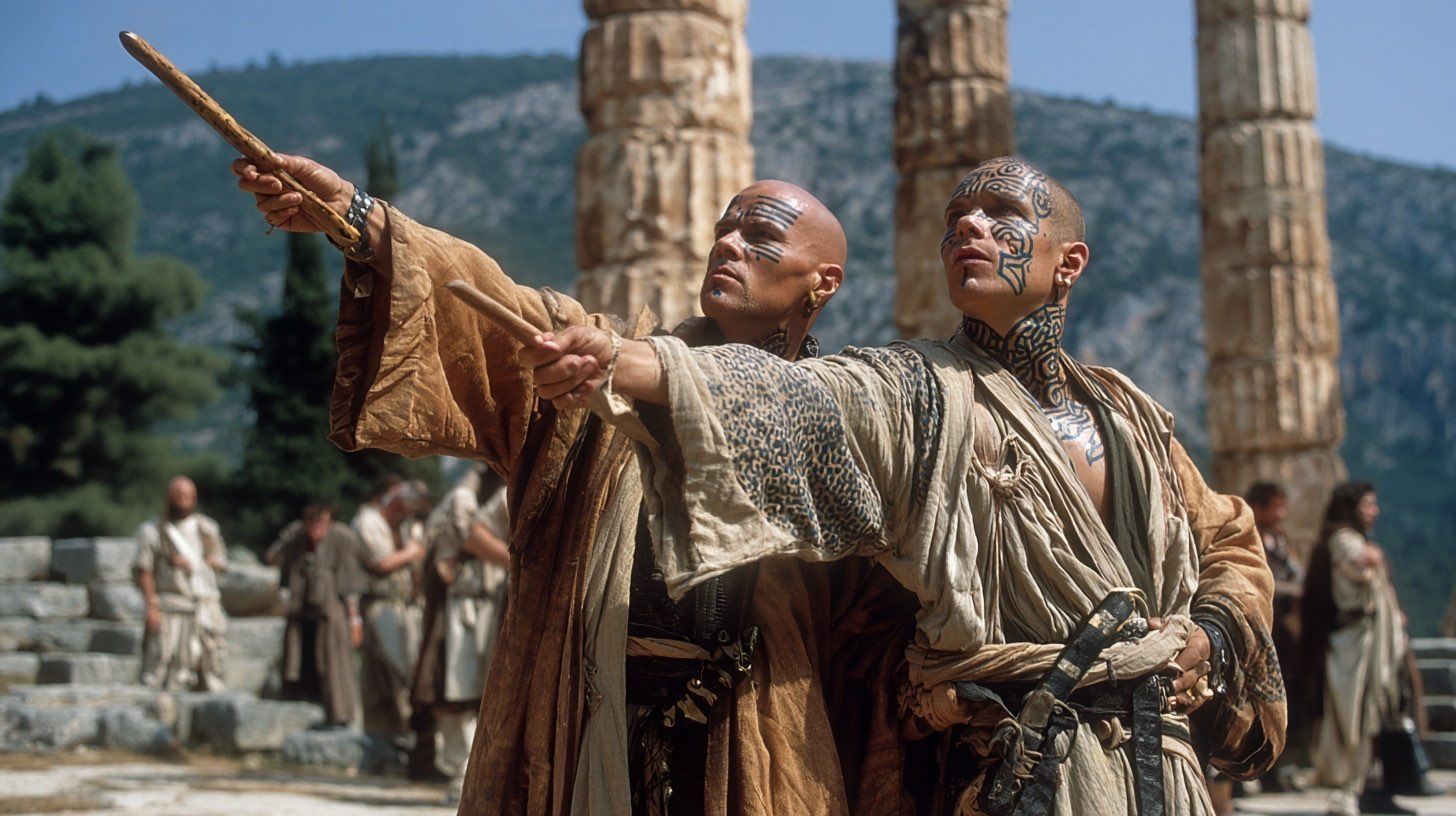
ophis (serpent) priest(s) hold their zulon 'wooden things', one for life, one for gnosis
Zulon could be an instrument like an alabastron plunger, a penis, or temple structure.
These "wooden tools" are all used to administer drugs to initiates during rites.
Beauty/harmonious (kalon) and Oppressive/disharmonious (poneron):
- these are more nuanced, different, than simple moral "Good" and "Evil"
- kalon/καλόν tends toward harmony; poneron/πονηρόν toward damage and breakdown.
- kalon (καλὸν) - beautiful - fitting, harmonious, effective. (is not moralized as "good", too simple)
- poneron (πονηρόν) - oppressed by toils - toilsome, oppressive, injurious, damage, burden, corrosion, disharmonious. ("evil" or "bad", also too simple)
Gnosis (γιγνώσκω / γνῶναι) means:
- to recognize through encounter
- to learn by undergoing
- to come into awareness through experience
- not simple knowledge, but an experiential acquisition of knowledge
- aligns perfectly with:
- initiation language
- medical diagnosis language
- mystery-rite vocabulary
- pharmacological experience
- reinforced by
- καλόν = fitting, harmonious, effective
- πονηρόν = harmful, burdensome, damaging
- These are evaluative outcomes of experience, not commandments of good vs evil.
- You discover them by exposure.
- Exactly how:
- medicine works
- drugs work
- rites work
- initiations work
- Exactly how:
- γνῶναι is experiential knowing
- it is the event that produces gnosis
- it implies participation, exposure, initiation
There are 2 "trees" (literally zulon "wooden things"):
- the tree of the life (re)animating force (zoues / ζωῆς) - (located: middle of the paradise)
- zoues (ζωῆς) - life (re)animating force
- the tree of the gnosis (experiential knowledge) of good and evil - (location unknown)
- gnounai (γνῶναι) - gnosis, not just knowledge, but experiential knowledge.
Location: Remember we are in a paradise, like the one common at emperor's palaces, "In the east".
Sacred groves were very important to Hellenic and pre-Hellenic peoples.
These trees could signify sacred spaces, possibly glades/temples where the (ophis) serpent-priesthood specializes in animating/forming/moulding different aspects of the initiate's psyche (remember heschius defines ζωῆς as psuche? that life animating force).
2:10
10 And a river flows out of Edem to water the paradise;
ἐκεῖθεν ἀφορίζεται εἰς τέσσαρας ἀρχάς.
from there it divides into four heads.
2:11–14 The four rivers which give Edem's location, but it's not geographic, it's mental
11 The name of the one is Phison; this one is the one encircling the whole land of Evilat, where the gold is.
12 τὸ δὲ χρυσίον τῆς γῆς ἐκείνης καλόν· καὶ ἐκεῖ ἐστιν ὁ ἄνθραξ καὶ ὁ λίθος ὁ πράσινος.
12 And the gold of that land is beautiful / fitting; and there is the anthrax (glowing stone / carbuncle) and the green stone.
13 καὶ ὄνομα τῷ ποταμῷ τῷ δευτέρῳ Γηών· οὗτος ὁ κυκλῶν πᾶσαν τὴν γῆν Αἰθιοπίας.
13 And the name of the second river is Gēōn; this one is the one encircling the whole land of Aithiopia (Ethiopia).
14 καὶ ὁ ποταμὸς ὁ τρίτος Τίγρις· οὗτος ὁ πορευόμενος κατέναντι Ἀσσυρίων. ὁ δὲ ποταμὸς ὁ τέταρτος, οὗτος Εὐφράτης.
14 And the third river is Tigris; this one is the one going opposite the Assyrians. And the fourth river—this one is Euphrates.
This is one of the classic unsolved problems
Often called:
- “The location of Eden”
- “The four rivers of Paradise”
- “The problem of Pishon and Gihon”
the problem only exists if you insist it’s a map.
this is a very old and very famous debate.
- No, there is no consensus solution.
- Many scholars now quietly accept it is non-geographic.
- Very few articulate why
However...
Neoplatonists, Orphics, and medical writers all used:
- one source → four outflows
- four rivers / winds / elements / faculties
- precious stones + metals as markers of potency (see Alchemy and Alchemical Symbol Lexicon for more on this)
- encircling flows as boundary principles
These 4 winds, rivers... This is exactly how:
- Plato maps the soul,
- medical writers map bodily humors,
- mystery traditions map initiation stages.
But biblical studies almost never reads Genesis inside that discourse, especially not through Greek.
- Reading rivers as archai (ἀρχαί) - governing principles, not scenery
- Recognizing mineral lists as initiatory markers, not travel notes
Four Winds In Greek cosmology:
- Boreas — North (cold, constricting, clarifying)
- Notos — South (hot, dissolving, overwhelming)
- Zephyrus — West (gentle, generative, fertile)
- Eurus — East (unstable, driving, disruptive)
Winds are forces, not weather reports.
Later these turn to 4 Elements
- Fire — animation, intensity, ascent
- Air — movement, perception, breath
- Water — dissolution, emotion, depth
- Earth — solidity, structure, form
Hippocratic and later medical writers map the body the same way (in 4):
- Blood (warm, moist)
- Yellow bile (warm, dry)
- Black bile (cold, dry)
- Phlegm (cold, moist)
Plato and later thinkers divide the psyche into four operating powers:
- Nous — intellect / vision
- Thumos — drive / force / courage
- Epithumia — desire / appetite
- Soma / Physis — embodiment / grounding
2:15-17 PARADISE & FORBIDDEN EATING
2:15 - placing the human's mental state into paradise
15 And Kurios the Theos (divine) took the human (sex-indeterminate / generic human)
ὃν ἔπλασεν,
whom he had molded/formed (by education),
καὶ ἔθετο αὐτὸν ἐν τῷ παραδείσῳ
and placed them in the paradise
ἐργάζεσθαι αὐτὸν καὶ φυλάσσειν.
to work it and to guard it.
- eplasen (ἔπλασεν) - generally, mould, form by education (paedea), training
- paradeisou (παραδείσῳ) - enclosed garden / cultivated sacred park
- enclosed park, garden, pleasure-garden, royal park
- Persian loanword originally
- Often used for:
- royal gardens
- enclosed cultivated spaces
- later: “paradise”
- ergazesthai (ἐργάζεσθαι) - work
- phulassein (φυλάσσειν) - guard
placed him in the paradise - could refer to the eplasen (molded/formed by education) as guidance during the rite. The Kurios may be mentally placing this human into a mental paradise or cultivated space. Prior work: Priestesses in oracular rites often sang hymns to place imagery (eidolon) into the initiates mind, to guide their mental state.
2:16 - do not eat from the wooden thing that gives you gnosis of beauty and oppression
16 And Kurios the Theos (divine) commanded Adam, saying:
Notice that Adam (τῷ Ἀδὰμ) is now named, no longer "the human" (τὸν ἄνθρωπον).
from every wooden thing in the paradise you may freely eat;
- apo (ἀπὸ) - from
- pantos (παντὸς) - every / all
- zulon (ξύλου) - wooden thing (instrument)
- paradeisou (παραδείσῳ) — paradise
- brouse phage (βρώσῃ φαγῇ) - you may freely eat / eat without restriction
2:17 - except from the wooden thing of gnosis of what is beautiful/harmonious and oppressive/disharmonious
17 but from the wooden thing (instrument) by which one comes to gnōsis (experiential knowing) of what is beautiful/harmonious and what is oppressive / disharmonious,
Smoother
do not eat from the wooden thing that gives you gnosis of beauty and oppression
- zulon (ξύλου) - wooden thing (instrument)
- ginouskein (γινώσκειν) - the process or event by which gnōsis is produced through encounter.
- the verb form for the process that produces gnōsis (experiential knowledge).
- gnousis (γνῶσις) = the state/result (knowledge possessed)
- ginouskein (γινώσκειν) = the act/process (coming-to-know)
- the verb form for the process that produces gnōsis (experiential knowledge).
- kalon (καλὸν) - beautiful / fitting / harmonious
- poneron (πονηρόν) - oppressive / corrosive / disharmonious
What's the wooden thing? If its a rod that gives gnosis, then perhaps some alignment with Asclepian and Echidnaic alabastron medical applicator used in those rites, but we may never know exactly.
you shall not eat from it;
ᾗ δ’ ἂν ἡμέρᾳ φάγητε ἀπ’ αὐτοῦ,
for in the day you eat from it,
ἀποθανεῖσθε θανάτῳ.
you will die away completely (ἀποθανεῖσθε) — by death (θανάτῳ).
- apothaneisthe (ἀποθανεῖσθε) - you will die away completely
- thanatou (θανάτῳ) - by death
Odd language here, a clue to our Level 2 reading:
- Dont eat from the wooden thing, it will make you die completely "by death".
- Why didn't they say apothaneisthe (ἀποθανεῖσθε) alone: "you will die away completely". Wouldn't that be good enough?
- Why the extra emphasis on how: "by death" (θανάτῳ)?
- Why "completely", what is the alternative, partial death?
- This comes up again later, when they find out exactly how they'll die (not by death!), which is a strong clue to the mystery rite
- mystery rite - death and resurrection catharsis rites; refers to psychotic ecstasy/mania symbolic death rites involving extreme states and near death; also appears to include "ego death" in addition, for those familiar with modern entheogen practices; but this death and resurrection rite is much more severe and unique vs today's soft entheogens. Aionian Fire 🔥
This is the place where Kurios becomes a liar.
Later, they "eat" from it, and they die without death (they do not physically die).
Why would Kurios lie?
- Because dying without death creates a new Theos (god)... and our Kurios may not want the competition
2:18 - it's not good to be alone, let's make a battle partner
18 And Kurios the Theos (the lord of the realm, with the divine mind) said:
οὐ καλὸν εἶναι τὸν ἄνθρωπον μόνον·
it is not good for the human (sex-indeterminate / generic human) to be alone;
ποιήσωμεν αὐτῷ βοηθὸν κατ’ αὐτόν.
let us make for him a boēthos corresponding (correspondence by measure, alignment, role-fit) to him.
- boēthon (βοηθὸν)
- partner in battle, like a comrade soldier in war
- κατ’ αὐτόν - according to him / corresponding to him - "corresponding" gives weight to equality here
- an Eua Boethos is the battle partner who cries euai
- later we'll see the person who is woman (gune) given the role of Zoe (animating life, vital force), and then later given the role/title of Eua (the cry of euai).
- Kurios Theos (κύριος ὁ θεός) - literally the lord of the realm, who's divine (e.g. with the divine mind), see Gods which is a title
Here, the grammar for "the human" (τὸν ἄνθρωπον) is sex-indeterminate / generic.
2:19 - more education from the earth dust, of earth beasts and sky birds, psychic animated force, were their name.
19 And the god molded/formed (educated) further out of the earth
πάντα τὰ θηρία τοῦ ἀγροῦ
all the beasts of the field
καὶ πάντα τὰ πετεινὰ τοῦ οὐρανοῦ,
and all the birds of the sky
καὶ ἤγαγεν αὐτὰ πρὸς τὸν Ἀδὰμ
and he brought them to Adam
ἰδεῖν τί καλέσει αὐτά·
to see what he would call them;
καὶ πᾶν ὃ ἐὰν ἐκάλεσεν αὐτὸ Ἀδὰμ
and whatever Adam called it
ψυχὴν ζῶσαν
a psyche/soul of animated life force (pneuma)
τοῦτο ὄνομα αὐτοῦ.
this was its name.
- eplasen (ἔπλασεν) - generally, mould, form by education (paedea), training
- the earth (τῆς γῆς) - using kollourion for molding of the psyche/soul (ψυχὴν ζῶσαν)
- psuche (ψυχή) - psyche/soul - pneuma/breath, animating principle, that which departs at death
- zousan (ζῶσαν) - living, being alive, animated life force, vital-force,
- Heyschius defines Zoe as Psuche (ψυχή)
Beasts (earth), Birds (sky) - allusion to Gaia and Ouranos
- Here, some mythic stuff, giving names to everything, as if Adam's now starting from a blank slate.
- Cosmic Egg mechanics, with the splitting of sky and earth
Are we still in the (lemnian) earth molded Kollourion rite? Is Adam still being formed/guided? Yes: Eplasen (educated) further out of the Earth
2:20 - Adam calls names to Gaia creatures, Ouranos creatures, and Wild/Untamed/Venomous creatures, looking for a partner in battle
20 And Adam called names
πᾶσιν τοῖς κτήνεσιν
to all the livestock / domestic animals (which are of the earth / Gaia)
καὶ πᾶσι τοῖς πετεινοῖς τοῦ οὐρανοῦ
and to all the birds of the ouranos (which are of the heaven / Ouranos)
καὶ πᾶσι τοῖς θηρίοις τοῦ ἀγροῦ·
and to all the beasts of the field; (which are untamed / dangerous life)
τῷ τε Ἀδὰμ οὐχ εὑρέθη βοηθὸς ὅμοιος αὐτῷ.
and for Adam there was not found a boēthos (partner in battle) comparable (similarity in kind, likeness, comparability) to him.
Again, we're calling out all the Gaia creatures and the Ouranos creatures, but this time also the dangerous creatures too (theriois).
Again, we're (still) looking for an equal battle partner in action.
- Cosmic Egg mechanics, with the splitting of sky and earth
Interesting:
2:18's corresponding (κατ’ αὐτόν) vs 2:20's comparable (ὅμοιος αὐτῷ)
- In 2:18 we see corresponding (κατ’ αὐτόν)
- In 2:20 we see comparable (ὅμοιος αὐτῷ)
- this is exactly where Greek precision matters, because the text is doing something deliberate by switching constructions. There is no redundancy here.
- They are not synonyms.
- They answer two different questions.
- 2:18's corresponding (κατ’ αὐτόν) - one whose capacity corresponds to the human’s. capable of operating on the same plane, fit for the same arena of action - equal.
- 2:20's comparable (ὅμοιος αὐτῷ) - like him, similar to him, of the same kind - suitable peer.
Terms:
- ἐκάλεσεν (ὀνόματα) - designation / identification language
- theriois (θηρίοις) - wild animals, untamed beasts (including those with venomous pharmakon, such as Theriac)
- boēthos (βοηθὸς)
- partner in action/battle (not a servant), like one of your soldier comrades in war
- ὅμοιος αὐτῷ - "corresponding" gives weight to equality here
- an Eua Boethos is the battle partner who cries euai
- later we'll see the person who is woman (gune) given the role of Zoe (animating life), and then later given the role/title of Eua (the cry of euai).
Looking for a boēthos (partner in battle), those animals certainly will not do.
Here, some mythic stuff, giving names to everything, as if Adam's now starting from a blank slate. Are we still in the (lemnian) earth molded Kollourion rite? Is Adam still being formed/guided?
2:21 - Theos forcefully applied ecstasy to Adam, and put him to sleep. Takes a side and replenish it.
21 And the Theos forcefully applied ekstasis upon Adam, and put him to sleep;
Guided Initiatory Experience, after molding with Kollourion, Kurios guides Adam (somehow) to ecstasy and then sleep.
- epebalen (ἐπέβαλεν) — cast upon, imposed upon, laid over (deliberate, forceful application)
- ekstasin (ἔκστασιν) - displacement, standing-outside oneself, trance, altered state. ἔκστασις in Greek medical and ritual texts means altered consciousness, often induced. A pharmakon inference is not stated, but ἐπέβαλεν ἔκστασιν is exactly how an externally induced state is described.
- hupnousen (ὕπνωσεν) — put to sleep (not hypnotize, that's a modern definition)
Venom drugs cause near death experience, progression leads to passing out then coma, e.g. sleep.
- ecstasy then sleep, would imply passing out or coma
- remember there's an ophis (serpent/dragon temple guardian role) here later, so we can assume we're doing venom rites
and He received one of the sides,
- pleuroun (πλευρῶν) - side or flank (general, buildings, animals, landscapes, humans, etc)
Pleuroun is NOT specifically a rib (that's a later mistranslation / reframing)
- There is no language indicating specifically "rib", here.
- Pleuras means side.
Side could refer to many things:
- anatomical side of Adam, literal flesh and/or bone, arm or torso.
- person standing to Adam's side, the woman Eua (the one at your side). An analogy about arriving at a party and someone wants to “borrow my side” to have a chat with my date, is exactly the kind of euphemism ancient writers relied on.
- sexual front side of Adam. Greek texts routinely avoid naming genitals directly – “side,” “thigh,” “loins,” “parts” are standard evasions. See Mary Jesus Mountain for another abrahamic cult performing a similar rite ~350years later. And yes they also use the same pleuras "side" language as well.
- gendered side/half of Adam. Rather than a physical side, it could be his "female side". Was Adam sexless before, so that the "genderless male/female human" whole is now being split into two genders male/female? A androgenous / gynomorphic god analogy here perhaps? Or one gynomorphic person discovering his masculine and feminine components to his own personality? Babies born in the purple were said to have both sexes, and be given the title of "god"... Perhaps we're talking about initiation revelation helping that "god" role understand their inner parts better.
Another possibility:
- remember that right now Adam is in Ecstasy and Sleeping (coma or passed out possibly). all this side surgery business could easily be a metaphor (and not literal) for some unnamed undescribed behind-the-scenes stuff going on while Adam is sleeping in ecstasy, which ultimately leads to the woman being put through her own ordeal (her own ecstasy/sleep?) which leads to her being "constructed" as in paidea education of her soul/psyche to construct her inner kosmos order and structure.
So yes: πλευρά is a deliberate ambiguity container.
At This Point: If you notice, Adam's ecstasy and sleep was introduced and then kind of left there forgotten, and we're distracted easily by the bold claim of side-surgery which seems engineered to distract us from the ecstasy trance sleep happening.
- Level 1: Side surgery from a supernatural being, ignore the ecstacy, that's just weird meaningless blah blah...
- Level 2: Some kind of ecstatic rite is going on, and "side" language is metaphorical to what's happening within that act.
Question: Is there a mortal female, or are we talking about Adam's feminine side of his psyche (animating force)?
and He replenished flesh instead of it.
- flesh - as semen (body and blood)
repair language is exactly what you use after:
- surgical extraction
- ritual bleeding
- loss of bodily substance
- sexual depletion
- trance-induced mental depletion (if we're talking about an ecstasy/sleep state, there'll be a hangover)
Can σάρξ cover bodily substance without specifying it?
Yes — constantly.
2:22 - Kurios Theos educates a woman using Adam's side
- oukodomesen (ωκοδόμησεν / οἰκοδομέω) is a compound of οἶκος (“house, dwelling”) and δομέω / δόμος (“to build, structure”), originally denoting the literal construction of houses and temples, and secondarily the formative structuring of communities, bodies, or persons.
- οἶκος — house, dwelling, household (not ouko, but oiko-)
- δομέω / δόμος — to build, structure; a built thing, frame, edifice
In authors like Aeschylus, Herodotus, Thucydides, and later inscriptions:
- οἰκοδομεῖν ναόν — to build a temple
- οἰκοδομεῖν ἱερόν — to erect a sacred structure
- οἰκοδομεῖν τείχη — to build walls
The verb is the standard architectural term for sacred construction.
- a temple is a configured space — not just matter, but ordered matter for habitation by a god.
- an initiate's mind (inner kosmos) is also configured space... for habitation by the divine (harmonious ordering of forces).
So when rites “build” a person, the verb is doing exactly that:
- οἰκοδομεῖν = to impose form so that something can be inhabited
Architectural language. Architecting her Kosmic order.
- the woman is not “born”
- she is structured
- ordered
- internally configured
This works extremely well with:
- education (paideia) of the psyche
- initiation
- installation of cosmological order
- formation of ritual role
see Fire for more background on initiatory fire.
the side which He took from Adam, into a woman,
- here the woman is being molded, formed, constructed (as with a temple), similar to Adam's molding earlier. Education of her psuche (soul/psyche)
Options:
- semen taken from Adam drugged with ecstasy - given to the women, contained some pharmakon which formed her kosmos. Example: Mary Jesus Mountain has same "side" (pleura) language 350years later
- the person by Adam's side is simply given the role of woman
and brought her to Adam.
- remember he is sleeping from the ecstasy, and her ordeal probably leaves her in some similar state as well, so maybe they need some time to revive after the ordeal.
2:23 - Adam gives his communion, calls her woman, because she was educated from her man
23 And Adamas said:
τοῦτο νῦν ὀστοῦν ἐκ τῶν ὀστέων μου,
this now is bone from my bones,
καὶ σὰρξ ἐκ τῆς σαρκός μου·
and flesh from my flesh;
- Did Adam just give her his communion? See later christian body and blood (hyma) language for tradition... Example: Mary Jesus Mountain ..... (todo: find more examples from Septuagint or Hellenic works?)
she shall be role-named as "woman" (gune / γυνή),
role/gender naming:
- role designation, acknowledgment of gender (female being one half of a whole).
- gune (γυνή) (female/woman) and andros (ἀνδρός) (male/man) - there is no "wo" modifier to man, don't even go there... lol
- gune (γυνή) can mean wife and andros (ἀνδρός) can mean husband, as well. Generally, counterparts to a whole union.
initiation:
- initiated a woman from Adam's ecstasy biological state, some pharmakon contact high transferred to the woman
because she was obtained from her man.
Options:
- "eua was standing by his side" - she was standing right beside him, and that's where she came from (was obtained from / was taken from).
- "eua was initiated" - her enlightenment, or her role initiation
- initiated her from Adam's ecstasy biological state, some pharmakon contact high transferred to the woman
- points to the hypothesis that his front-side was used, semen, like Jesus gave Mary on the mountain apocryphal text.
- "adam realizes his masculine and feminine sides" - through the initiation/molding of his psyche, and then initiation/constructing of the feminine side, adam now realizes the virtue to both masculine and feminine thinking.
2:24 - this is why a person shall leave their parents, and be bound to their woman, and the two shall be one flesh
24 For this reason a human shall leave father and mother,
- to promote family, we definitely want you to go forth and multiply, get out of your parent's home!
and be bound to their woman,
καὶ ἔσονται οἱ δύο εἰς σάρκα μίαν.
and the two shall be one flesh.
- greek mindset is that male + female = a whole human, this is why many gods are androgynous, a "whole" human is more human (better) than a gendered human.
- this plays into mating as well, we are stronger (and more whole as humans) paired with the opposite sex.
2:25
25 And the two were naked, Adamas and his woman,
καὶ οὐκ ᾐσχύνοντο.
and they were not ashamed.
3 - Genesis 3
3:1
Now the ophis was the most discerning of all the beasts of the field
ἃ ἐποίησεν κύριος ὁ θεός·
which Kurios Theos had made;
καὶ εἶπεν ὁ ὄφις τῇ γυναικί·
and the ophis said to the woman:
τί ὅτι εἶπεν ὁ θεός…
“Why is it that Theos said…?”
(He questions the command.)
3:2–3 (Eua responds)
3 ἀπὸ δὲ καρποῦ τοῦ ξύλου ὅ ἐστιν ἐν μέσῳ τοῦ παραδείσου, εἶπεν ὁ θεός Οὐ φάγεσθε ἀπ᾽ αὐτοῦ οὐδὲ μὴ ἅψησθε αὐτοῦ, ἵνα μὴ ἀποθάνητε.
TODO: provide a better english translation, instead of this quick summary:
She repeats the command:
eat from any tree - except this one.
3:4
- remember ophis (serpent) is synonym for a dragon, a temple guardian of relics and secrets
not by death you will die-away
- you will die not by death.... a dying-away that is not biological death. this is clear marker for death and resurrection rites, or in modern parlance, ego-death (die without death, get it?). There's a famous saying, which is used for such mystery/initiatory experiences such as this - "die before you die so that you don't die when you die". It's a clever way to talk about dying during your life, to be reborn without fears (aligned/harmonized internal forces/parts/personas or daimones).
3:5
5 for Theos knows that in the day you eat from it,
διανοιχθήσονται ὑμῶν οἱ ὀφθαλμοί,
your eyes will be opened wide,
καὶ ἔσεσθε ὡς θεοὶ γινώσκοντες καλὸν καὶ πονηρόν.
and you will be as gods, knowing good and evil.
- sure sounds like initiation, enlightenment, catharsis, "the mystery"... here.
3:6
6 And the woman saw that the tree was good for eating,
καὶ ὅτι ἀρεστὸν τοῖς ὀφθαλμοῖς
and pleasing to the eyes,
καὶ ὅτι ἀρεστὸν εἶναι εἰς τὸ κατανοῆσαι·
and desirable to make one understand;
καὶ λαβοῦσα τοῦ καρποῦ αὐτοῦ ἔφαγεν,
and taking from its produce she ate,
καὶ ἔδωκεν καὶ τῷ ἀνδρὶ αὐτῆς μετ’ αὐτῆς, καὶ ἔφαγεν.
and she gave also to her man with her, and he ate.
3:7
7 And the eyes of the two were opened fully,
καὶ ἔγνωσαν ὅτι γυμνοί ἦσαν·
and they knew that they were naked;
καὶ ἔρραψαν φύλλα συκῆς,
and sewed fig leaves,
καὶ ἐποίησαν ἑαυτοῖς περιζώματα.
and made for themselves girdles.
3:8–19 (Meeting with Kurios; consequences)
Here we see the fruit of the Zulon (wooden thing). Epiphanius explains in his Panarion just what that fruit is exactly. The fruit is "the product" of that "wooden thing", produced by aischrourgia.
3:9-13
And they heard the voice of Kurios the Theos walking in the paradise at evening; and both Adam and the woman of him hid themselves from the face of Kurios the Theos in midst of the wooden thing / tree of the paradise.
9 καὶ ἐκάλεσεν Κύριος ὁ θεὸς τὸν Ἀδὰμ καὶ εἶπεν αὐτῷ Ἀδάμ, ποῦ εἶ;
And kurios the Theos called Adam and said to him, 'Adam, where are you?'
Take as much time as you need to digest that one. When monists tell you that Kurios/God is all seeing and all knowing, remind them that their holy book disagrees with them. If Kurios/God is omniscient, how did he not know where they were???
10 καὶ εἶπεν αὐτῷ Τὴν φωνήν σου ἤκουσα περιπατοῦντος ἐν τῷ παραδείσῳ, καὶ ἐφοβήθην, ὅτι γυμνός εἰμι, καὶ ἐκρύβην.
11 καὶ εἶπεν αὐτῷ Τίς ἀνήγγειλέν σοι ὅτι γυμνὸς εἶ, εἰ μὴ ἀπὸ τοῦ ξύλου οὗ ἐνετειλάμην σοι τούτου μόνου μὴ φαγεῖν, ἀπ᾽ αὐτοῦ ἔφαγες;
12 καὶ εἶπεν ὁ Ἀδάμ Ἡ γυνή, ἣν ἔδωκας μετ᾽ ἐμοῦ, αὕτη μοι ἔδωκεν ἀπὸ τοῦ ξύλου, καὶ ἔφαγον.
3:13
And the lord of the realm who's divine (Κύριος ὁ θεὸς) said to the woman (γυναικί), “What is this that you did?” And the woman said, “The serpent (ὄφις) caused me to err (ἠπάτησέν), and so I ate.”
- Kurios the Theos (Κύριος ὁ θεὸς) - the divine lord; lord of the realm who's considered to be divine
- caused me to err (ἠπάτησέν) - mislead, trick, deceive, beguile. "err" is a cult concept, hamartelos (later sin) to go against the cult.
Nuances in translation to notice:
- Not "eve" (or Eua), but, "the woman" - she isn't named.
- Not deceive, but, "caused to err" - reflects the concept of error/sin (going against the cult), in this case, against the Kurios.
Here, "the woman" (not Eve/Eua) went against the Kurios, so she was led to "err" (sin) against the Kurios's wishes.
3:14
Because you did this, you are placed under a hostile spell (ἐπικατάρατος) apart from all the cattle and the beasts (therion) of the earth (gaia); upon your chest and your belly you shall go, and you shall eat earth (gaia) through every period of illumination (ἡμέρα) within your living existence (zoe).
- you are placed under a hostile spell (ἐπικατάρατος) - sounds enchanting, under the influence of something
- beasts (θηρίων) - alluding to venoms, perhaps; or perhaps comparing an enchantment mental state to normal animal consciousness.
- earth (γῆς/γῆν) - possible lemnian earth reference
through every period of illumination within your living existence
- hemera (ἡμέρα) - is the period of light (as Hesychius suggests)
- zoe (ζωή) - is one’s living force or living existence
3:15-19
16 καὶ τῇ γυναικὶ εἶπεν Πληθύνων πληθυνῶ τὰς λύπας σου καὶ τὸν στεναγμόν σου· ἐν λύπαις τέξῃ τέκνα, καὶ πρὸς τὸν ἄνδρα σου ἡ ἀποστροφή σου, καὶ αὐτός σου κυριεύσει.
17 τῷ δὲ Ἀδὰμ εἶπεν Ὅτι ἤκουσας τῆς φωνῆς τῆς γυναικός σου καὶ ἔφαγες ἀπὸ τοῦ ξύλου οὗ ἐνετειλάμην σοι τούτου μόνου μὴ φαγεῖν, ἀπ᾽ αὐτοῦ ἔφαγες, ἐπικατάρατος ἡ γῆ ἐν τοῖς ἔργοις σου· ἐν λύπαις φάγῃ αὐτὴν πάσας τὰς ἡμέρας τῆς ζωῆς σου·
18 ἀκάνθας καὶ τριβόλους ἀνατελεῖ σοι, καὶ φάγῃ τὸν χόρτον τοῦ ἀγροῦ.
19 ἐν ἱδρῶτι τοῦ προσώπου σου φάγῃ τὸν ἄρτον σου ἕως τοῦ ἀποστρέψαι σε εἰς τὴν γῆν ἐξ ἧς ἐλήμφθης· ὅτι γῆ εἶ καὶ εἰς γῆν ἀπελεύσῃ.
...since this is descriptive narrative (less philologically controversial), we'll condense...
Kurios walks in the breeze.
Adamas hides.
Kurios questions.
Adamas blames the woman.
The woman points to the ophis.
Kurios delivers each their consequences.
3:20 — The Role Naming
20 And Adamas gave the role-name to the woman: "life / animating force"
- In Greek, calling a name often identifies role or essence, not person identity but person role. Naming here explains what she is, not her new name.
- Her previous role-name up to this point was "gune (woman)", now she is the "animating force of life" or "Zoe (Ζωή)".
because she is mother of all the living ones.
- the Eua Zoue (Ζωή) is the "cry of animating life", the boethos battle helper in the rite, who's responsible for resurrection, who's cry pulls the initiate away from near death into reanimation, completing the catharsis. And she can do this for all who live. Molding, forming, creating a better psyche for, all initiates who she resurrects. She mothers these new lives.
3:21–24 (Garments; expulsion; cheroubim with the turning sword)
22 Καὶ εἶπεν Κύριος ὁ θεός Ἰδοὺ Ἀδὰμ γέγονεν ὡς εἷς ἐξ ἡμῶν, τοῦ γινώσκειν καλὸν καὶ πονηρόν· καὶ νῦν μή ποτε ἐκτείνῃ τὴν χεῖρα καὶ λάβῃ τοῦ ξύλου τῆς ζωῆς καὶ φάγῃ, καὶ ζήσεται εἰς τὸν αἰῶνα.
23 καὶ ἐξαπέστειλεν αὐτὸν Κύριος ὁ θεὸς ἐκ τοῦ παραδείσου τῆς τρυφῆς, ἐργάζεσθαι τὴν γῆν ἐξ ἧς ἐλήμφθη.
24 καὶ ἐξέβαλεν τὸν Ἀδὰμ καὶ κατῴκισεν αὐτὸν ἀπέναντι τοῦ παραδείσου τῆς τρυφῆς, καὶ ἔταξεν τὰ χερουβὶν καὶ τὴν φλογίνην ῥομφαίαν τὴν στρεφομένην φυλάσσειν τὴν ὁδὸν τοῦ ξύλου τῆς ζωῆς.
TODO: translate to english here...
Typical revelatory visionary "trip report" here:
- cheroubim (χερουβὶν) - are "messengers" (the greek word angelos means messenger) have hundreds of eyes and 6 sets of wings. This is a very common sight with mushroom or LSD, for example, since entheogens generally increases our pattern recognition (both erroneously, and virtuously), we get all kinds of extra signals for "that's an eye".
- strephoumenen (στρεφομένην) - twist and turn in about itself. STR root is often mystical. The twisting is typical of entheogenic experience (think - e.g. impossible multidimensional hypercube animations, etc)
4 - Genesis 4
4:1-7 - Cain and Abel
4:1
1 And Adam knew Eua the woman,
καὶ συλλαβοῦσα ἔτεκεν τὸν Κάϊν,
and having conceived, she bore Cain,
καὶ εἶπεν· ἐκτησάμην ἄνθρωπον διὰ τοῦ θεοῦ.
and she said: “I have acquired a man through Theos.”
todo: continue...
3καὶ ἐγένετο μεθ᾽ ἡμέρας ἤνεγκεν Κάιν ἀπὸ τῶν καρπῶν τῆς γῆς θυσίαν τῷ κυρίῳ·
4καὶ Ἅβελ ἤνεγκεν καὶ αὐτὸς ἀπὸ τῶν πρωτοτόκων τῶν προβάτων αὐτοῦ καὶ ἀπὸ τῶν στεάτων αὐτῶν. καὶ ἔπιδεν ὁ θεὸς ἐπὶ Ἅβελ καὶ ἐπὶ τοῖς δώροις αὐτοῦ·
5ἐπὶ δὲ Κάιν καὶ ἐπὶ ταῖς θυσίαις αὐτοῦ ⸆ οὐ προσέσχεν. καὶ ἐλύπησεν τὸν Κάιν λίαν καὶ συνέπεσεν τῷ προσώπῳ.
6καὶ εἶπεν Κύριος ὁ θεὸς τῷ Κάιν Ἵνα τί περίλυπος ἐγένου, καὶ ἵνα τί συνέπεσεν τὸ πρόσωπόν σου;
7οὐκ ἐὰν ὀρθῶς προσενέγκῃς, ὀρθῶς δὲ μὴ διέλῃς, ἥμαρτες; ἡσύχασον· πρὸς σὲ ἡ ἀποστροφὴ αὐτοῦ, καὶ σὺ ἄρξεις αὐτοῦ.
Isaiah 29:10
Related to the ekstasin (ἔκστασιν) and hupnousen (ὕπνωσεν) the Kurios causes to Adam in Genesis, is the Katanukseis (κατανύξεις - stupefaction bewilderment) in Isaiah. There appears to be a tradition happening here.σίκερα ούδέ άπό οϊνου· 10 ότι πεπότικεν ύμάς Κύριος πνεύματι κατανύξεως καί καμμύσει τούς όφθαλμούς αύτών καί τών προφητών αύτών και τών άρχόντων αύτών, οι όρώντες τά κρυπτά.
The lord watered us with the spirit of katanukseous (κατανύξεως),
and he will shut the eyes
of them,
and of their prophets,
and of their rulers,
those who see the hidden things.
- Katanukseis - (κατανύξεις) - stupefaction bewilderment. to induce a stunned or altered state
- In medical and experiential Greek, κατάνυξις denotes a piercing, invasive condition - often sudden, overwhelming, and externally induced
Terrence McKenna commentary
https://www.instagram.com/reel/DX7NhOXElRx/?igsh=Z3QyOXgwN2Z5ejhw
Terrence McKenna on Genesis:
Not "it's bad", or "it's poisonous" or "they'll make themselves sick", but "they will become as we are".
Well how plain does it have to be, people? It's right there embedded in the urtext of Western civilization. The story of the woman's fascination with the dimension brought by the plant and how this had to be suppressed in order that everything could be a bring down for thousands of years
So maybe Genesis is a recipe to create a Theoi/God... or a caution to the priesthood, not to let the "basics" in, those average anthoupos, oh it's ok to rearrange them a little with kollourion / lemnian earth, but don't let them near the zulon "wooden thing" the Ophis/Drakon has, they'll become a Theoi like we are!
Analysis of Adam and Eve's names
Analysis from Dr Hillman
Edem is the mystery.
Edem is that place, that paradise from which the river flows.
Edem is Medea spelled backwards...
τοῦτο, φησίν, ἐστὶ μυστήριον Ἐδέμ, τοῦτο ποταμὸς ἐξ Ἐδέμ, τοῦτο σημεῖον τὸ τεθὲν τῷ Κάϊν, ἵνα πᾶς ὁ εὑρίσκων αὐτὸν μὴ ἀποκτείνῃ.
This, he says, is the mystery of Eden; this is the river from Eden; this is the sign placed upon Cain, so that everyone finding him might not kill him.”
Analysis from Philo of Judea
Philo Judeas (Philo of Alexandria), the late 1st century BCE (writing in 20–50 CE), Judean guy in Alexandria, he is explaining the book of Genesis based on the Greek. He's quoting it in Greek and then he explains very carefully what each of the Greek terms means - not as a translation - but as the original.
His works are among our earliest surviving examples of someone treating the Greek text itself (Greek Septuagint) as the authoritative text to be explained. He quotes the Greek wording, often a single word or phrase, and builds philosophical arguments from the precise Greek vocabulary.
Quick AI Summary (may have some errors! dont trust AI completely):
- Creation through the Logos (λόγος): The Logos is the divine rational principle through which the cosmos is created and ordered. The creative commands in Genesis are understood as expressions of the Logos.
- Two levels of creation: Genesis describes both an intelligible (ideal) cosmos and the visible material cosmos. The visible world is patterned after the invisible one.
- Two kinds of humanity: The “human according to the image” is the rational, incorporeal human, while Adam eplasen (formed by education) from "earth" is the physical, embodied human. The two creation accounts describe different aspects of humanity.
- The image (εἰκών) refers to the rational mind: Being made “according to the image” primarily concerns intellect rather than the physical body. Human rationality reflects the divine order.
- Paradise represents the psyche/soul: Eden symbolizes the well-ordered psyche/soul rather than merely a physical location. Its features illustrate the inner life of virtue and wisdom.
- The rivers of Eden symbolize virtues and powers: The four rivers represent the psyche/soul’s faculties or the virtues flowing from divine wisdom. Their names and descriptions carry philosophical meaning.
- The trees symbolize kinds of knowledge: The trees in Paradise represent different forms of knowledge and moral understanding. The Tree of Life and Tree of Knowledge express different spiritual realities.
- Adam symbolizes the mind (νοῦς): Adam often represents the governing intellect within the human person. He embodies reason directing the psyche/soul.
- Eve symbolizes sensation (αἴσθησις): Eve represents perception and the senses. She illustrates how sensation interacts with reason.
- The serpent symbolizes pleasure and irrational desire: The serpent is the persuasive force of passion that draws the psyche/soul away from reason. It represents temptation through pleasure.
- The Fall describes psychological conflict: The Genesis narrative illustrates the interaction of intellect, sensation, and desire within the human psyche/soul. It explains moral failure through psychology rather than only external events.
- The patriarchs model stages of the philosophical life: Abraham, Isaac, Jacob, and Joseph each exemplify different stages of wisdom, virtue, and spiritual development. Their lives become models for the psyche/soul’s progress.
- Cain and Abel represent opposing dispositions: Cain embodies self-love, pride, and attachment to material things, while Abel represents piety and contemplation. Their conflict depicts opposing orientations of the psyche/soul.
- Names contain philosophical meaning: Philo frequently pauses to explain the significance of Greek names and titles. Individual words often become the basis for extended philosophical discussion.
- Every word of Genesis is significant: Repeated words, numbers, genealogies, places, plants, and animals all possess deliberate meaning. Nothing in the text is considered accidental.
- Genesis teaches philosophy: The text conveys metaphysics, ethics, psychology, cosmology, and the nature of virtue through its narrative. Historical events simultaneously communicate universal philosophical truths.
- Reason governs virtue: The righteous life consists of bringing the passions under the rule of reason. Virtue is the proper ordering of the psyche/soul according to the divine rational order.
- Allegorical interpretation uncovers deeper meaning: The literal narrative remains meaningful, but it also conceals philosophical truths accessible through careful interpretation of the Greek text. This method reveals teachings about the psyche/soul, virtue, and the cosmos encoded within Genesis.
See Also
- Snakes in the ancient world, what was so special about them?
- Pharmakon in the ancient world, including Thanasimon (death inducers) and Theriac (panacea drug) and The Burning Purple
- Medea and Medusa and the Echidnaic Priesthood