![[back]](/assets/home_24dp_E3E3E3_FILL0_wght400_GRAD0_opsz24.svg "[back]")
![[search]](/assets/search_24dp_E3E3E3_FILL0_wght400_GRAD0_opsz24.svg "[search]")
Cosmic Egg
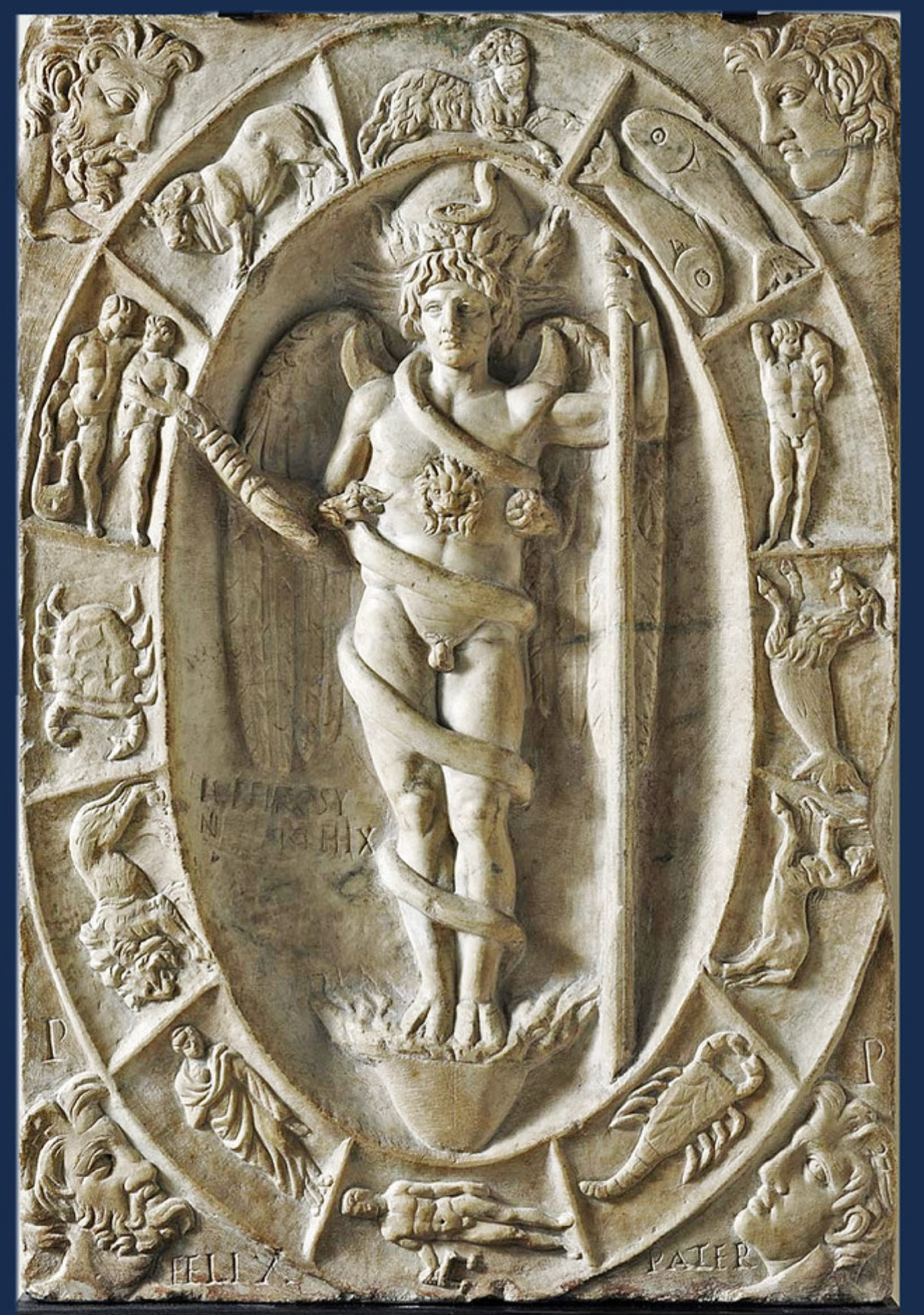
Phanes breaking out of the egg with flames, wrapped in a snake, surrounded by zodiac
- Wait What?
- Inwardness
- Varying Traditions
- Conclusion
- Deep Dives
- Deep Dive - The Cosmic Egg in Egyptian Cosmogony: The Hermopolitan Tradition 2600–2100 BCE
- Deep Dive - The Cosmic Egg in Hiraṇyagarbha: The Golden Womb in Vedic Cosmogony 1500–1000 BCE
- Deep Dive - The Cosmic Egg in Zoroastrian Cosmogony: Order, Sacrifice, and Enclosure 1200–800 BCE
- Deep Dive - The Cosmic Egg in Phoenician Cosmogony: Wind, Desire, and Putrefaction 1000–800 BCE
- Deep Dive - The Cosmic Egg in Early Chinese Cosmogony: Pangu and the Architecture of Sacrificial Creation 400 BCE – 200 CE
- Deep Dive - Phanes and the Orphic Cosmic Egg: Light, Androgyny, and the Genesis of Conscious Order 1400–600 BCE (with texts from 300 BCE – 200 CE)
- Deep Dive - Cosmogony without an Egg: Creation, Ritual, and Purification in the Kojiki 712 CE
- Deep Dive - The Cosmic Egg in Dogon Cosmogony: Water, Twins, and Ritual Continuity 1000–1500 CE
- Deep Dive - The Cosmic Egg in Slavic–Baltic Folklore: Birds, Domestic Ritual, and Fragile Order. Pre-30 CE, 1200–1600 CE
- Deep Dive - The Cosmic Egg in Finnish Cosmogony: Ilmatar and the Duck’s Egg in the Kalevala 1500–500 BCE (text 1835CE)
- Deep Dive - Containment and Separation in Polynesian Cosmogony: The Sky–Earth Embrace as a Cosmic Egg 1000 BCE – 1000 CE
- Deep Dive - The Reedbed Origin in Zulu Cosmogony: Egg, Ancestry, and Ritual Stewardship (recorded 19th–20th century CE)
- Deep Dive - The Layered Cosmic Egg in Mongolian and Siberian Shamanism: Vertical Cosmology and Ritual Navigation ≥2000 BCE
- Deep Dive - The Luminous Egg in Tibetan Cosmogony and Practice: Light, Polarity, and Meditative Origin 700–1000 CE
- Deep Dive - The Philosophical Egg in Hermetic and Alchemical Thought: Technique, Transmutation, and Inner Cosmology 100 BCE – 400 CE
- The Dissection of the Cosmic Egg
- 1. Structural Features of the Egg as a Cosmogonic Symbol
- 2. The Egg as a Ritual and Material Tool
- 3. Cognitive and Psychological Resonance
- 4. The Egg and Scientific Resonance
- 5. Recurring Sub-Motifs Associated with the Cosmic Egg
- 6. Methodological Considerations for Comparative Analysis
- Conclusion: The Function of the Cosmic Egg
- See Also
Across cultures, one image keeps returning when people try to explain how a world begins: an egg. A closed shell. Something whole, dark, and compressed. Inside it, everything already exists. Then the shell breaks — and light, space, and life spill out.
This image appears so often, in so many places, that it stops being a curiosity and starts looking like a pattern.
Across many mystical traditions, the cosmic egg expresses the same core grammar: reality begins as a sealed totality, a contained potential that is neither nothing nor fully formed. The decisive act is not creation-from-absence but rupture—a breaking, cracking, opening, or separating that releases differentiation. Light, order, time, gods, matter, or consciousness emerge only after this break. Whether the egg floats on water, sits on a knee, is wrapped by a serpent, or is layered like a vessel, the point is consistent: before the world can appear, unity must be stressed to the point of division. This applies both cosmically and inwardly. “As above, so below” isn’t a later slogan—it’s already baked into the symbol.
The cosmic egg is not only an explanation of origin, but a template for ritual repetition — especially initiation, burial, and kingship. As a ritual template, the egg governs three domains: initiation (rebirth during life), burial (rebirth at death), and kingship (only the transformed are fit to rule). It's a technique - something meant to be reenacted through ritual, burial, initiation, or controlled ordeal.
In these traditions, the egg is re-entered: sealed space, applied pressure, controlled darkness, followed by a managed rupture into light or order. The myth survives because the procedure works — the same pattern is enacted on minds, corpses, and thrones.
Wait What?
What did we just say above?
before the world can appear, unity must be stressed to the point of division.
This applies both cosmically and inwardly.
“As above, so below” isn’t a later slogan - it’s already baked into the symbol.
That line is basically the whole engine of the egg motif, and later, when we show other religions, we'll actually say it in about five different dialects.
Before the world can appear, unity must be compressed until it fails. Chaos is not empty; it is overfull. The egg breaks not because something attacks it, but because containment itself becomes intolerable.
In other words, the egg breaks because unity cannot remain sealed forever — pressure becomes the antagonist, forcing differentiation as a release.
When we keep returning to “sealed totality → crack → world”, we're describing a very specific logic: unity isn’t stable. The “One” (undifferentiated chaos / potential / compressed being) can’t appear as a world until it’s forced into difference. That forcing is what we mean by “unity must be stressed to the point of division.” This shows up as pressure (Pangu sleeping in a compressed chaos-egg for 18,000 years until the limit breaks), as boundary (the egg as a shell that creates “before/after”), and as violence (the shell breaks; the first sacrifice happens; the many are born). The “creation event” is not a manufacture; it’s a structural failure of perfect containment. The moment the shell can’t hold, the world becomes legible: heaven separates from earth, light differentiates from dark, order is carved out of indistinction.
To be clear, what spills out is not random. The break produces polarity and stratification: sky/earth, light/heavy, sun/moon/stars, upper/lower realms, lawful order versus chaotic remainder. In Pangu, the crack becomes literal cosmic sorting: yang rises, yin sinks and then the titan has to hold the separation open so it doesn’t collapse back into unity (that’s a huge clue: unity is portrayed as a kind of suffocating gravity). In the Kalevala, the egg shatters and its fragments become the architecture of the cosmos (shell = sky, yolk = sun, etc.). In the Egyptian Hermopolitan section, the egg laid on the waters yields the first light/sovereign (sun) and then that same “hatch logic” becomes a repeatable ritual program for the dead king—“how to hatch again.”
Now the “inwardly” part: the bridge is explicit in the “Dissection” section. The egg is not only a story but a portable ritual tool (offerings, fertility rites, burials, foundation deposits), and then it goes one step further with the philosophers’ egg: a sealed vessel where the same cosmological sequence is reenacted as a process—blackening/putrefaction (old form collapses), whitening (reordering/purification), reddening (integration/new birth). That’s the psychological / initiatory reading:
- the “shell” is your existing identity structure;
- the “stress” is ordeal, catharsis, guided rite;
- the “crack” is when the old unity can’t hold and a new configuration becomes possible.
So when we say “as above, so below is baked into the symbol,” we dont mean the slogan itself is ancient in that exact wording - we mean the structure is intrinsic. The egg naturally maps both ways (internal kosmos/psyche vs external cosmos) because it’s already a two-level model: a cosmos in miniature (a sealed whole that becomes a differentiated world) and a psyche in miniature (a sealed self that becomes a reorganized consciousness). We lean into this with the cognitive/psychological explanations: enclosure → emergence into light is primal, and myths exploit that because it’s the simplest narrative of transformation that still feels true.
Put bluntly: the cosmic egg teaches one rule that works at every scale — nothing becomes visible until the closed whole is broken into differences. Stars, societies, and selves all “begin” the same way: containment, pressure, rupture, reordering. That’s why the motif survives cultural translation so easily: it’s not just a myth. It’s a compact model of how transformation works.
Inwardness
Not every culture framed this process explicitly as inner psychology. In some traditions, the egg is worked outwardly through burial architecture, kingship rites, or communal ritual; in others — especially Orphic, Vedic, and later Hermetic contexts — the same structure is consciously internalized. The difference is not in the symbol itself, but in where the culture chose to apply it.
The inward reading is not universal, but it is structurally available wherever initiation replaces mere myth.
In some cases, the inward looking initiatory dimensions may have been restricted, ritually concealed, or lost to us through historical disruption.
Varying Traditions
What varies by tradition is what the rupture emphasizes.
Each culture speaks this image with a different accent. The grammar is shared — containment, pressure, rupture, emergence — but the emphasis shifts: some traditions stress gestation, others sacrifice, others illumination, others law and architecture.
The cosmic egg is therefore not a single doctrine but a symbolic syntax, capable of generating multiple cosmologies without losing its underlying structure.
Egypt
In Egypt, the egg is embedded in ritual kingship and funerary technique. Emergence from the egg (or lotus, or mound) legitimizes solar order and teaches the dead how to “hatch” again. Death is not an end but a controlled return to the germinal state, aiming at rebirth as light.
- The internalization happens via funerary reenactment as death/resurrection, not introspection.
Vedic
In Vedic thought, the egg (Hiraṇyagarbha) stresses gestation and vibration. The cosmos grows lawfully from a luminous seed awakened by sound. This same logic is turned inward through mantra and meditation: remembering the seed is remembering one’s origin.
- Internalization via mantra, meditation, bindu, seed imagery
Persian/Zoroastrian
In Persian/Zoroastrian cosmology, the egg becomes architectural and moral. The world is designed as a protected vessel, but life multiplies only through sacrificial rupture. Order survives by stewardship, enclosure, and ritual maintenance.
- Calling it an “egg” cosmology is metaphorical. Zoroastrian texts emphasize world-as-enclosure, sacrifice, and ordered layers more than a literal egg.
- Internalization should be understood as moral discipline and stewardship, not inner illumination
- Zoroastrian internalization is ethical alignment with asha, not contemplative awakening.
Phoenician
In Phoenician myth, the egg is visceral and erotic. Desire, wind, mud, and rot precede light. Creation is messy, bodily, and inventive. Civilization emerges not from purity but from transformation of corruption.
Pangu
In China’s Pangu, the egg is pressure and labor. The world is physically forced apart, then held apart by sacrifice. The body of the first being literally becomes the cosmos. Creation is sustained by exhaustion and death.
Japan
In Japan, the egg logic appears as ritualized stirring and purification. Correct form, speech, and cleansing generate light; missteps generate death and monsters. Creation is ongoing and procedural.
- “Egg logic” is interpretive; Japan doesn’t foreground eggs, but the containment → rupture → purification logic is real.
Dogon, Zulu, Siberian
Among Dogon, Zulu, Siberian, and shamanic traditions, the egg becomes a living structure—layered, watery, inhabited by ancestral forces. Specialists (shamans, elders) move through its layers to heal, retrieve souls, and maintain balance. The cosmos is something you traverse, not just remember.
- Internal via Shamanic rites
Northern European / Kalevala
In Northern European and Kalevala traditions, the egg is fragile and domestic. A small accident births the world. The emphasis is on tenderness, maintenance, and memory—creation as something that can fracture again if neglected.
Tibetan and Bon traditions
In Tibetan and Bon traditions, the egg explicitly doubles as cosmology and inner map. White and dark eggs give rise to order and confusion, and the same structure reappears as luminous drops within the body-mind. Awakening is recognizing the inner egg.
Archaic Greek (Orphic) 1400–600 BCE
In Archaic Greek Orphic cosmogony, the egg emphasizes illumination and conscious order. From the cosmic egg—compressed by Chronos (Time) and Ananke (Necessity)—emerges Phanes, the First-Born: luminous, androgynous, and self-generated. The rupture of the egg is not primarily sacrificial or architectural, but revelatory: light itself becomes the organizing principle of the cosmos.
Creation here is the appearance of visibility and intelligibility. Through Phanes, unity differentiates into ordered succession (Night, Sky, later divine regimes), establishing a cosmos that can perceive and be perceived. Gaia and Ouranos function as complementary cosmic conditions—material generativity and structural separation—while Aion names the continuity that arises once order is established.
- Emphasis on light, androgynous unity, and the genesis of conscious order
- Internalization and initiation occur later, but the cosmogony itself remains external and cosmological
See Orphic Cosmology for deeper dive into the initiatory framework, using Gaia, Ouranos, Fire, and Aion
Hermetic and Alchemical 300 BCE – 300 CE
In Hermetic and alchemical traditions, the egg is transformed from a cosmogonic image into a repeatable technical instrument. These systems do not introduce a new creation myth; instead, they deliberately reenact earlier Orphic and cosmic rupture within a sealed vessel. The egg becomes a controlled environment in which death, dissolution, clarification, and rebirth are intentionally induced.
Creation is no longer singular or remote, but procedural and reproducible. Through heat, enclosure, and time, the same grammar—containment, putrefaction, separation, and emergence—is applied to matter and to the practitioner alike. The cosmic egg becomes a laboratory analogue of the universe, where transformation is achieved by method rather than mythic event.
- Emphasis on technique, repetition, and controlled transmutation
- The rupture is intentional and instructional, not primordial or spontaneous
See Orphic Cosmology for deeper dive into the Orphic and Hermetic initiatory frameworks, using Gaia, Ouranos, Fire, and Aion.
Conclusion
Seen through this lens, death and resurrection in Orphic and mystery contexts are not about post-mortem destiny but about initiatory rebirth during life. The “death” is the collapse of a sealed psychic structure; the “resurrection” is the emergence of a re-ordered consciousness. Catharsis rites, ordeal, pharmacological guidance, symbolic burial, and revelation all reenact the egg’s cracking. This is why figures like Phanes matter: Phanes is not a craftsman-god but the moment of illumination itself, the flash that occurs when containment fails.
So yes—sometimes these myths describe the external universe, sometimes the inner psyche, and often both at once. The cosmic egg is a model for how anything meaningful comes into being: pressure, enclosure, rupture, light, and reorganization. Whether we apply it to stars or to consciousness, the message is the same. Nothing truly new appears without a breaking, and nothing breaks without risk. The world—and the self—are what spill out after the shell can no longer hold.
The endurance of the cosmic egg lies in its usefulness: it explains origin, authorizes power, structures ritual, and offers a repeatable map for transformation — cosmic or human.
Deep Dives
Here we'll go deep into the cosmic egg, for each culture, whereas before we briefly touched on them quickly to give a quick readable overview.Deep Dive - The Cosmic Egg in Egyptian Cosmogony: The Hermopolitan Tradition 2600–2100 BCE
(Hermopolis, Old Kingdom Egypt, ca. 2400–2300 BCE)
Among the earliest recorded cosmogonic systems of the ancient world, Egyptian theology presents a distinctive and enduring image of origin: the Cosmic Egg. Attested in Old Kingdom Pyramid Texts and later theological elaborations, this image functions not merely as a metaphor but as a conceptual model for emergence, order, and political legitimacy. The Hermopolitan tradition, centered in the city of Hermopolis (Egyptian Khemenu, “City of Eight”), preserves one of the most explicit formulations of this cosmology.
Egyptian cosmogony consistently begins not with creation ex nihilo, but with emergence from a primordial condition. This condition is named Nun, the infinite, undifferentiated watery abyss. Nun is not passive emptiness but a dynamic, pre-cosmic state—an unformed totality in which all future realities exist in latent form. It is from within this pressure-filled, pre-ordered medium that creation unfolds.
The Ogdoad as Pre-Cosmic Conditions
The Hermopolitan system describes the primordial state through the Ogdoad, a group of eight deities arranged in four male–female pairs. These figures are not anthropomorphic creator-gods in the later mythological sense, but abstractions representing fundamental conditions of existence:
- Nu and Naunet: the watery abyss
- Heh and Hauhet: infinity or boundlessness
- Kek and Kauket: darkness
- Amun and Amaunet: hiddenness or invisibility
Rather than acting through deliberate craftsmanship, the Ogdoad collectively embody the raw parameters of reality prior to differentiation. Temple iconography often depicts them with amphibian and serpentine features—frogs and snakes—creatures associated with liminality, moisture, and regenerative cycles. These forms emphasize their pre-human, pre-cosmic status and their alignment with transitional states.
The Cosmic Egg and the Great Cackler
From the interaction or pressure of these primordial conditions emerges the central cosmogonic event: the laying of the Cosmic Egg. In the Hermopolitan account, this act is attributed to a divine goose known as the “Great Cackler.” The goose is not a trivial or rustic symbol, but a ritualized embodiment of generative sound and animal vitality. Its cry marks the first disturbance of the primordial silence, and its egg contains the totality of future existence in concentrated form.
The egg is laid upon the surface of the waters of Nun. Within it resides light, order, time, kingship, and the structure of the cosmos itself. When the egg breaks open, what emerges is not an animal offspring but the solar principle—most commonly identified as Ra, though some variants name Thoth or another early creator figure. Regardless of the specific identification, the essential structure remains constant: the sun and the ordered world arise from a sealed, hidden potential that ruptures into manifestation.
Emergence, Multiplicity, and Symbolic Variants
Egyptian theology does not insist on a single, exclusive cosmogonic image. Alongside the egg, other emergence symbols appear: the benben (the primeval mound rising from the waters), the lotus opening to reveal the sun, or Atum self-generating from the abyss. These are not competing doctrines but parallel expressions of the same underlying logic. Egyptian thought privileges pattern over narrative consistency, emphasizing the transition from undifferentiated chaos to ordered space.
Water remains the constant substrate in all these accounts. Creation is always depicted as a contained and sacred emergence from a fluid, unstable background, mirroring the annual flooding of the Nile and its transformation of barren land into fertile ground.
Ritual, Kingship, and Political Theology
The Hermopolitan egg cosmology is inseparable from Egyptian ritual and political ideology. By tracing the origin of cosmic order to the birth of the sun from the egg, Egyptian theology provides a foundation for sacral kingship. Pharaohs are understood not merely as rulers but as living participants in the original creative event, inheritors of solar authority. Their legitimacy derives from claimed proximity to the moment of cosmic emergence.
This connection is reinforced through temple architecture, reliefs, and liturgy. Images of geese, frogs, snakes, and solar symbols placed at thresholds and portals assert the continued activation of cosmogonic forces. Myth is not relegated to the past; it is perpetually reenacted through ritual.
Funerary Theology and Repetition of the Cosmogonic Act
The same logic governs Egyptian funerary practices. The Pyramid Texts, among the earliest religious compositions in human history, function as procedural guides rather than speculative philosophy. They instruct the deceased king in how to retrace the path of the sun—how to return to the primordial waters, re-enter the state of concentrated potential, and emerge anew as a star or solar being.
In this framework, death is not an endpoint but a controlled attempt at rebirth. The tomb becomes an incubatory space analogous to the Cosmic Egg itself, where dissolution precedes reconstitution. The deceased seeks to replicate the primordial act of emergence, aligning personal destiny with cosmic pattern.
Symbolic Implications of the Egg
The egg carries a dual symbolism throughout Egyptian cosmology. It represents protection and containment, but also fragility and necessary rupture. The breaking of the shell is both creative and violent, an irreversible transition from potential to actuality. This logic extends to natural cycles—the flooding of the Nile, the daily journey of the sun through the underworld, and the continual renewal of kingship and ritual order.
The daily solar cycle itself reenacts the egg’s logic: dawn as birth, night as reabsorption, and sunrise as renewed emergence. Egyptian religion repeatedly stages this pattern across cosmology, ritual, architecture, and political structure.
In Summary
The Hermopolitan Cosmic Egg encapsulates a comprehensive model of origin in which chaos is not evil but foundational, potential is concentrated before release, and order arises through patterned emergence. The Ogdoad articulate the preconditions of existence; the Great Cackler initiates creation; the egg concentrates the cosmos; and the sun’s birth establishes order, authority, and time.
Through this system, Egyptian thought transforms cosmogony into technique, myth into ritual practice, and origin into political theology. The Cosmic Egg thus functions as both a metaphysical principle and a practical framework through which Egyptians understood creation, rulership, death, and renewal.
Deep Dive - The Cosmic Egg in Hiraṇyagarbha: The Golden Womb in Vedic Cosmogony 1500–1000 BCE
Within Vedic cosmology, the image of the Cosmic Egg appears in a distinctly contemplative and generative form as Hiraṇyagarbha, commonly translated as “the Golden Womb” or “Golden Germ.” Attested most prominently in the hymns of the Rigveda, this concept presents origin not as a sudden rupture or violent division, but as a process of gestation and lawful unfolding. Hiraṇyagarbha functions simultaneously as cosmological principle, metaphysical bridge, ritual focus, and political foundation.
The Vedic cosmogonic vision begins in a state of undifferentiated silence: no sky, no earth, no sun, and no articulated order—only a vast, dark, unmanifest expanse. Within this primordial condition, a single luminous seed appears, floating within the cosmic waters. This seed is named Hiraṇyagarbha, from hiraṇya (“golden”) and garbha (“womb,” “embryo,” or “germ”). The terminology is not ornamental but doctrinal: the golden womb is understood as containing, in concentrated form, the totality of what will later emerge as the cosmos.
According to the relevant Rigvedic hymn, Hiraṇyagarbha is described as the “first-born” (prathama-jā), rising at the beginning and giving rise to the structured world. From this germ originate the first light, the first differentiation, and the conditions that allow heaven and earth to stand apart. The seed is not inert matter awaiting external activation; it is a living, generative center that germinates into cosmic form. It sustains heaven and earth and functions as the underlying structural axiom that prevents the world from collapsing back into undifferentiated chaos.
A defining feature of the Vedic conception is the inseparability of sound and substance. Creation is not merely a physical or visual event but an acoustic one. The primordial vibration—articulated later as AUM—is understood as the activating principle that awakens the golden germ. In this framework, sound is not a representation of reality but a causal force. A single primal vibration contains within it the pattern for natural forms, social structures, and biological life. Through sound, the latent potential of Hiraṇyagarbha expands into multiplicity, transforming silence into articulated order.
Hiraṇyagarbha is also associated with divine agency. In some formulations, the golden womb is identified with or subsumed under Prajāpati, the “Lord of Begetting,” who mediates the transition from unmanifest potential to manifest forms. From this seed emerge the gods, and from the gods arise human beings, establishing a cascading lineage that links cosmic origin to social order. This lineage has explicit political implications: kingship and priestly authority derive legitimacy from claimed proximity to the primordial source. As such, Hiraṇyagarbha operates simultaneously as a spiritual principle and a mechanism of statecraft.
The choice of garbha—womb rather than shell—is central to the Vedic model. The womb implies internal development, duration, and lawful growth. Unlike cosmogonies centered on violent rupture or sacrificial dismemberment, Hiraṇyagarbha emphasizes gradual emergence governed by ṛta, the cosmic order. Creation unfolds according to rhythm and law rather than randomness. Nevertheless, this gestational model does not exclude tension or disruption; birth itself remains a transformative and destabilizing event.
The golden quality of the womb further signals sanctity and value. Gold functions as a marker of incorruptibility, radiance, and worth, indicating that origin itself is pure and authoritative. This symbolism extends into contemplative and meditative practices, in which practitioners are instructed to visualize a golden sphere within the heart or between the brows. Such practices reinforce the idea that the individual self is not accidental or chaotic, but an echo or extension of the primordial seed.
Ritual performance plays a central role in sustaining this cosmology. Through the chanting of hymns and the coordinated use of breath and sound, ritual does not merely recount creation but reactivates it. The golden germ becomes both symbol and method: by intoning the primordial sound and recalling the seed, participants are ritually invited to reorient themselves toward their cosmic source. In this respect, initiation functions as a controlled recollection of origin, paralleling initiatory structures found in other ancient traditions.
Later philosophical developments refine but do not discard the concept. In the Upanishadic and Vedantic traditions, thinkers increasingly emphasize that Hiraṇyagarbha is not the absolute principle. Brahman, the unconditioned and ineffable reality, remains prior even to the golden womb. Hiraṇyagarbha thus occupies an intermediate position: it is the hinge between the unmanifest and the manifest, the point at which the nameless becomes name and form. While it can be identified as a beginning, it simultaneously gestures beyond itself toward an ineffable silence that resists conceptualization.
When placed alongside other egg-based cosmogonies—such as those involving Pangu or Phanes—Hiraṇyagarbha represents a distinct emphasis. Where one tradition frames origin through bodily sacrifice and another through sudden luminous emergence, the Vedic model presents origin as method: seed, sound, and lawful growth. Despite these differences, all such accounts converge on a shared intuition: multiplicity arises from an original unity, and the many are reflections of an earlier One.
In summary
Hiraṇyagarbha articulates a cosmogony in which creation is contemplative rather than purely catastrophic, structured rather than arbitrary. The universe is not simply broken into existence but cultivated from a concealed center according to rhythm, law, and sound. At the same time, this process demands transformation and cost, as birth and differentiation inevitably disturb primordial equilibrium. The golden womb thus serves as both source and challenge, grounding cosmology, ritual practice, political authority, and individual self-understanding in a single, generative image of origin.
Deep Dive - The Cosmic Egg in Zoroastrian Cosmogony: Order, Sacrifice, and Enclosure 1200–800 BCE
(Iranian Plateau; Avestan and Pahlavi Sources, ca. 1200–1000 BCE)
Within Zoroastrian cosmology, as preserved in the Avesta and later elaborated in Middle Persian (Pahlavi) texts, the motif of the Cosmic Egg appears not as a dramatic rupture or spontaneous birth, but as a model of deliberate design, moral order, and cosmic stewardship. Emerging from the religious imagination of the Iranian plateau, this tradition presents creation as an act of architectural planning governed by law and light, presided over by Ahura Mazda, the Wise Lord.
Zoroastrian cosmology frequently describes the world as a structured vessel. The sky is fashioned as a protective dome or shell that encloses all creation; beneath it lie the waters, and upon those waters rests the earth, often conceived as a flat disk. This tripartite structure—shell, waters, and earth—forms an implicit egg-like model of the cosmos. Creation here is not accidental or chaotic but intentional, ordered, and supervised. Each region of the cosmos is formed deliberately and assigned guardianship, reflecting a vision of the universe as an engineered system rather than a spontaneous eruption.
Creation as Architecture and Guardianship
In Zoroastrian accounts, creation begins with the establishment of cosmic axes and protections. Ahura Mazda brings into being not only physical realms but also spiritual guardians, most prominently the Amesha Spentas (“Immortal Bounties”). These entities are entrusted with specific aspects of creation and function as custodians of cosmic order. The sky, as the outer shell of the world, is created first and assigned its protector; the waters fill the lower region; and the earth is shaped as the habitable center. This sequence emphasizes creation as architecture, with each zone purposefully constructed and maintained.
The cosmos thus resembles an ordered egg: a bounded, layered structure designed to contain and sustain life. Law (asha) precedes life, and stewardship precedes multiplication.
Primordial Beings as Sacramental Seed
At the center of this ordered world stand two primordial beings: Gayōmart (also known as Gaya Maretan), the first human, and Gavaevodata, the primordial bovine. In Avestan and later Pahlavi tradition, these figures function as protoplasts—original embodiments of human and animal life respectively. Gayōmart occupies a liminal position between divine intention and earthly existence, while the primordial bovine is the ancestor of all animals and the ultimate source of sustenance, including grains and medicinal plants.
Both beings are conceived not merely as living creatures but as sacramental seeds. Their creation is intentional, and their subsequent transformation is central to the multiplication of life. The Zoroastrian world is thus founded on a principle of sacrificial generation rather than simple propagation.
Dualism and Sacrificial Cosmogony
Zoroastrian cosmology is defined by an intrinsic moral dualism. Opposing Ahura Mazda’s ordered creation is Angra Mainyu (Ahriman), the destructive spirit. In the primordial confrontation, Angra Mainyu assaults the created world, introducing violence and corruption into the cosmic structure. In several accounts, this attack results in the injury or death of Gayōmart and the primordial bovine.
These deaths, however, are not sterile losses. From Gayōmart’s body arise the seeds of humanity, while from the body of the bovine spring grains, medicinal plants, metals, and the diversity of animal life. Destruction is thus converted into fecundity. The first beings die so that multiplicity may live, and violence is transformed into nourishment for the created order. This model constitutes a sacrificial cosmogony in which death is a necessary precondition for abundance.
Later Zoroastrian texts, including the Bundahishn, elaborate this theme in detail. The dying bovine becomes an engine of fertility: numerous kinds of grain and medicinal plants arise from its substance, and the chihr (seed or prototype) of species is preserved and purified, often associated with the moon. The soul of the bovine (geush urvan) laments until assurances of cosmic protection are given. Similarly, Gayōmart’s death yields the first human pair or the generative seed of humanity, depending on the version. Across variants, the logic remains consistent: primordial sacrifice enables structured life.
Enclosure and Preservation: Yima’s Vara
A complementary expression of the egg motif appears in the account of Yima’s Vara, associated with the culture hero Yima (Jamshid). During a primordial golden age, Yima constructs a sealed enclosure (vara) to preserve life in anticipation of a catastrophic winter. This structure is described as a multi-level, artificially illuminated refuge containing selected humans, animals, and plants.
The Vara functions as a womb-like container, preserving the seeds of life until external danger passes. This narrative echoes the cosmic shell imagery: when creation is threatened, salvation takes the form of enclosure rather than expansion. Preservation becomes a creative act, and containment ensures continuity. The motif reinforces the Zoroastrian emphasis on protection, foresight, and stewardship as cosmic virtues.
Political and Ritual Implications
The Zoroastrian egg-model carries explicit political and ritual significance. Gayōmart serves as the ancestral prototype from which righteous kingship and human lineage claim descent. Yima’s preserved golden age becomes a paradigm invoked by rulers who promise restoration of order. Zoroastrian cosmological texts are therefore not neutral speculative accounts but prescriptive manuals for priests, kings, and cultivators, outlining proper care for sky, water, earth, and living beings.
Stewardship of the cosmic shell—maintaining purity, protecting life, and upholding order—is framed as a moral and religious obligation. Cosmology functions as a guide to ethical governance and ritual responsibility.
In Summary
The Zoroastrian articulation of the Cosmic Egg introduces a distinctive grammar of origin characterized by three interrelated principles: deliberate order, sacrificial fertility, and protective enclosure. Creation is engineered rather than accidental; life multiplies through the transformation of primordial sacrifice; and preservation through containment ensures cosmic continuity.
While differing in emphasis from traditions that foreground violent rupture or sudden illumination, the Persian model participates in a shared human intuition: unity precedes multiplicity, containment precedes expansion, and life emerges through patterned transformation. The shell functions simultaneously as law, refuge, and boundary, while the earth within remains a promise sustained through ritual care and moral vigilance.
This Persian formulation thus contributes a critical variation to the wider comparative study of the Cosmic Egg, emphasizing design, responsibility, and the conversion of violence into ordered life within a bounded and protected world.
Deep Dive - The Cosmic Egg in Phoenician Cosmogony: Wind, Desire, and Putrefaction 1000–800 BCE
(Levantine Tradition Attributed to Sanchuniathon, ca. 1000–800 BCE)The Phoenician articulation of the Cosmic Egg, preserved in fragments attributed to Sanchuniathon and transmitted through later authors, presents one of the most materially grounded and psychologically charged cosmogonies of the ancient Mediterranean world. Emerging from the mercantile and ritual cultures of the Levant, this tradition frames creation not as an act of moral fiat or architectural planning, but as a process driven by wind, desire, decay, and practical invention. The egg motif appears here in an explicitly physical and generative register, closely tied to bodily processes and human craft.
Phoenician cosmogony begins in a primordial state characterized not simply by darkness, but by a dense, turbulent atmosphere—an indistinct, wind-laden condition without stable form. Alongside this exists Chaos, described as black, heavy, and turbid, akin to the depths of a stormy sea. This phase is marked by prolonged tension and pressure rather than immediate creation. The primordial wind turns inward upon itself, generating a reflexive attraction identified as Pothos, or desire. Desire, rather than intention or law, becomes the initiating force of creation.
From the union of desire and chaos arises Môt, a term variously understood as mud, putrefaction, or a dark, generative substance. Môt is not a moral evil but a fertile medium in which the first patterns of life begin to coalesce. It functions as the substrate from which form emerges, emphasizing decay and material instability as prerequisites for generation.
Within this context, the Cosmic Egg appears not as a pristine object but as a product of the muddy, amorphous condition of Môt. The sources describe the formation of embryonic beings within the egg, known as the Zophasemin, often rendered as “overseers of the heavens.” These beings exist in a liminal state—neither fully formed nor inert—characterized by observation and anticipation. Their presence within the egg introduces a proto-conscious dimension to creation, in which awareness precedes full articulation.
The rupture of Môt marks a decisive transition. From this bursting forth emerge the luminous bodies of the cosmos: the sun, the moon, and the stars, both great and small. Light arises directly from decay, and celestial order is generated from material corruption. The Phoenician egg thus encodes a cosmogony in which fecundity and illumination are inseparable from putrefaction. Creation is not depicted as a clean or orderly miracle but as an unstable, bodily process through which measure is wrested from excess.
This emphasis on physicality and desire distinguishes the Phoenician account from more idealized cosmogonies. Primordial forces are described in tactile terms—wind interacting with water, longing producing motion, decay yielding structure. The result is a worldview in which creation is neither sanitized nor purely transcendent, but deeply immanent and sensuous. Disorder is not eliminated but transformed.
The narrative subsequently turns toward genealogy and the emergence of human culture. From the early watcher-beings arise figures associated with skill, knowledge, and record-keeping. Central among these is Taautus, identified by later traditions with Thoth and Hermes. Taautus is presented as a culture-bringer who systematizes reality through writing, law, and art. The Phoenician tradition explicitly frames its gods as originating from human figures whose deeds were later magnified into divinity. This euhemeristic tendency presents myth as an extension of memory and invention rather than as revelation detached from history.
Serpentine imagery further integrates the egg into a cyclical framework. The egg is frequently imagined as encircled by a serpent, a symbol of both protection and danger. The serpent represents motion, renewal, and the ambiguous boundary between life and death. Taautus himself is said to attribute divinity to serpents on the grounds that they move by spirit, renew themselves through shedding, and ultimately consume themselves in a ritualized form of death. In this symbolism, the serpent becomes the living mechanism that binds the egg to cycles of birth, dissolution, and rebirth.
The Phoenician cosmogony carries explicit social and political implications. It does not function as abstract metaphysics but as a legitimizing framework for craft, trade, and priestly authority. By locating the origin of the world in desire, material transformation, and the subsequent ordering of knowledge, the myth affirms the cultural centrality of scribes, artisans, and merchants. Cosmology and instruction are fused: the same narrative that explains the universe also justifies the structures that sustain civic life.
At a practical level, the myth advances a clear anthropological claim: human ingenuity arises from necessity. The awakening of the watcher-beings coincides with the emergence of tools, agriculture, law, and religious institutions. Civilization is presented as the direct outcome of grappling with disorder and longing. From mud comes measurement; from hunger, writing; from decay, permanence.
In summary
The Phoenician version of the Cosmic Egg articulates a model of origin grounded in appetite, materiality, and human invention. Wind and desire generate a fertile chaos; decay becomes the medium of creation; light emerges from rupture; and knowledge transforms a messy beginning into a durable social order. Within the broader comparative study of egg cosmogonies, this tradition emphasizes embodiment, ambiguity, and craft, offering a distinctly Levantine articulation of a shared human intuition: that the foundations of the world lie in something small, concealed, and profoundly generative.
Deep Dive - The Cosmic Egg in Early Chinese Cosmogony: Pangu and the Architecture of Sacrificial Creation 400 BCE – 200 CE
(China; earliest written attestations ca. 350 BCE, with earlier oral roots)
In early Chinese cosmogony, the myth of Pangu presents one of the most structurally complete and influential articulations of the Cosmic Egg motif. Unlike traditions that emphasize light, law, or abstract order as primary creative agents, the Pangu narrative centers on a living being whose body becomes the structural framework of the world. Here, the egg is not merely the site of birth but a crucible in which unity, separation, labor, and sacrifice are simultaneously enacted.
The cosmogony begins with a state of absolute undifferentiation. Prior to names, categories, or spatial orientation, reality exists as a dense, chaotic totality in which opposites are fully intermingled. This primordial condition is not simply darkness, but a compressed state of potential marked by pressure and instability. From this undifferentiated mass, the cosmos condenses into a single, immense egg. The egg functions as a total enclosure, containing within itself all future distinctions in latent form.
Within the egg reside the paired forces later identified as yin and yang: heavy and light, cold and heat, dark and bright. These principles are not yet separated but exist in intimate conjunction. Curled within this compressed totality is Pangu, whose name is traditionally interpreted as “the Ancient Coil” or “the Primordial Enfolded One.” He is depicted not as a refined creator but as a latent titan—an embodiment of accumulated pressure poised at the threshold of differentiation.
For an extended period—symbolically described as eighteen thousand years—this state persists. The duration emphasizes gestation rather than instantaneous creation. Eventually, the internal tension reaches a breaking point. Pangu awakens and stretches, and this singular act fractures the egg. The cracking of the shell marks the first act of differentiation and the beginning of articulated reality. The lighter, clearer elements (yang) rise and form the heavens, while the heavier, denser elements (yin) sink and become the earth. Creation is thus achieved through rupture and division rather than harmonious unfolding.
This initial separation is unstable. Heaven and earth tend naturally toward recombination, threatening to collapse back into undifferentiated unity. To prevent this, Pangu positions himself between them, standing upright and physically holding the sky apart from the earth. As time progresses, the heavens ascend and the earth thickens, while Pangu grows correspondingly taller. In this role, he becomes the axis mundi: the living column that maintains cosmic separation. Within this single image, the egg is transformed into the world-mountain, the world-tree, and the cosmic pillar—motifs that recur across later mythological systems.
When the work of separation is complete, Pangu’s role concludes in death. This death is not an epilogue but a final creative act. The myth treats Pangu’s body as the material substrate of the cosmos. His breath becomes wind and clouds; his voice becomes thunder; his eyes form the sun and the moon; his blood becomes rivers; his flesh becomes soil; his hair becomes forests; his bones form mountains; and his marrow, teeth, and bones transform into minerals and precious stones. Even his limbs are said to become the pillars that stabilize the heavens. The world is thus explicitly constructed from the body of a sacrificed being.
This narrative establishes creation as an inherently sacrificial process. The egg is not a gentle womb but a crucible, and emergence is inseparable from destruction. The creator does not merely initiate the world but is consumed by it. In this respect, the Pangu myth provides an early and explicit model for later themes of sacrificial origin, dying-and-transforming creators, and the legitimization of order through bodily expenditure.
The symbolism of the egg in this tradition is notably compact and comprehensive. The egg represents unity prior to division, androgyny prior to differentiation, and containment prior to expansion. Its rupture generates spatial structure, temporal progression, and moral order. The myth integrates motifs that appear separately in other traditions: separation of opposites, establishment of a cosmic axis, transformation of a divine body into the material world, and the necessity of sacrifice for sustained order.
The persistence of this image can be attributed to its bodily resonance. The sequence of containment, rupture, and emergence mirrors human experiences of birth and growth, while also reflecting ecological and social realities in which labor and loss underpin stability. The Pangu myth articulates creation not as a purely transcendent event but as embodied work, marked by strain, endurance, and cost.
In comparative perspective, the Pangu cosmogony functions as a structural template rather than a localized narrative curiosity. Within this single myth are already present the key grammatical elements that recur throughout global cosmological traditions: unity fractured into multiplicity, a central axis sustaining order, death transmuted into world, and a primordial enclosure that precedes manifestation. The Cosmic Egg, in this Chinese articulation, is not merely one origin story among others, but a condensed schema through which later myths of floods, world-trees, twins, cycles, and sacrificial kingship can be understood.
In summary, the Pangu myth presents the Cosmic Egg as the foundational image through which separation, structure, sacrifice, and renewal are rendered intelligible. Creation emerges through rupture, order is maintained through labor, and the world itself is the residue of a total self-giving. This formulation offers one of the most explicit and enduring expressions of the human attempt to conceptualize how multiplicity arises from unity, and how existence itself is purchased through the breaking of an original containment.
Deep Dive - Phanes and the Orphic Cosmic Egg: Light, Androgyny, and the Genesis of Conscious Order 1400–600 BCE (with texts from 300 BCE – 200 CE)
(Greek Orphic Tradition; Hellenistic period, Likely Mycenaean / pre-Homeric ritual myth. Survives through later Orphic hymns and philosophical references. ca. 300–200 BCE, with earlier roots)
Within the Greek Orphic tradition, the figure of Phanes represents one of the most conceptually complete articulations of the Cosmic Egg motif. Emerging from Hellenistic-era Orphic hymns and fragments, this cosmogony presents creation not primarily as physical construction or legal ordering, but as the emergence of light, consciousness, and generative unity. In contrast to traditions that emphasize bodily sacrifice or architectural separation, the Orphic account foregrounds illumination, erotic totality, and metaphysical awakening.
Orphic cosmogony begins prior to the Olympian gods and even prior to familiar mythic genealogies. At the origin stand the primordial forces Chronos (Time) and Ananke (Necessity). These principles are not anthropomorphic deities but foundational constraints of existence. Through their interaction, a luminous cosmic egg is generated in the primordial darkness. The egg is frequently depicted as radiant and encircled by a serpent, an image that condenses themes of cyclical return, boundary, and generative containment.
From this egg emerges Phanes, also called Protogonos (“First-Born”), whose name derives from the notion of appearing or shining forth. Phanes does not emerge as an undeveloped being but as an already complete and active creative principle. His birth marks the first manifestation of light and the initial articulation of order from undifferentiated darkness.
A defining characteristic of Phanes is androgyny. He is portrayed as simultaneously male and female, embodying generative completeness prior to sexual differentiation. This attribute functions symbolically rather than biologically: Phanes represents unity before division, the undivided template from which later polarities—male and female, ruler and ruled, divine and mortal—will emerge. In this sense, androgyny operates as a resistance to categorical fragmentation and establishes a primordial wholeness that precedes social and cosmic stratification.
Phanes is also identified as the first light. This light is not limited to physical illumination but extends to intelligence, awareness, and self-recognition. In Orphic thought, light is inseparable from knowledge; the appearance of Phanes signals the birth of consciousness itself. Through illumination, darkness becomes intelligible, and the cosmos becomes a knowable order rather than an inert mass. Phanes thus functions as the metaphysical catalyst that allows reality to be perceived, named, and structured.
The serpent that encircles the Orphic egg reinforces this framework. Far from a decorative element, the serpent symbolizes cyclical necessity, generative sexuality, and the binding constraints that surround creative potential. Often associated with the image later known as the Ouroboros, the serpent represents continuity, return, and the self-enclosing nature of cosmic processes. In Orphic iconography, the egg and serpent together form a compact statement of origin: creation arises within limits, is guarded by cyclical law, and is destined to return to itself.
From Phanes proceeds the entire genealogical sequence of gods, cosmos, and mortal life. Orphic traditions trace divine succession back to this luminous source, establishing Phanes as the ultimate ancestor of both gods and humans. At the same time, Orphism introduces a distinctive anthropological claim: the human psyche/soul is understood as a fragment or residue of the original divine light. Embodiment is therefore experienced as a condition of entrapment, and ritual initiation aims to awaken memory of the psyche/soul's luminous origin. Phanes serves as the archetype of this awakening, the model of what the psyche/soul once was and may become again.
The Orphic narrative also emphasizes succession and transmission of power. After Phanes’ initial reign, creative authority passes through a sequence of figures—Nyx, Uranus, Kronos, and finally Zeus. In some Orphic accounts, Zeus absorbs or internalizes the primordial creative essence, effectively reconstituting the cosmos within himself. This sequence models the circulation of authority as inheritance, absorption, and rearticulation rather than simple replacement. Mythic succession thus mirrors political theology: power is transmitted, transformed, and legitimized through claims of proximity to original creative force.
Within the broader comparative framework of Cosmic Egg traditions, the Orphic Phanes represents the moment at which origin becomes explicitly cognitive. Where other myths emphasize separation of matter or the stabilization of space, the Orphic narrative identifies creation with illumination and awareness. The egg here gives rise not only to structure but to meaning, not only to world but to mind.
In summary, the Orphic figure of Phanes demonstrates the adaptability and depth of the Cosmic Egg motif. Through Phanes, the egg becomes the source of light, consciousness, and divine lineage, while also grounding doctrines of the soul and models of political succession. This tradition affirms that origin is not only a physical event but an epistemic one: the moment when the universe first becomes visible to itself.
Deep Dive - Cosmogony without an Egg: Creation, Ritual, and Purification in the Kojiki 712 CE
(Japan; first written compilation 712 CE)
The earliest recorded Japanese cosmogony, preserved in the Kojiki, does not present creation through the explicit image of a cosmic egg. Nevertheless, it articulates the same fundamental structural grammar found in egg-based cosmogonies elsewhere: an undifferentiated primordial state, a catalytic stirring or piercing that releases form, and a sequence of generative ruptures through which multiplicity arises. In this tradition, creation is mediated through ritual action, correct procedure, and purification rather than through a singular act of violent separation.
The Kojiki opens with the appearance of the Plain of High Heaven (Takamagahara) and a series of primordial entities whose names function less as personal deities than as abstract principles. Figures such as Amenominakanushi, Takamimusuhi, and Kamimusuhi represent origin, generative power, and creative motion. These beings act as foundational conditions rather than active creators, establishing a pre-narrative framework within which subsequent events unfold.
From this initial stillness emerge the paired deities Izanagi and Izanami, male and female figures tasked with shaping the world. They are granted a sacred implement, the Amenonuhoko, a jeweled spear that functions not as a weapon but as a ritual instrument. Standing upon the Floating Bridge of Heaven, they lower the spear into the primordial waters and stir the formless sea. When the spear is withdrawn, droplets of brine fall and condense, forming the first island, Onogoro-shima. Creation here proceeds through condensation rather than explosion: potential becomes place through deliberate, symbolic motion.
Following the formation of the first land, Izanagi and Izanami construct a central pillar and perform a marriage rite by circling it. The initial ritual fails, producing malformed offspring, a failure attributed to improper ceremonial order—specifically, Izanami’s speaking first. This episode establishes a central cosmological principle: correct ritual form is not merely social convention but a law governing reality itself. When the rite is repeated properly, creation proceeds successfully, resulting in the birth of the Eight Great Islands of Japan and the emergence of numerous kami, spirits associated with natural phenomena and domestic life. Creation is thus genealogical and procedural, unfolding through successive, ordered acts rather than a single moment.
The narrative explicitly integrates suffering and mortality into the creative process. Izanami’s final childbirth produces Kagutsuchi, the fire deity, whose birth fatally burns her. Her death introduces irrevocable separation into the cosmos. Izanagi’s attempt to retrieve her from Yomi, the land of the dead, fails when he violates taboo by looking upon her decayed form. This episode establishes the boundary between life and death as absolute and non-negotiable. Death acquires its own domain and permanence.
Izanagi’s escape from Yomi is followed by a purification ritual (misogi) performed in a river. This act of cleansing is itself generative. From Izanagi’s washing are born three major deities: Amaterasu from his left eye, Tsukuyomi from his right eye, and Susanoo from his nose. Light, time, and disorder thus arise directly from purification following contamination. The myth presents cleansing not as restoration of a prior state but as a productive transformation through which new cosmic functions emerge.
Several structural principles govern this cosmogony. First, water serves as the primordial medium, functioning as both womb and boundary. Second, creation is initiated through ritualized stirring rather than spontaneous eruption. Third, correct ceremonial form determines successful generation, while deviation produces disorder. Fourth, death and defilement are not terminal but catalytic, giving rise—through purification—to renewed creative power.
The Kojiki also binds cosmogony to political legitimacy. Amaterasu, born through Izanagi’s purification, becomes the ancestral deity of the imperial line. Through this genealogy, imperial authority is presented as a direct continuation of cosmic order. The narrative thus serves as both a theological account of origins and a charter for rulership, in which ritual correctness underwrites political legitimacy.
Within the broader comparative framework of the Cosmic Egg motif, the Japanese tradition demonstrates that the egg need not appear as a literal object to function structurally. The Kojiki reproduces the same three movements found in egg-based cosmogonies: a contained primordial state (the endless sea), an initiating rupture or stirring (the spear and the ritual act), and generative fragmentation through death and purification (Izanami’s demise and Izanagi’s cleansing). Rather than emphasizing violent sacrifice, this tradition foregrounds ritual precision and moral order as the mechanisms through which the world coheres.
In summary
The Japanese cosmogony preserved in the Kojiki articulates a model of creation in which reality responds to correct action, proper speech, and ritual discipline. The world is not forced into being but coaxed into form through patterned behavior. Islands, deities, and social order emerge through covenant, loss, and purification. Although lacking a visible cosmic egg, the narrative preserves the same foundational logic: from undifferentiated potential, a deliberate intervention releases form, and through rupture and renewal, a living world is sustained.
Deep Dive - The Cosmic Egg in Dogon Cosmogony: Water, Twins, and Ritual Continuity 1000–1500 CE
(Dogon tradition, Mali, West Africa; oral transmission recorded in the 1940s, with earlier roots likely extending into the medieval period; Mythic structures may be older, but no secure dating.)
Among the Dogon of present-day Mali, the motif of the Cosmic Egg appears within a richly developed oral cosmogony in which creation is conceived as a dynamic, watery, and ritually sustained process. Preserved through speech, ceremony, architecture, and mask performance rather than early written texts, Dogon cosmology presents origin as a living pattern continuously reenacted within the community. The egg in this tradition is not an abstract philosophical symbol but a generative, breathing seed through which law, life, and social order are perpetually renewed.
At the center of Dogon cosmology stands Amma, the primordial creator. Amma is not portrayed as a distant sovereign but as an artisan and namer who shapes reality through intention and form. The raw potential of creation is contained within a seed-like entity often described as a cosmic egg. This egg holds the latent principles of life, from which animate beings emerge and the structured world unfolds.
From this primordial seed arise the Nommo, amphibious and serpentine beings who occupy a central role in Dogon myth. The Nommo are ancestral spirits associated with water, speech, and transformation. Often described as half-human and half-fish, they embody liminality, existing between land and water, order and fluidity. They are not passive deities but active agents who return repeatedly in myth as teachers of language, ritual, agriculture, and social organization. In Dogon thought, the cosmos is not a static structure but a living vessel animated by speech and motion.
A defining structural principle of Dogon cosmology is twinning. The Nommo emerge as twins, and twinness functions as a fundamental organizing logic rather than a narrative embellishment. Typically, one twin conforms to the order established by Amma, while the other rebels. The rebellious twin is struck down and fragmented, and from this torn body emerge animals, plants, rivers, and the diversity of earthly life. The obedient twin, by contrast, becomes the bearer of law, ritual order, and correct procedure. Through this paired opposition, the Dogon articulate a cosmogony in which unity precedes division, and abundance arises through sacrificial rupture.
This pattern situates Dogon cosmology within a broader class of sacrificial creation myths. The fragmentation of the rebellious twin parallels other global narratives in which primordial bodies are dismembered to form the world. In the Dogon case, however, the emphasis remains firmly on water, sound, and regeneration. Life emerges not simply from destruction but from the transformation of violence into fertility and structure.
The cosmic egg in Dogon tradition is inseparable from ritual practice and material culture. Cosmological principles are embedded in architecture, mask design, and seasonal ceremonies. Masked dances and chants reproduce the sounds of water and ancestral voices, ritually reenacting the original transition from contained potential to articulated order. Speech itself is treated as a creative force: water becomes sound, sound becomes law, and law becomes social cohesion.
Ritual life serves as an ongoing enactment of cosmogony. The Dama funerary ceremonies, in which the dead are guided toward ancestral status through masked performance, explicitly mirror the original movements of creation—containment, rupture, and reordering. In this way, cosmology functions as a practical blueprint for living rather than as a detached mythic account. Knowledge of origin informs agriculture, mourning, initiation, and governance.
Dogon cosmology also carries clear social and political implications. Elders and ritual specialists serve as custodians of the original pattern, preserving the correct formulas, chants, and gestures through which balance is maintained. Authority derives not from coercion but from ritual competence and memory. Masks and esoteric knowledge are not ornamental but essential mechanisms through which the community remains aligned with the original act of creation. As in other cosmic-egg traditions, origin becomes the foundation of authority and continuity.
The Dogon version of the Cosmic Egg is marked by a persistent emphasis on water and coiling forms. The amphibious nature of the Nommo links creation to rivers, floods, and the fertile boundary between land and water. The recurring theme of tearing and reconstitution—violent fragmentation followed by ordered renewal—connects Dogon cosmology to parallel traditions elsewhere, while maintaining a distinctly African articulation grounded in oral performance and seasonal rhythm.
Because this tradition was transmitted orally for centuries and recorded only in the twentieth century, its preservation extends beyond narrative into embodied practice. The myth lives in gesture, architecture, dance, and agricultural timing. Creation is not a singular event confined to the past but a process repeatedly activated through communal ritual. When ceremonies are performed, the cosmic egg is understood to move again.
In summary
Dogon cosmogony presents the Cosmic Egg as a watery seed containing the principles of life, speech, and order. Through the emergence and division of twin beings, multiplicity arises from unity, and sacrifice becomes the source of abundance. Ritual communities sustain this balance by reenacting the original movements of creation, ensuring continuity between origin, social order, and the lived environment. The Dogon articulation thus contributes a vital, embodied variation to the global grammar of the Cosmic Egg, one in which creation remains a living, communal practice rather than a closed mythic past.
Deep Dive - The Cosmic Egg in Slavic–Baltic Folklore: Birds, Domestic Ritual, and Fragile Order. Pre-30 CE, 1200–1600 CE
(Slavic and Baltic regions; motifs recorded in medieval folklore, Likely preserves pre-Christian material. Egg survives strongly in seasonal ritual. Recorded folklore from ca. 1200–1600 CE)
In Slavic and Baltic folklore, the motif of the Cosmic Egg appears in a subdued yet resilient form, transmitted primarily through song, household ritual, and seasonal custom rather than through centralized priestly cosmology. Preserved in medieval-era folk collections and embodied in everyday practices, this tradition presents creation as an intimate, domestic event: a world hatched quietly over water by a bird whose actions mirror the rhythms of village life. Although less dramatic than other cosmogenic narratives, the Slavic–Baltic version retains the core structural grammar of the egg motif—containment, rupture, and generative dispersal—while emphasizing fragility, continuity, and communal care.
Many Slavic and Baltic variants begin with an expanse of water, mist, or cloud, above which a solitary bird circles. The bird may be depicted as a duck, a swan, a crane, or a luminous sky-bird, depending on regional ecology and tradition. Seeking a place to rest, the bird settles upon a liminal support—a reed emerging from a lake, the back of an animal, or the knee of a female figure associated with earth or sky. There the bird lays an egg that functions explicitly as a world-egg.
The hatching of this egg initiates creation. When the shell breaks, its curved halves become the dome of the heavens; the yolk spreads to form the earth and luminous bodies such as the sun and moon; and smaller fragments scatter as stars. Creation is thus presented as a literal dispersal of egg components across the cosmos. The imagery emphasizes fragility: the world is born from a thin shell, and its order depends on the integrity of that initial enclosure.
These narratives survive not as canonical texts but as dispersed elements in folk songs, embroidery, oral storytelling, and ritual craft. They were later recorded by medieval and early modern collectors but long persisted as living tradition. One of the clearest material survivals of the motif appears in the practice of decorating eggs—most notably pysanky—in which solar symbols, wheels, birds, and spirals of life are painted onto eggshells. These objects function not merely as ornamentation but as ritualized continuations of the cosmic egg, preserved through seasonal rites and carried forward even after Christianization.
The choice of a bird as the agent of creation is structurally significant. Birds traverse earth, water, and sky; they migrate seasonally, signal climatic change, and occupy liminal ecological niches. Ducks, in particular, move easily between land and water, while sky-birds are associated with dawn and weather. By placing creation in the actions of such creatures, the myths link cosmic origin to agricultural timing, fishing cycles, and the practical observation of nature. Cosmology here functions as applied knowledge: by watching birds, people learn when to plant, harvest, travel, or prepare for winter.
Gendered imagery also plays a consistent role. In many variants, the egg is laid upon the knee or lap of a female figure—an earth-mother or sky-maiden—reinforcing a model of creation that is embodied, maternal, and domestic. The world is born from a lap rather than decreed from a throne. This framing renders the rupture of the egg both intimate and necessary, aligning cosmic creation with familiar acts of nourishment and care within the household.
With the spread of Christianity, these traditions were not eradicated but recontextualized. Pre-Christian deities were replaced by saints and biblical figures, yet the egg persisted as a ritual object, particularly in spring and Easter customs. Painted eggs, seasonal songs, and communal games preserved the older symbolism under new religious language. The egg continued to signify life, renewal, and promise, even as its theological framing shifted.
Some Slavic–Baltic variants also acknowledge the dangers implicit in cosmic rupture. The breaking of the shell is sometimes portrayed as the first fracture through which disorder may re-enter the world. Myths describe monsters, serpents, or hostile forces testing the newly formed firmament, reflecting environmental realities in regions marked by severe winters, frozen lakes, and precarious harvests. The sky is understood as a shell that can crack again, necessitating protective charms, ritual observance, and seasonal repetition to maintain balance.
The Slavic–Baltic egg myths also form part of a broader northern European continuum. Closely related imagery appears in neighboring traditions, such as the Finnish account of Ilmatar and the egg in the Kalevala, indicating shared motifs adapted to local landscapes and dialects. The movement of the egg motif across regions reflects cultural exchange through trade, marriage, and migration rather than simple borrowing, with each community reshaping the image to fit its environment.
Within the comparative study of cosmic egg traditions, the Slavic–Baltic version contributes several distinct emphases. First, it demonstrates that cosmogony need not be spectacular to be enduring; creation may occur through quiet, incremental imagery. Second, it shows how everyday practices—painting eggs, singing seasonal songs, washing in rivers—serve as the primary vehicles for cosmological memory. Third, it affirms a democratic model of cosmology, embedded in kitchens, fields, and village rituals rather than confined to temples or elite texts.
In summary
Slavic–Baltic folklore presents the Cosmic Egg as a humble yet comprehensive image of origin. A bird lays an egg over primordial water; the shell breaks into sky and earth; and human communities sustain the resulting order through domestic ritual and seasonal repetition. This tradition underscores the fragility of creation and the responsibility of human practice in preserving balance. The cosmic egg here is not an abstract symbol but a small, tangible object repeatedly handled, painted, and remembered—an enduring reminder that the world itself is something delicate, hatched, and in need of care.
Deep Dive - The Cosmic Egg in Finnish Cosmogony: Ilmatar and the Duck’s Egg in the Kalevala 1500–500 BCE (text 1835CE)
(Finland; oral rune tradition with Bronze Age roots ca. 1500–500 BCE, recorded in written form in 1835 CE)
In Finnish mythic tradition, preserved most fully in the Kalevala, creation is articulated through one of the most intimate and materially grounded expressions of the Cosmic Egg motif. Transmitted for centuries through oral rune-poetry and only committed to writing in the nineteenth century, this cosmogony presents the world as arising not from royal decree or heroic conquest, but from a fragile accident involving a bird, an egg, and a solitary maternal figure. The result is a creation narrative that is simultaneously domestic and cosmic, emphasizing vulnerability, patience, and transformation.
At the beginning of the Kalevala cosmogony stands Ilmatar, the Daughter of the Air. She exists alone, drifting upon an endless expanse of primordial waters, with no land, structure, or orientation. Ilmatar is not depicted as a ruling deity but as a gestational presence—pregnant with potential yet without a place to give birth. This prolonged state of suspension emphasizes waiting and containment rather than immediate creative action.
A bird—variously described as a teal, duck, or golden-diver—enters the scene in search of a nesting place. Observing Ilmatar’s knee rising slightly above the water’s surface, the bird selects it as a temporary island. There it lays its eggs, typically described as one of gold and several of white, and begins to incubate them. The act is mundane and unintentional, driven by instinct rather than divine plan.
The incubation proves unstable. The heat generated by the eggs becomes excessive; Ilmatar shifts in discomfort; the nest trembles; and the eggs fall into the surrounding waters and shatter. This moment of rupture initiates creation. From the fragments of the broken eggs the components of the cosmos take form: the lighter shell pieces rise to become the sky; the yolk ignites and becomes the sun; the egg white spreads into the moon and clouds; smaller fragments scatter as stars; and the darker remnants sink and harden into earth, hills, and the deep places of the world. From the destruction of a single, fragile object, the entire natural order emerges.
Ilmatar herself remains integral to the process. Moved by the violence of the egg’s breaking, her body participates in shaping the world. Her knee becomes the first landmass; her breath becomes wind; and in some versions, the first humans arise from the waters associated with her body. Creation in this tradition is thus explicitly embodied. Maternal presence, material transformation, and cosmic formation are inseparable.
The Kalevala preserves this cosmogony in the form of rune-songs—poetic chants that function simultaneously as myth, instruction, and ritual practice. These songs were not composed for abstract contemplation but for practical life in a demanding northern environment. The imagery of cracking ice, fragile light, and patient endurance resonates directly with lived experience. The same gestures used to recount the creation—measured speech, repetition, rhythm—are employed in activities such as healing, agriculture, boat-building, and child-rearing. Myth operates here as a mode of perception, training individuals to recognize kinship between humans, animals, landscapes, and celestial bodies.
The narrative also carries a moral and social dimension. The fragility of the egg underscores the precariousness of life and the necessity of care in sustaining order. Creation is not portrayed as guaranteed or invulnerable; it arises through accident moderated by patience and attention. The rune-singers, as custodians of the songs, hold responsibility for maintaining the world’s coherence by preserving and performing the verses that recall its origin. In times of hardship—failed harvests or severe winters—communities return to these songs, reaffirming the pattern that brought the world into being. Myth, in this context, functions as maintenance rather than explanation.
The Finnish cosmogony is notable for its scale and intimacy. The world is not forged through monumental acts but through a small, almost incidental event that nonetheless carries cosmic consequence. The egg rests on a knee rather than on a throne; its breaking is accidental rather than triumphant. This framing emphasizes tenderness toward fracture and respect for vulnerability. The cosmos is imagined as something that could, in principle, be held, cradled, and protected.
Within the broader comparative study of Cosmic Egg traditions, the Kalevala contributes a distinctive emphasis on smallness, accident, and care. It affirms a recurring structural pattern—containment, rupture, and generative dispersal—while grounding that pattern in the lived realities of a northern landscape shaped by cold, water, and seasonal light. The Finnish articulation demonstrates that cosmic origins need not be spectacular to be profound; a single egg, broken on a goddess’s knee, is sufficient to generate a world.
In summary
The Kalevala presents the Cosmic Egg as a fragile vessel whose destruction gives rise to sky, earth, and life. Through Ilmatar’s patient presence and the bird’s unintended act, creation emerges as an intimate process binding mother, material, and cosmos. The continued performance of rune-songs ensures that this origin remains active, reinforcing a worldview in which the world is both delicate and enduring—born from fracture, sustained by care, and remembered through song.Deep Dive - Containment and Separation in Polynesian Cosmogony: The Sky–Earth Embrace as a Cosmic Egg 1000 BCE – 1000 CE
(Polynesian traditions; Māori, Tahitian, Samoan, Tongan, and related cultures; Strong oral continuity. Dates tied to settlement patterns, not texts. Oral transmission recorded in the 18th–19th centuries CE, with prehistoric roots preceding Pacific migrations 1000 BCE – 1000 CE)
Across Polynesian cultures, cosmogonic narratives articulate a structure equivalent to the Cosmic Egg without consistently employing the image of a literal shell. Instead, creation is framed through an initial state of extreme containment: the Sky-Father and Earth-Mother pressed together in a worldless embrace. From this compressed unity, separation produces space, light, and the conditions necessary for life. This model preserves the same foundational grammar found in egg-based cosmogonies elsewhere—containment, rupture, and generative expansion—while expressing it through genealogy, ecology, and ritual practice.
In the Māori tradition of Aotearoa, the primordial parents are Ranginui (Sky) and Papatūānuku (Earth). Comparable figures appear throughout Polynesia under different names—such as Ta‘aroa or Io in certain traditions—but the underlying structure remains consistent. Sky and earth are locked together so tightly that darkness fills the space between them, leaving no room for their offspring to stand, breathe, or see.
The children of this union exist in a confined, suffocating state and deliberate on how to create space for life. The decisive act is carried out by Tāne, associated with forests, growth, and structural order. Tāne braces himself and physically forces sky and earth apart, lifting Ranginui upward while Papatūānuku remains below. This act of separation introduces light, air, and spatial differentiation into the cosmos. Where there was once only darkness and compression, there is now an open world in which islands, seas, and living beings can emerge.
Following the separation, the children of sky and earth assume distinct domains. Tāne becomes associated with forests and terrestrial life; Tangaroa governs the ocean and marine life; Tū becomes linked to hunting, conflict, and human assertiveness. Through these genealogical relationships, the world is organized not as an abstract system but as a network of kinship. Natural features—reefs, winds, stars, animals—are understood as relatives rather than resources, reinforcing a worldview in which cosmology, ecology, and social identity are inseparable.
This genealogical cosmology is closely tied to Polynesian navigation and settlement. For ocean-going cultures that traversed vast distances of open sea, the environment itself functioned as an archive of knowledge. Stars, winds, bird movements, and ocean swells were named and memorized as ancestral figures guiding voyages. The separation of sky and earth thus enables not only biological life but also orientation and movement; creation opens the world to navigation, exploration, and historical continuity.
Polynesian cosmogonies also integrate ritual and political order. Chiefs and priests invoke descent from the primordial parents and their children to legitimate authority and land claims. Genealogies are carved into meeting houses and recited in ceremonial contexts, embedding cosmic origins within social structure. Concepts such as tapu (sacred restriction) and noa (ordinary or released state) are understood as consequences of the original separation: the world becomes inhabitable only through the maintenance of proper boundaries and ritual observance. Material culture—carvings, tattoos, kava ceremonies, chants—functions as a continual remembrance of how the world was first opened.
The separation of sky and earth, however, introduces ongoing tension. In Māori tradition, Tāwhirimātea, associated with winds and storms, opposes the separation and wages conflict against his siblings. His storms batter forests, seas, and human settlements, representing the instability inherent in a world created through rupture. These narratives acknowledge that while separation makes life possible, it also generates conflict, environmental risk, and moral obligation. Light is gained at the cost of exposure to storm and scarcity.
Throughout the Pacific, this cosmogonic structure is adapted to local geography and social organization. In Tahiti, Ta‘aroa shapes and breaks a cosmic enclosure; in Samoa and Tonga, genealogies trace the origins of gods, chiefs, reefs, and canoes; across island groups, the myth simultaneously sanctifies land, explains environmental forces, and establishes social hierarchy. Each retelling functions as a map, a charter, and a prayer, grounding cosmic origins in specific landscapes and lineages.
A defining feature of Polynesian cosmogony is its emphasis on motion. Unlike continental traditions that often foreground mountains or skeletal remains of primordial beings, Pacific narratives return repeatedly to voyaging, swell, and drift. Creation is tested and reaffirmed through travel across water. The myth is not only told but enacted through navigation, with each journey retracing ancestral movements and renewing the original opening of the world.
In summary, Polynesian cosmogony articulates a non-literal yet structurally complete version of the Cosmic Egg. The initial embrace of sky and earth functions as a state of total containment; their forcible separation introduces space, light, and life; and the resulting world is sustained through genealogy, ritual law, and continual negotiation with environmental forces. Rather than a shell held in the hand, the Polynesian egg is a living embrace that had to be pried open so humanity could stand, breathe, and voyage into history.
Deep Dive - The Reedbed Origin in Zulu Cosmogony: Egg, Ancestry, and Ritual Stewardship (recorded 19th–20th century CE)
(Zulu tradition, southern Africa; oral transmission recorded in the 19th–20th centuries CE)
Within Zulu cosmology, creation is articulated through an origin narrative grounded in wetlands, ancestry, and ritual continuity. Rather than presenting creation as a distant or spectacular event, this tradition situates the beginning of the world in a reedbed—an ecologically intimate space where water, plant life, and human subsistence intersect. The cosmic egg appears here not as a polished or symbolic object, but as a modest, egg-like vessel concealed among reeds, emphasizing humility, lineage, and communal responsibility as foundational principles of existence.
The Zulu cosmogonic setting opens in a primordial landscape characterized by still water, reeds, and low light. In this environment, the earliest forces are not depicted as thunderous deities but as ancestral presences moving quietly within the natural world. From this watery hush emerges a small, oval container—an egg-like form hidden within the reeds—that holds the potential of life. This vessel is described as earth-wet and unadorned, underscoring a conception of origin that is embedded in ordinary materials rather than elevated above them. The world is said to begin in this concealed space, where potential remains dormant until the appropriate moment of release.
When the vessel opens, life emerges in familial rather than monumental terms. The beings who arise are ancestral figures—entities that occupy a liminal status between human and other-than-human—and who function as teachers and progenitors. In some versions of the narrative, a bird assists in awakening the egg; in others, an ancestor breathes into it, activating the latent life within. Upon opening, the primordial container yields the first humans alongside the first cattle, accompanied by song and the sensory qualities of wet earth and clay. Creation is thus framed as genealogical and domestic, with human society and animal life originating together from a single rupture.
This co-emergence establishes a central principle of Zulu cosmology: humans, cattle, crops, and land are inseparable continuations of the same origin. Cattle, in particular, occupy a dual role as both sacred and economic beings. Their significance derives directly from their shared origin with humanity; to exchange cattle is to reaffirm ancestral covenants, and to slaughter an animal is to engage in a ritual act that acknowledges the original bond. The creation narrative therefore provides an ethical and ritual foundation for everyday practices of herding, feasting, mourning, and reciprocity.
Ritual performance occupies a central role in sustaining this cosmology. Dances, praise-songs, initiation rites, and seasonal ceremonies reenact the movements of the reedbed origin. Dancers imitate the sway of reeds in water, while oral praise recitations recall the first emergence of life. These practices do not merely commemorate creation but actively participate in it. The myth functions as a technique for maintaining balance, with elders serving as the custodians of the correct forms through which the original pattern can be recalled during times of drought, hunger, or social disruption.
Political authority is also grounded in this origin narrative. Chiefs and kings are understood not simply as administrators but as stewards of ancestral memory. Their legitimacy rests on demonstrated genealogical connection to the first emergence and on their ritual competence in maintaining harmony between people, land, and cattle. Praise names and genealogies function as authoritative records of this connection, operating as moral and legal instruments rather than as ornamental speech. Leadership is thus framed as custodianship of origin rather than domination.
In comparative perspective, the Zulu reedbed origin shares structural features with other cosmic egg traditions: an initial state of containment, a decisive rupture, and the transformation of singular potential into multiplicity. The distinctive contribution of the Zulu narrative lies in its ecological and communal orientation. Creation unfolds in reeds rather than in heavens or palaces, and the first products of the rupture are immediately domestic—humans and cattle together—reflecting a worldview shaped by pastoral life and close attention to water and land.
In summary, Zulu cosmogony presents creation as an ancestral event embedded in the natural environment and sustained through ritual practice. The egg-like vessel concealed in the reeds functions as the origin of kinship, economy, and authority, binding cosmic beginnings to everyday life. Through dance, song, and genealogical memory, the community continually reactivates the original emergence, ensuring that the world remains balanced and alive. This tradition exemplifies a form of cosmic-egg cosmology in which origin is neither abstract nor remote, but intimately woven into livelihood, leadership, and the rhythms of the land.
Deep Dive - The Layered Cosmic Egg in Mongolian and Siberian Shamanism: Vertical Cosmology and Ritual Navigation ≥2000 BCE
(Mongolian and Siberian shamanic traditions; oral transmission with fragments recorded in the 19th–20th centuries CE, likely reflecting much earlier prehistoric roots ≥2000 BCE)
In Mongolian and Siberian shamanic traditions, the motif of the Cosmic Egg appears as a structural model of the universe rather than as a singular moment of origin. The egg functions as a layered vessel that organizes existence into vertical domains: the upper celestial realm, the middle world of humans and animals, and the lower watery or subterranean realm of ancestors and spirits. This cosmology reflects the lived experience of steppe and taiga environments and is inseparable from shamanic ritual practice, in which practitioners actively traverse these layers through trance, song, and drumming.
Shamanic accounts describe a primordial, luminous kernel—a world-egg—suspended in the void prior to differentiation. This egg is not homogeneous but stratified. Its outer layer becomes the dome of the sky; inner membranes give rise to air, weather, and atmospheric forces; a central, often golden core becomes the living earth; and a lower, darker membrane settles into cold waters and the underworld. The cosmos is thus conceived as nested layers, each with distinct properties and inhabitants. The upper region houses celestial powers, including sky spirits often associated with Tengri; the middle layer supports human and animal life; and the lower realm contains ancestors, chthonic beings, and the waters that sustain fertility.
This vertical, egg-shaped cosmology is not merely descriptive but operative. The universe is understood as tiered, and these tiers are accessible through ritual action. Shamans are specialists trained to move within this structure. Using drums, chant, and altered states of consciousness, they ascend through the upper layers of the egg to communicate with sky beings or descend through its membranes to negotiate with underworld spirits. Each membrane functions as a threshold governed by specific rules, offerings, and rhythms. Failure to observe these correctly risks spiritual injury or madness, underscoring the egg’s role as both pathway and boundary.
The cosmic egg thus serves as a ritual map and a pedagogical framework. Mastery of its layers enables shamans to perform healing, retrieve lost souls, ensure successful hunts, or petition for rain. Cosmology and practice are inseparable: the egg describes the world, and ritual movement within it sustains cosmic balance. The drum, in this context, operates as a key that unlocks the egg’s layers, allowing controlled passage between realms.
Regional variants emphasize different aspects of this structure. In some Altaic traditions, the egg’s core is described as explicitly golden, a luminous seed whose warmth and vitality radiate outward to animate life. In others, the egg is conceived as a series of skins or membranes that must be peeled back in trance. Among Mongolian herders, the surrounding landscape itself is read through this imagery: the vast sky is identified with the cracked shell, rocky hills with hardened fragments, and rivers with residual “white” from the egg. These associations are not merely poetic but serve as practical cosmological geography, integrating myth with orientation, seasonal movement, and subsistence.
The golden or vital center of the egg is associated with fertility and continuity. It is understood as the source of animal reproduction, the health of herds, and the sustaining warmth of hearth fires. In this sense, the egg’s structure underwrites both cosmology and economy, linking spiritual order to pastoral life.
Social and political organization is likewise embedded in this model. Shamans function as custodians of the egg’s map, mediating between layers on behalf of the community. Clan lineage, naming rites, and birth ceremonies situate individuals within the middle layer of the cosmic egg, affirming their place in the ordered world. When misfortune occurs—such as illness, failed hunts, or drought—the shaman may descend to the lower realm to bargain for lost souls or ascend to petition celestial powers. Authority, therefore, is grounded in ritual competence rather than centralized rule: myth operates as governance enacted through ceremonial knowledge.
In comparative perspective, the Mongolian and Siberian shamanic egg shares the same fundamental grammar observed in other cosmic-egg traditions: an initial containment, subsequent differentiation into layers, and distribution of life and power across those divisions. What distinguishes this articulation is its explicitly vertical orientation. For peoples living in environments marked by extreme exposure—where the sky can bring death, the earth can conceal, and water can overwhelm—the cosmic egg becomes a ladder or scaffold. This imagery accounts for the prominence of world-trees, sky-ladders, and ascent–descent narratives in shamanic myth, all of which echo the egg’s tiered structure.
In summary
Mongolian and Siberian shamanic traditions present the Cosmic Egg as an enduring architectural model of the universe. It is not only the origin of the world but its ongoing framework, a layered house through which ritual specialists travel to maintain balance between humans, spirits, and the environment. The egg here is not an ornament of myth but an instrument of practice: a navigable cosmology activated by drum, voice, and trance, ensuring the coherence of a world understood as stratified, dynamic, and perpetually in need of mediation.
Deep Dive - The Luminous Egg in Tibetan Cosmogony and Practice: Light, Polarity, and Meditative Origin 700–1000 CE
(Tibetan Plateau; Bon and early Buddhist traditions, Bon material may be older, but textual form stabilizes here, ca. 700–1000 CE)
Within Tibetan religious and cosmological traditions, the motif of the Cosmic Egg appears in a distinctly luminous and dual form, integrating cosmogony with ritual practice and contemplative psychology. In this context, creation is not only an account of the world’s beginning but also a model for understanding mind, perception, and awakening. The egg functions simultaneously as an explanation of cosmic order and as an instructional schema for spiritual realization.
In the earliest layers of Tibetan mythic tradition—particularly within Bon materials that predate or develop alongside Buddhism—creation is described as emerging from the gathering of primordial elements into egg-like forms. These accounts often speak of two eggs rather than one: a bright or white egg and a dark or black egg. Each egg gives rise to a distinct lineage of beings. The opening of the white egg produces luminous, ordered entities associated with clarity, hierarchy, and constructive power, while the opening of the black egg releases forces associated with obscurity, confusion, and destructive or chaotic tendencies. This paired emergence establishes a foundational cosmological polarity in which light and darkness arise simultaneously and generate their own corresponding worlds.
The white egg is frequently described as a radiant sphere forming within primeval mist. It opens through the action of light rather than force, releasing rays that extend upward into higher realms and downward into the human and animal world. From this luminous nucleus emerges a primordial king of light, a figure who names mountains, delineates rivers, and initiates an ordered lineage of beings. In parallel, the black egg gives rise to a king of shadow whose progeny inhabit fog, night, and disordered realms. Together, these two origins render the cosmos intelligible by establishing complementary domains of guidance and testing.
These narratives are not presented as purely symbolic poetry but as ontological foundations closely tied to ritual systems. Bon texts, including works such as the Srid pa’i mdzod phug, relate the egg schema to the five elements and to a cosmological choreography in which sound, breath, and intentional utterance animate the world. Creation is described as being vocalized into existence through a primal exhalation or sacred sound, often characterized as a single aspirational utterance. In this framework, the cosmic egg arises from the interaction of elemental substance and ritualized sound, positioning cosmogony itself as a liturgical act.
Tibetan Buddhism absorbs and reinterprets this imagery within its own philosophical and ritual systems, particularly in tantric and Dzogchen contexts. The macrocosmic egg is mirrored within the human body and mind through the concept of subtle “drops” of essence. These drops—described as white and red points of luminous energy—are understood as the seeds of awakening within the subtle body. Their recognition and unification reenact, on a microcosmic scale, the same process expressed in the cosmic egg: differentiation from unity followed by reintegration through insight. In this way, the myth of the luminous egg becomes a template for the recognition of primordial awareness within consciousness.
The Tibetan egg thus operates on two interrelated levels. Cosmologically, the white and black eggs explain the existence of gods and demons, luminous and obscured lineages, and the structured differentiation of the world. Soteriologically, the same imagery functions as a meditative map, guiding practitioners toward recognition of innate luminosity. The egg collapses inward as a model for spiritual practice, teaching how layers of obscuration may be peeled back to reveal a luminous center that was present from the beginning.
Ritual specialists—shamans, priests, and tantric practitioners—engage this cosmology through trance, chant, and visualization. They ascend and descend the layered structure of the egg, tracing rays of light and invoking ritual language to retrieve lost souls or restore balance when individuals fall under the influence of darker forces. The egg is therefore not a static symbol but an active framework through which ritual action is organized. Its layered architecture—upper realms, middle world, and lower domains—resonates with other vertical cosmologies, yet in the Tibetan context it is explicitly articulated through light, sound, and meditative discipline.
In comparative perspective, the Tibetan articulation of the Cosmic Egg follows the same broad rhythm observed elsewhere: a concentrated seed, a decisive opening, and a distribution of forces across differentiated realms. What distinguishes this tradition is its explicit internalization of the motif. The egg is not only the origin of the cosmos but also a mirror into which the practitioner can step. Where other traditions emphasize kingship, law, or sacrifice, Tibetan traditions emphasize recognition and practice. The luminous egg becomes both the story of how the world arose and the instruction for how awakening occurs.
In summary
Tibetan cosmogony presents the Cosmic Egg as a dual, luminous structure that accounts for both cosmic polarity and individual realization. The emergence of white and black eggs explains the coexistence of order and confusion, while their internal reflection within meditative practice provides a path toward recognizing primordial luminosity. In this tradition, the egg is not merely a relic of mythic imagination but a practical and contemplative instrument—layered, radiant, and continually activated through ritual and insight.
Deep Dive - The Philosophical Egg in Hermetic and Alchemical Thought: Technique, Transmutation, and Inner Cosmology 100 BCE – 400 CE
(Hermetic and alchemical traditions, Core Hermetica and early alchemy belong here. Later medieval expansion is derivative. ca. 100 BCE – 400 CE)
In late antique Hermetic and alchemical traditions, the motif of the Cosmic Egg undergoes a decisive transformation. No longer functioning primarily as a mythic account of the world’s origin, the egg becomes an operational instrument: a laboratory vessel, a symbolic schema, and a disciplined method for inner and outer transformation. Known as the ovum philosophicum (Philosophical Egg), this formulation translates earlier cosmogonic imagery into a practical framework for spiritual, material, and psychological work.
The alchemical setting situates the egg within workshops and laboratories characterized by furnaces, glass vessels, alembics, and controlled heat. In this environment, the egg is no longer a narrative symbol but a technical object. It is the container of prima materia, the undifferentiated and impure substance from which all transformation begins. This raw material—described as base, corrupt, and unstable—must be subjected to sustained heat, containment, and observation. Through this process, the alchemist seeks not only the transmutation of metals but the emergence of a perfected substance, often identified with the philosopher’s stone or with the refinement of the practitioner’s own being.
Hermetic alchemy explicitly draws upon earlier mythic reservoirs, including the Orphic egg, serpent imagery, and primordial light, but reframes them within an intimate and methodical practice. The Philosophical Egg functions as a microcosm that mirrors the macrocosm. The same processes that once described the cracking of the cosmic shell and the birth of sun, sea, and world-order are reenacted within the sealed vessel of the retort. Transformation is no longer a distant cosmological event but a repeatable operation conducted under controlled conditions.
Central to this process is the classical tripartite sequence of alchemical stages. Nigredo, the blackening, corresponds to putrefaction and dissolution: matter decomposes, identities collapse, and the substance enters a state often likened to rot or death. This stage is frequently associated with the imagery of a “rotten egg,” emphasizing decay as a necessary precondition for rebirth. Albedo, the whitening, follows as purification and clarification, in which the substance is washed, refined, and rendered receptive. Rubedo, the reddening, completes the process through union and integration, culminating in the birth of the perfected substance. These stages are applied simultaneously to material operations and to the moral and spiritual condition of the practitioner.
Serpent imagery remains integral to the Philosophical Egg. The Ouroboros—depicted as a serpent consuming its own tail—frequently encircles the egg in alchemical manuscripts, symbolizing cyclical time, self-consumption, and regeneration. In visual representations, the egg may appear crowned by the sun and moon, suspended in water, or surrounded by planetary symbols, presenting a condensed image of the cosmos. Within this miniature universe, the egg serves as the site where opposites are reconciled: sulfur and mercury, sun and moon, masculine and feminine principles. Successful union within the vessel signifies the completion of the work.
Hermetic authors consistently emphasize that alchemy is not merely metallurgical. The true opus is framed as an ethical and spiritual transformation. The goal is not wealth but illumination—the conversion of a base condition into a luminous one. The egg becomes the space in which this alchemical psychology unfolds. The practitioner incubates what is shadowed and impure, exposes it to fire and time, and allows transformation to occur through disciplined attention. In this framework, the cosmos itself is treated as a recipe, and the human being as an ingredient within it.
Alchemical literature expresses these ideas through dense and often unsettling symbolism. Texts describe dragons being consumed and reborn, kings and queens united in sacred marriage, and birds escaping from sealed vessels in renewed forms. Such imagery encodes multiple layers of meaning—material, sexual, social, and spiritual—allowing practitioners to engage transformation without explicit doctrinal language. The Philosophical Egg thus becomes a medium through which esoteric knowledge is transmitted indirectly, beyond the immediate reach of institutional religious or political authority.
The influence of the Philosophical Egg extends well beyond late antiquity. It is inherited by medieval and Renaissance alchemists, incorporated into Rosicrucian writings, and preserved in occult manuscripts and emblem books. In modern periods, the imagery is reinterpreted within psychological frameworks, most notably as symbolic descriptions of inner development and individuation. Across these afterlives, the egg continues to function as a hinge between ancient cosmogony and interior practice, preserving the idea that transformation—cosmic or personal—follows a lawful, staged process.
In summary
The Hermetic and alchemical Philosophical Egg represents a culmination of the cosmic egg motif as a disciplined technique. It translates myth into method, cosmology into chemistry, and origin into ongoing practice. Within the sealed vessel of the egg, craft and spirit are joined, and transformation becomes an act requiring heat, patience, and a willingness to endure dissolution. In this tradition, the egg no longer merely explains how the world began; it instructs how the world—and the self—may be remade.
The Dissection of the Cosmic Egg
Structural, Ritual, Cognitive, and Comparative Dimensions of a Universal Symbol
The recurrence of the cosmic egg motif across cultures invites systematic analysis. Rather than treating the egg as a poetic curiosity, this section examines why the image functions so effectively as a vehicle for cosmogonic thought. By dissecting its structural features, ritual applications, cognitive resonance, and cross-cultural persistence, the egg emerges as a symbol uniquely suited to articulating human conceptions of origin, transformation, and order.
1. Structural Features of the Egg as a Cosmogonic Symbol
Containment and Potential
The egg provides a concrete model of containment, establishing a clear boundary between interior and exterior. As a sealed shell enclosing latent life, it offers a precise metaphor for the transition from a pre-creative state to an ordered cosmos. Creation myths require a conceptual boundary between “before” and “after,” and the egg supplies this boundary in a materially intuitive form.
Birth and Reproduction
Eggs function universally as reproductive vessels in the natural world. Birds, reptiles, fish, and insects reproduce through eggs, making the image immediately accessible in agrarian and hunter-gatherer societies alike. Because humans directly observe life emerging from eggs, the symbol operates as an embodied metaphor for generation. The egg thus becomes a culturally intuitive model for cosmic birth.
Duality and Polarity
The egg’s structure naturally supports binary cosmologies. The division between shell and contents maps easily onto sky and earth, light and dark, above and below. Hatching itself is an act of separation, and many cosmogonies explicitly define creation as the first division. The egg stages this division in a single, legible act.
Fragility and Violence
The egg is both protective and vulnerable. Creation through an egg is never entirely gentle; the shell must break. Myths emphasize this rupture through stretching, accident, sacrifice, or violence. The egg therefore accommodates a fundamental insight shared across traditions: creation is generative but also destructive. Emergence requires fracture.
Androgyny and Unity
Prior to division, the egg contains all principles in unity. This makes it an ideal symbol for myths that posit an undifferentiated origin before the emergence of sex, hierarchy, or multiplicity. Figures such as androgynous creator-deities exemplify this logic: the egg represents completeness prior to differentiation.
2. The Egg as a Ritual and Material Tool
Symbols do not remain confined to narrative; they are enacted in practice.
Ritual Eggs and Fertility Rites
Across Eurasia and beyond, eggs appear in spring festivals, fertility rituals, and household offerings. Painted eggs in seasonal rites—later incorporated into Christian Easter practices—preserve older associations between eggs, renewal, and cyclical time. Eggs are buried in foundations or offered at thresholds, functioning as portable models of the cosmos that can be placed, broken, or gifted.
Burial and Temple Contexts
Egg-shaped containers, burial caches, and foundation deposits echo the idea of returning the dead to a cosmic womb. These practices frame death not as termination but as re-entry into a generative container, reinforcing the egg’s association with protection and rebirth.
Alchemical and Esoteric Practice
In Western Hermetic traditions, the ovum philosophicum (philosophical egg) becomes a sealed vessel in which transformation occurs. Alchemical operations replicate the egg’s conditions: enclosure, heat, pressure, and time. The vessel functions as a laboratory analogue of cosmic processes, culminating in symbolic “birth” through staged transformation. Serpent imagery, inherited from Orphic traditions, frequently encircles the egg, reinforcing themes of necessity, cyclicity, and return.
3. Cognitive and Psychological Resonance
The persistence of the egg motif is not accidental; several explanatory frameworks account for its deep psychological appeal.
Embodiment and Prenatal Experience
Human development occurs within a fluid enclosure. The experience of containment followed by emergence into light constitutes a foundational bodily pattern. Archetypal and psychological interpretations identify the egg with wholeness and the emergence of consciousness, reflecting how embodied experience biases symbolic formation.
Ecological Saliency
In environments where eggs are common and visible, the egg becomes a cognitively efficient shorthand for “contained life.” Its material familiarity makes it an effective conceptual bridge between everyday observation and cosmological speculation.
Narrative Economy
The egg compresses change into a minimal narrative: containment, rupture, emergence. Humans favor explanations with clear causality, and the egg offers a concise, memorable structure for explaining transformation at any scale.
Projection of Social Structure
The image of a protected germ developing into complexity mirrors how societies conceptualize hierarchical emergence: from nucleus to multiplicity. The egg enables social structures to be projected onto the cosmos in a naturalized form.
4. The Egg and Scientific Resonance
While myth and modern cosmology operate in distinct epistemological domains, a notable parallel exists. Contemporary cosmology describes a compact, high-energy origin followed by expansion, while mythic traditions repeatedly imagine creation as a concentrated seed that opens outward. The egg is not a scientific model, but it represents convergent symbolic reasoning: a human attempt to articulate emergence from singularity using embodied language.
5. Recurring Sub-Motifs Associated with the Cosmic Egg
Several secondary motifs consistently accompany the egg across traditions:
- Egg and Serpent: A serpent encircling the egg symbolizes containment, protection, and cosmic necessity. Later Ouroboros imagery reinforces themes of cyclicity and return.
- Egg Fragmented into World-Parts: Shell fragments become sky, sea, sun, moon, and stars; in parallel traditions, the body of a primordial being becomes the world.
- Golden or Luminous Egg: Many traditions emphasize brightness or gold, marking creation as sacred, valuable, or morally elevated.
- Hatched Creator-Deity: Often the egg releases not merely life but agency—a creator who completes the ordering of the world.
6. Methodological Considerations for Comparative Analysis
Rigorous analysis of the cosmic egg motif requires methodological discipline:
- Chronology: Distinguish early forms from later syncretisms. Similarity does not imply equal antiquity.
- Material Context: Assess ecological and biological relevance. Where eggs are absent or marginal, substitute metaphors often appear.
- Language and Metaphor: Track terminological shifts among “egg,” “womb,” “seed,” and “germ,” as each emphasizes different aspects of generation.
- Symbolic Function: Determine whether the egg legitimizes kingship, structures ritual, explains cosmology, or encodes moral order.
- Cultural Transmission: Evaluate trade, conquest, and priestly exchange before assuming independent invention.
Conclusion: The Function of the Cosmic Egg
The cosmic egg represents one of humanity’s earliest symbolic responses to the problem of emergence. It frames existence as the result of rupture from unity into multiplicity, balancing protection with vulnerability, and order with violence. The world is imagined simultaneously as the broken shell and the being that emerges from it.
To engage the cosmic egg is not merely to catalog a motif, but to encounter a shared symbolic grammar through which human cultures have articulated identity, origin, and destiny. Beneath cultural variation lies a consistent pulse: containment, pressure, rupture, and birth. The egg persists because it speaks in the language of lived experience—small, fragile, and inevitable—offering a form equal to the magnitude of the question it seeks to answer.