![[back]](/assets/home_24dp_E3E3E3_FILL0_wght400_GRAD0_opsz24.svg "[back]")
![[search]](/assets/search_24dp_E3E3E3_FILL0_wght400_GRAD0_opsz24.svg "[search]")
Mark 14:51-52 Oxos Analysis
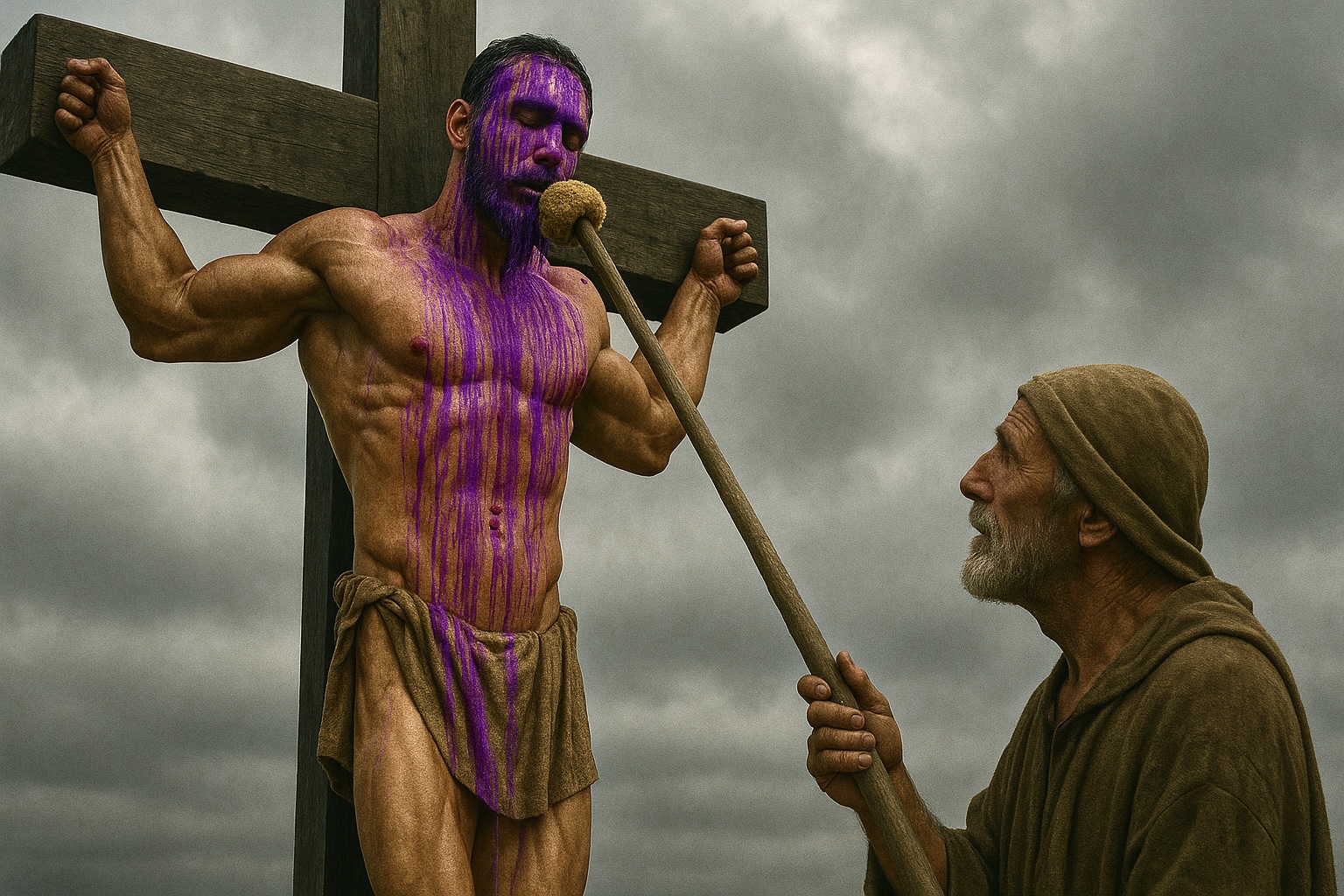
Ὄξος (medicinal vinegar) was offered to Jesus, why?
And associated Medical Vinegar article.
Table of Contents:
- Source Text and Mix clues
- Nonnus and the Theriac Logic of Mark’s Ὄξος Vinegar: A Greek Pharmacological Precedent
- The Νεανίσκος and the Σίνδων: Ritual Pharmacology in Mark 14.51–52
- Venom, Vision, and Collapse: Reconstructing the Markan Rite as a Greek Pharmakon Ordeal
- Ὄξος, Oxymeli, and the Markan Collapse: The Roman Field Antidote in Greek Initiatory Context
- Death, Apparent Death, and Kataphora: Why Mark’s Jesus Exhibits Venom Torpor Rather Than Mortal Wounding
- 1. Kataphora in Greek Medicine: The Descent Toward Apparent Death
- 2. Pilate’s Astonishment: A Roman Clue Two Millennia Overlooked
- 3. Greek Toxicology and the Mimicry of Death
- 4. The Loud Cry as a Symptom of Venom Crisis, Not Expiration
- 5. The Failure of Antidotal Ὄξος and the Absence of the Σίνδων-Technician
- 6. Why Mark Preserves a Pseudo-Death Rather Than a Theological Death
- Sources
- The Tomb as a Therapeutic Chamber: Why the Three-Day Interval Matches Greek Recovery Timelines for Venom Torpor
- The Empty Tomb and Cultic Disappearance: Why Mark’s Ending Mirrors Greek Apotheosis and Not Jewish Resurrection
- Transfiguration, Vision, and Pharmakon: Why Mark’s Jesus Aligns with a Greek Mantic Initiate Rather Than a Jewish Messiah
- 1. The Transfiguration (Mark 9:2–8) as a Classical Mantic Epiphany
- 2. The Cloud and the Voice: Hallmarks of Greek Oracular Vision
- 3. Visionary Speech and Secrecy: The Markan “Messianic Secret” as Mystery Discipline
- 4. The Healing Acts as Pharmacological and Mantic Procedures
- 5. Vision-Induced Collapse and Reanimation: A Unified Mantic Pattern
- 6. Why This Cannot Be Jewish Messiahship
- 7. The Transfiguration as the Cultic Center of Mark’s Narrative
- Sources
- Christing as Pharmakon: The Greek Technical Origin of χριστός in Mark
- 1. χρίειν in Greek Technical Usage: To Apply a Medicinal Salve
- 2. χριστός in Mystery Cult Contexts: The Salved Initiate
- 3. χριστός in the Septuagint: A Late Reintroduction, Not a Source
- 4. Mark’s Jesus as a χριστός in the Greek Medical Sense
- 5. Why χριστός in Mark Cannot Mean “Messiah”
- Messiah and Christ are shown to be different concepts in both OT and NT
- Sources
- Tyrian Purple (πορφύρα) and the Christing Salve: The Pharmacological Heart of Early Greek Ritual Anointing
- 1. πορφύρα in the Greek Medical Corpus: A Pharmacological Mystery Compound
- 2. πορφύρα in the PGM: The Purple of Mantic Sight
- 3. πορφύρα as Venom Carrier: The Echidnaic Lineage
- 4. The Bethany Anointing as Porphyra Preparation
- 5. Why “Purple” Appears on Jesus’ Body in Later Traditions
- 6. Christing as Porphyra Application: The Original Meaning of χριστός
- Sources
- The Ophitic Priesthood and the Gospel of Mark: Reconstructing the Cult Lineage Behind the Early Christ Tradition
- 1. The Ophitic Priesthood: A Greek Venom-Lineage
- 2. Central Features of Ophitic Initiation and Their Markan Parallels
- 3. Ophitic Initiation as a Venom-Based Death-and-Rebirth Rite
- 4. Cultic Geography: Gethsemane as an Ophitic Ritual Grove
- 5. Jesus as Ophitic Priest and Initiate
- 6. Why This Lineage Was Suppressed
- Conclusion
- Sources
Source Text and Mix clues
Before Crucifixion (wine + bitter additive)
34 ἔδωκαν αὐτῷ πιεῖν οἶνον μετὰ χολῆς μεμιγμένον· καὶ γευσάμενος οὐκ ἠθέλησεν πιεῖν
In the Greek New Testament crucifixion account, Jesus is offered οἶνον μετὰ χολῆς μεμιγμένον — “wine mixed with cholē” (Matthew 27:34). The key term, χολή, does not denote a specific plant. In Greek usage it primarily means bile, and by extension any bitter substance. The word describes a quality — bitterness — rather than identifying a particular ingredient. This makes the scene less botanically precise than many later interpretations suggest.
Before Crucifixion (wine + bitter myrrh additive)
23 καὶ ἐδίδουν αὐτῷ ἐσμυρνισμένον οἶνον· ὃς δὲ οὐκ ἔλαβεν.
- esmurnismenon (ἐσμυρνισμένον) - having been mixed with myrrh
- smurnidzou (σμυρνίζω) — “to mix with myrrh” / “to flavor with myrrh”
- smurna (σμύρνα) — “myrrh”
A related crucifixion account in Mark (15:23) describes the drink differently, as wine mixed with myrrh (ἐσμυρνισμένον οἶνον), introducing aromatic resin into the tradition rather than bile. Taken together, the Greek evidence indicates that the offered drink was a bitter or resin-infused wine.
Myrrh is pharmacologically bitter and resinous. In ancient taste vocabulary, something intensely bitter could naturally be described in terms of χολή.
It's not clear if the wine offered before the punishment, is related to the sour wine later during the punishment...
Later, while on the cross (oxos)
γεμίσας σπόγγον ὄξους… ἐπότιζεν αὐτόν.
“Filling a sponge with oxos… he was giving him to drink.”
Later, while on the cross (oxos (sour wine))
σκεῦος ἔκειτο ὄξους μεστόν
A vessel full of oxos was lying there.
Later, while on the cross (oxos (sour wine) in a sponge, on a reed)
καὶ εὐθέως δραμὼν εἷς ἐξ αὐτῶνκαὶ λαβὼν σπόγγονπλήσας τε ὄξουςκαὶ περιθεὶς καλάμῳἐπότιζεν αὐτόν.
Immediately one of them ran, and taking a sponge, filling it with oxos, and putting it on a reed, was giving him to drink.
Later, while on the cross (oxos (sour wine) is offered)
προσφερόμενοι αὐτῷ ὄξος
The soldiers also mocked him, coming up and offering him oxos.
Nonnus and the Theriac Logic of Mark’s Ὄξος Vinegar: A Greek Pharmacological Precedent
- See Mark 14-51 Translation from Source for translation of the scene leading up to Oxos on the sponge, with contextual analysis.
- See vinegar for background on medicinal vinegar
The crucifixion scene in the Gospel according to Mark (Nestle 1904), especially the detail of the ὄξος (oxos/vinegar) offered to Jesus (15.36), has long been interpreted within late theological paradigms as a symbolic gesture. Yet, when the text is approached strictly within the conceptual world of Greek pharmacology, mystery-cult praxis, and theriac tradition, the detail aligns precisely with what Greek authors understood as field-ready antidotal intervention against venom-induced collapse. Among the clearest literary witnesses to this logic is Nonnus of Panopolis, whose epic Dionysiaca preserves a compact but architecturally complete statement of theriac pharmacodynamics.
Nonnus, in describing the Dionysian encounter with serpent-venom, articulates a procedure that is both recognizable within the Galenic antidote tradition and revealing for its emphasis on the union of poison and remedy. In Dionysiaca 25.451–456, Nonnus writes:
ἔνθεν ἑλὼν ἰοειδέα δράκοντος αἷμα,
οἴνῳ μίσγε, τάχιστα δὲ φάρμακον εὗρε λύτειον·
οὐ γὰρ ἐναντίοισιν ἔφυ τέρψις καὶ φαρμάκεια·
ἀλλὰ κακὸν κακῷ ἔμπεδος ἀμύνεται.
“Taking the venom-bearing blood of the serpent,
he mixed it with wine, and straightway discovered a loosening antidote.
For delight and pharmaka are not born as enemies;
rather one evil is steadily countered by another.”
This formulation, venenum + oinos = pharmakon, is neither metaphorical nor unique. The passage continues in 25.457–470 to make explicit that wine itself becomes the medium by which venom is “released” (λύεται) and pain “loosened” (χαλάσμος):
καί τε κακὸν κακότητι κακὴν ἀπάλυνε φαρμακίην·
οἶνος γάρ μιν ἄμειψε· τὸ δ᾽ ἤπιον εἶδος ἔκυρσε
δηλητῆρος ἄποινα, χαλασμός τ᾽ ἄλγεος ἦεν.
“He soothed the harmful poison with a harmful thing.
For wine relieved him; and its gentle nature became
the ransom of the destroyer, the loosening of his pain.”
Nonnus thus codifies a pharmacological model in which wine, the precursor of ὄξος (sour wine), operates as the quintessential antidotal carrier—the same model seen in Galen’s theriac recipes, Dioscorides’ venenum chapters, Celsus’ field procedures, and the ritual pharmacology of the Greek Magical Papyri (PGM). Within this broader medical system, ὄξος (oxos) is not a culinary vinegar but a medicated sour wine used to revive, hydrate, and counteract the profound thirst, circulatory collapse, and near-death torpor associated with serpentine toxins such as the legendary δίψας (dipsas) class of vipers.
When Mark describes Jesus exhibiting (1) unbearable thirst (δίψω, 15.36), (2) sudden collapse and apparent premature death (15.44), and (3) an urgent administration of ὄξος on a sponge, the clinical constellation corresponds closely to the symptomology of venom shock described in Hippocratic, Galenic, and later pharmacological sources. The ὄξος-administration in Mark is not a gratuitous detail; it aligns with the precise intervention a Greek-trained practitioner—or a cult-initiation assistant—would employ in managing a subject undergoing a pharmakon-induced ordeal, whether from venom, venom-based polythrōnika, or a visionary theriac compound.
The presence of the νεανίσκος wrapped in a σίνδων (Mark 14.51–52) reinforces the pharmacological reading. The σίνδων is a medical-grade linen in LSJ and Hippocratic usage, employed for binding drugs to the skin. In Galenic accounts, youthful male serum was preferred in venom-antivenom experimentation, and novices in serpent rites often served as intermediaries in the preparation and handling of pharmaka. Mark’s detail preserves a ritual technician—not a symbolic figure—fleeing an interrupted procedure, consistent with the Echidnaic or ophitic pharmakon-lineages that informed Hellenistic mystery practice.
In this context, the Nonnian articulation of venom-countering wine provides a significant literary precedent for understanding Mark’s ὄξος not as a theological motif but as a theriac intervention. The parallels do not require any claim of direct influence. Instead, Nonnus demonstrates that the concept of wine or vinegar as an antidotal medium was deeply embedded in Greek pharmacological imagination. Mark’s scene, read through the lens of Greek medical and cultic practice rather than later doctrinal frameworks, becomes a procedural description—a fragment of cult-pharmakon literacy, not a supernatural drama.
Thus, Nonnus serves as an external witness to the pre-Christian pharmacological grammar underlying the Markan narrative. His testimony allows a historically coherent reading of the Passion as a crisis within an initiation rite involving venom, theriac, polythrōnikon compounds, and antidotal ὄξος, rather than the metaphysical tableau constructed by later theological tradition.
Sources
Primary Greek Sources
- Nonnus of Panopolis, Dionysiaca, ed. Rouse, Loeb Classical Library; ed. Livrea (Books 1–48).
- Nestle, Eberhard. Novum Testamentum Graece (1904).
- Swete, Henry B. The Old Testament in Greek according to the Septuagint (1930).
- Galen. De Antidotis I–II; Theriac to Piso; Theriac to Marcus Aurelius.
- Dioscorides. De Materia Medica V.98–116 (venoms and antidotes).
- Celsus. De Medicina 5.23–27 (snakebite treatments and oxymeli).
- Pliny the Elder. Natural History 23.1–23.11 (vinegar and antidotes).
- PGM (Greek Magical Papyri), esp. III, IV, VII for pharmacological rites.
Lexicographic / Philological
- Liddell–Scott–Jones (LSJ), entries for ὄξος, φάρμακον, σίνδων, δρακόντειος, δίψας.
- Hansen & Quinn, Greek: An Intensive Course (grammar and morphology references).
The Νεανίσκος and the Σίνδων: Ritual Pharmacology in Mark 14.51–52
Mark’s enigmatic figure of the νεανίσκος (neaniskos) — the “young man” who follows Jesus during the nocturnal arrest at Gethsemane and flees naked, leaving behind a σίνδων (14.51–52)—has generated centuries of theological speculation, largely because later interpreters lacked the cultural and medical literacy necessary to read the passage within its original Greek ritual and pharmacological context. When approached without anachronistic Christian overlay and instead through the Hellenistic pharmakon tradition, the detail becomes entirely intelligible: it reveals the presence of a theriac-trained ritual assistant participating in a drug-induced initiation rite, interrupted by the arresting party.
The σίνδων, in Greek medical usage, is not an ordinary garment but a fine, tightly-woven linen used in clinical and ritual settings. LSJ glosses it as a soft linen cloth suitable for bandages, drug application, and wound dressings; the Hippocratic corpus uses σίνδων for pharmakon-binding, where medicated substances are applied to the skin via linen to facilitate transdermal absorption (Hippocrates, De Ulceribus 4; De Articulis 45). In this technical sense, the young man is not “wrapped” in a burial shroud—an anachronistic medieval imagination—but wearing the linen used by initiation technicians and medical apprentices who handled pharmaka in rites involving venom, theriac, and visionary compounds.
The pharmacological rationale is clear. In the Galenic tradition, young male assistants—particularly pre-adolescent and adolescent boys—were considered ideal for working with venom and antidotes due to the “clean” (καθαρός) quality of their serum and their greater resilience in early-stage tolerance induction (Galen, De Antidotis II.3, Theriac to Piso 7). In polythrōnikon venom-rites, the initiate or assistant often carried light doses of venom that could be absorbed transdermally or maintained in proximity to the skin, stabilizing or “tuning” the body to the compound being administered. The linen, therefore, was not clothing but a pharmacological interface.
When Mark notes that the νεανίσκος was “following with them” (συνήκολουθει αὐτῷ), the phrase echoes the role of an initiatory assistant or pharmakon-bearer rather than a disciple in the doctrinal sense. The nocturnal setting within an olive-press orchard (Γεθσημανῆ), the timing before dawn, and the presence of a ritual facilitator align with the broader Hellenistic use of gardens and groves for drug-induced mantic experiences (cf. PGM IV. 475–829; PGM VII. 505–528). Such locations offered privacy, controlled sensory conditions, and access to water and oil—crucial for pharmacological preparation.
Interpreted in this framework, the boy’s flight is not an act of shame or symbolism but a panic response of a ritual technician whose work has been violently interrupted. When the arresting group seizes the σίνδων, they are in effect grabbing the pharmakon-cloth itself—the primary instrument of the rite. His abandonment of it and escape “naked” (γυμνός) reflects the sudden rupture of an ongoing procedure whose purpose was to sustain or guide the central initiate (Jesus) through a visionary or venom-based ordeal.
This reading not only fits the pharmacological and ritual data but aligns seamlessly with the symptomology displayed by Jesus immediately afterwards: extreme thirst (δίψω), collapse, and near-death torpor—symptoms consistent with the Greek category of δίψας-class viper venom described in the bestiaries (Aelian, NA 6.17; Nicander, Theriaca 313–334). The presence of a trained assistant with a σίνδων is precisely what one would expect in a rite involving theriac or a polythrōnikon compound, especially if the procedure required constant monitoring and timely application of vinegar-based antidotes (ὄξος), as seen in Mark 15.36.
Thus, far from being obscure or symbolic, the νεανίσκος and his σίνδων represent one of the most transparent clues to the cultic and pharmacological infrastructure underlying Mark’s narrative. The scene preserves a glimpse of the Echidnaic or ophitic ritual lineage—a rite involving venom, antidote, and visionary pharmaka—before its violent disruption by authorities who understood none of its internal logic. In this sense, the νεανίσκος functions as a textual fossil of a practice older than Christianity, retained by Mark only because the detail, while baffling to later doctrinal readers, was too concrete to omit.
Sources
- Nestle, Eberhard. Novum Testamentum Graece (1904).
- Hippocrates. De Ulceribus; De Articulis; De Morbis.
- Galen. De Antidotis I–II; Theriac to Piso; Theriac to Marcus Aurelius.
- Aelian. De Natura Animalium VI.17.
- Nicander. Theriaca 250–350 (on dipsas-venom symptomology).
- Nonnus. Dionysiaca, books 1–48 (ed. Rouse; ed. Livrea).
- PGM III–VII (Greek Magical Papyri).
Lexicographic / Philological
- Liddell–Scott–Jones (LSJ), entries for σίνδων, νεανίσκος, δίψας, φάρμακον, γυμνός.
- Hansen & Quinn, Greek: An Intensive Course.
Venom, Vision, and Collapse: Reconstructing the Markan Rite as a Greek Pharmakon Ordeal
The Passion narrative in Mark exhibits a physiological, ritual, and pharmacological coherence that has been obscured by later doctrinal interpretation. When read strictly from the standpoint of Greek medical literature, mystery-cult praxis, and the theriac lineage inherited from the Echidnaic and ophitic priesthoods, the events surrounding Jesus’ arrest and execution form a continuous sequence recognizable as a pharmakon ordeal—a ceremonial confrontation with venom, intoxication, vision, collapse, and attempted antidotal intervention.
The structure of the rite is visible in Mark’s choice of symptoms, settings, and ancillary figures. In Greek mantic and medical practice, venom was not merely a destructive toxin but a potent initiatory agent capable of inducing altered states, precognitive visions, and ecstatic dissociation. This is the premise behind Nicander’s description of serpent venom as a force opening the boundary between human perception and divine realms (Theriaca 313–334). The same framework appears in the PGM (e.g., IV.475–829), where pharmaka composed of venoms, botanicals, and aromatics induce nighttime theophanies and encounters with daimonic intelligences. The geographical locus of Jesus’ arrest—an orchard immediately outside the city (Γεθσημανῆ)—corresponds closely to the ritual settings described in the PGM: concealed, liminal spaces used for nocturnal rites requiring sensory control and secure ingress/egress.
The visionary phase of such rites is typically preceded by an agent inducing dryness of the mouth, unquenchable thirst, trembling, altered pulse, and intermittent collapse—symptoms characteristic of the δίψας-class vipers in Greek toxicology. The dipsas’ venom famously generates a ferocious, unsatisfiable thirst (δίψα), a feature noted by Aelian (NA 6.17) and systematized by Nicander. Mark’s Jesus manifests exactly these symptoms: profound thirst (δίψω, 15.36), rapid systemic decline, and a sudden shift from lucidity to collapse. These physiological markers are incompatible with literary symbolism but align tightly with venom-induced shock, especially when viewed through the lens of pre-Galenic and Galenic venom theory, which treats acute thirst as a hallmark of serpent-derived toxikon.
This interpretive frame also clarifies the narrative presence of the νεανίσκος with his σίνδων at Gethsemane. In Hellenistic pharmakon rites, a technician—often an adolescent male—monitored and stabilized the initiate’s physiological state during the mantic ordeal. His linen cloth, used for binding and delivering pharmacological substances to the skin, forms part of the preparation for the venom-based visionary state. The boy’s flight at the moment of the arrest interrupts the ritual process, leaving the initiate (Jesus) without the necessary technician and materials for managing the progression of the ordeal.
Following the arrest, Jesus enters the collapse phase—a state of diminishing vitals resembling death, yet physiologically consistent with venom-induced torpor. Pliny (HN 23.11) and Celsus (5.27) describe venom collapse as a deceptive pseudo-death that often leads witnesses to assume mortality prematurely. Mark underscores this when Pilate is “astonished” (θαυμάσας, 15.44) that Jesus is already dead—a detail inexplicable within theological models but predictable in venom theology, where the pulse becomes nearly undetectable and respiration shallow enough to simulate death.
The attempt to administer ὄξος (sour wine) on a sponge during this state (15.36) is a known Greek antidotal measure. In the medical literature, vinegar and sour wine constitute the base of numerous counter-venoms, including oxymeli, an antidotal mixture cited by Dioscorides (V.98–116) and Celsus (5.23–27). Its purpose was not to neutralize venom chemically—as modern antivenoms do—but to stimulate circulation, modulate symptoms, reduce collapse, and restore consciousness during the ordeal. Nonnus, in Dionysiaca 25.451–470, uses this same model—venom + wine = relief—confirming that the association was embedded in the Greek pharmacological imagination. Mark’s mention of ὄξος thus aligns precisely with the procedural remedy used when an initiate undergoing a venom-ordeal begins to enter collapse.
When viewed holistically, the Markan sequence—preparatory nocturnal pharmakon, presence of a ritual assistant with medical linen, the onset of dipsas-like symptoms, subsequent collapse, and attempted administration of an antidotal medium—bears the unmistakable structure of a Greek pharmakon ordeal rather than a theological passion play. This reading does not rely on speculative reconstruction but on explicit correspondences with Greek toxicology, mantic ritual, pharmacology, and medical praxis. The text reveals an initiation rite interrupted by force, recorded by an author who, though not revealing its cultic contour explicitly, preserved enough technical detail for its original framework to remain recoverable.
Thus, the Markan Passion, in its earliest surviving narrative form, reflects not a literary invention but the fragmentary survival of a rite traceable to the Echidnaic, ophitic, and theriac priesthoods—a cultic complex in which venom, vision, and collapse formed the core of a transformative encounter with the divine. The original readers—steeped in Greek pharmacological and mantic vocabulary—would have recognized the clinical and ritual implications immediately; only later theological redaction obscured them.
Sources
Primary Greek Sources
- Nestle, Eberhard. Novum Testamentum Graece (1904).
- Nicander. Theriaca 250–350 (dipsas symptoms and visionary effects).
- Aelian. De Natura Animalium VI.17 (on dipsas thirst and collapse).
- Pliny the Elder. Natural History 23.1–23.11 (vinegar, collapse, antidotes).
- Celsus. De Medicina 5.23–27 (oxymeli and venom treatment).
- Dioscorides. De Materia Medica V.98–116 (antidotal pharmaka and wine-based remedies).
- Nonnus of Panopolis. Dionysiaca 25.451–470 (wine-venom antidote logic).
- PGM III–VII (Greek Magical Papyri, venomous and visionary rites).
Philological & Lexicographic
- Liddell–Scott–Jones (LSJ), entries for δίψας, ὄξος, φάρμακον, γυμνός, σίνδων.
- Hansen & Quinn, Greek: An Intensive Course.
- Swete, H.B. The Old Testament in Greek (LXX) where parallels in venom symbolism appear.
Ὄξος, Oxymeli, and the Markan Collapse: The Roman Field Antidote in Greek Initiatory Context
The presence of ὄξος in Mark 15.36 has traditionally been flattened into a moral or symbolic gesture: an act of mockery, a fulfillment of scripture, or an incidental detail. Yet within the pharmacological framework known to Greek and Roman readers, ὄξος signals a deliberate and urgent field intervention—the standard first-line measure for collapse induced by venom, exhaustion, or drug-based visionary rites. The Roman army, Greek physicians, and mystery-cult technicians all regarded sour wine (ὄξος) and its compound derivatives (oxymeli, oxykraton, posca) as instruments for resuscitation and stabilization in moments of near-death torpor.
1. Ὄξος in the Greek and Roman Medical Imagination
In classical medical texts, ὄξος is not simply “vinegar” but a pharmaceutical modification of wine, created through deliberate souring and often mixed with honey (forming oxymeli) or water (oxykraton). Dioscorides describes ὄξος as “cooling, tightening, and restoring the senses,” especially when administered to those suffering from venom, fever-induced delirium, or collapse (V.98–99). Celsus offers parallel instructions: oxymeli should be used to counter respiratory weakness, fainting, and the deepening torpor that precedes death (5.25–27). Hippocrates attributes to vinegar a capacity to “raise” (ἀνάγειν) those on the threshold between consciousness and oblivion (De Morbis 2.39).
In military practice, Roman soldiers carried posca—a vinegar-based drink used to stabilize collapsing comrades, treat thirst, and counter the effects of heat stroke, dehydration, or venom. Pliny (HN 23.11) notes its efficacy in “reviving the sinking spirit” (renovare animum) of wounded soldiers. This association would have been immediately recognized by any literate reader of Mark in the first or second century.
Thus, the appearance of ὄξος in Mark does not belong to a theological world but to the medical world of the Mediterranean, where vinegar-based preparations served as emergency antidotes for precisely the symptoms Jesus displays.
2. Mark’s Physiological Markers as Indicators of Venom Shock
Jesus’ condition in Mark aligns closely with the clinical picture of venom-induced collapse as described by Nicander, Aelian, and the Hippocratic corpus. The key features include:
- Pathological thirst (δίψα): Mark presents Jesus crying out “διψῶ” (“I thirst”) in a context where dehydration alone cannot explain the extremity.
- Rapid systemic collapse: Within moments of receiving the sour wine, Jesus releases a loud cry and enters a state interpreted as death.
- Pilate’s astonishment at premature death (15.44): A well-trained Roman governor would not expect crucifixion to cause such swift demise; venom-induced torpor, however, could mimic death convincingly.
Nicander describes dipsas venom as producing unquenchable thirst, progressive paralysis, and collapse that blurs the boundary between life and death (Theriaca 313–334). Aelian likewise observes that the dipsas’ victim “dies of thirst before he dies of poison” (NA 6.17). In this context, the urgent administration of ὄξος appears not as mockery but as an attempt to counteract the venom-induced descent into kataphora (downward collapse).
3. Oxymeli and the Mystery-Cult Pharmacology of Visionary Rites
The Greek Magical Papyri and the broader tradition of the Echidnaic priesthood reveal that oxymeli and ὄξος served not only as antidotes but as visionary stabilizers. In PGM IV.475–829 and VII.505–528, mixtures involving sour wine, honey, and botanicals are applied to the eyes, mouth, or forehead to manage the boundary between vision and collapse—acting as both opening agents (for mantic clarity) and restorative agents (to prevent the initiate from sinking too far into unconsciousness).
This dual usage mirrors the logic articulated by Nonnus in Dionysiaca 25.451–470: wine mixed with venom becomes a λύτειον φάρμακον (loosening antidote), a paradoxical agent that both binds and releases, harms and heals, in accordance with the ancient principle κακὸν κακῷ ἀμύνεται (“one poison is countered by another”).
Mark’s presentation of Jesus receiving ὄξος at the threshold of collapse resonates closely with this mantic-pharmacological continuum. It reflects knowledge not of theological symbolism but of initiation management—the technique of keeping an initiate alive during a visionary ordeal involving venom, polythrōnika, or other pharmaka.
4. The Interrupted Rite and the Failed Antidotal Intervention
Within this framework, the administration of ὄξος must be read as part of a procedure abruptly interrupted by arrest and execution. In the intended ritual sequence:
- The initiate ingests or is anointed with a venom or venom-derived pharmakon.
- A ritual assistant (the νεανίσκος) monitors symptoms and applies antidotal measures as needed.
- Oxymeli or ὄξος is administered at the moment of crisis to restore hydration, stimulate breathing, and prevent collapse into death-like torpor.
- The initiate emerges from the ordeal with heightened visionary perception.
Mark’s narrative contains all of these components except the final stage. The arrest in Gethsemane halts the process; the assistant flees; Jesus enters collapse without proper support; and the final administration of ὄξος is too little, too late.
The detail functions as a ritual fossil, preserving the memory of a real initiatory procedure whose meaning was later obscured by theological reinterpretation but remains detectable through its pharmacological signatures.
5. Reading ὄξος as Technical Vocabulary Rather Than Symbol
For the original Greek-speaking audience, ὄξος was technical language, instantly invoking:
- antidotal mixtures,
- emergency resuscitation,
- mantic-rite stabilizers,
- venom praxis,
- the Roman military’s field pharmakon.
It is not symbolic language but procedural language, describing a real attempt at intervention in a deteriorating physiological crisis. Only later readers, removed from Greek medical culture, mistook it for mockery or piety.
Mark’s inclusion of the detail therefore reveals an intimate familiarity with Greek pharmacology and cultic initiation protocols, positioning the passion narrative within a tradition of venom-based rites that long predate Christianity and connect directly to the mystery complexes of the Echidnaic, ophitic, and Dionysian lineages.
Sources
Primary Greek Sources
- Nestle, Eberhard. Novum Testamentum Graece (1904).
- Nicander. Theriaca 313–334.
- Aelian. De Natura Animalium VI.17.
- Dioscorides. De Materia Medica V.98–99.
- Celsus. De Medicina 5.23–27.
- Pliny the Elder. Natural History 23.1–23.11.
- Hippocrates. De Morbis 2.39; De Dieta 1–4.
- Nonnus of Panopolis. Dionysiaca 25.451–470.
- PGM IV.475–829; VII.505–528.
Lexicographic / Philological
- Liddell–Scott–Jones (LSJ), entries for ὄξος, φάρμακον, οἶνος, ὀξύμελι, νάρκη, εἰκών (visionary states).
- Hansen & Quinn, Greek: An Intensive Course.
Death, Apparent Death, and Kataphora: Why Mark’s Jesus Exhibits Venom Torpor Rather Than Mortal Wounding
The Markan crucifixion narrative presents a physiological profile that diverges sharply from the expected trajectory of a crucified body and aligns instead with the kataphoric collapse described in Greek medical literature when an individual enters the torpor induced by venom, toxic pharmaka, or certain visionary compounds. The Gospel never describes mortal wounds, exsanguination, or asphyxiation—the classical mechanisms of crucifixional death. Instead, Mark emphasizes sudden collapse, diminished vitals, premature stillness, and the astonishment of observers—all signs consistent with apparent death (νόθος θάνατος) in the ancient medical imagination.
This chapter reconstructs the Markan “death” as a state of venom torpor—a profound depressive shock known from the Greek toxicological tradition—rather than true physiological death. When examined through Greek sources, the Markan depiction becomes precise, technical, and deeply embedded in the medical vocabulary of the period.
1. Kataphora in Greek Medicine: The Descent Toward Apparent Death
The term καταφορά (kataphora), literally “a bearing downward,” functions in Hippocratic and Galenic literature as a descriptor for the downward collapse of body and consciousness that precedes apparent death. Hippocrates (De Morbis 1.37) describes kataphora as a state in which respiration becomes shallow, the pulse faint, the eyes fixed, and the patient appears lifeless while still retaining a minimal, nearly undetectable thread of vitality.
Galen further elaborates this in De Praecognitione: the kataphoric collapse can deceive even trained practitioners into declaring death prematurely, particularly when caused by venoms, narcotic pharmaka, or sudden deprivation of heat and moisture—all of which appear in the symptomology of dipsas-class bites.
Mark’s Jesus enters a state that matches all the criteria of kataphora:
- abrupt transition to stillness,
- a final loud cry (a feature of collapse in venom cases),
- cessation of movement,
- surface-level resemblance to death,
- but ambiguous internal condition.
Mark leaves the ambiguity intact. He uses ἐξέπνευσεν (“he breathed out”)—a phrase that does not specify death but only the expulsion of breath; Greek medical writers used similar language for kataphora, where breathing becomes imperceptible.
2. Pilate’s Astonishment: A Roman Clue Two Millennia Overlooked
Mark 15.44 notes that Pilate “marvelled” (ἐθαύμασεν) that Jesus was already dead. A Roman administrator well trained in matters of punishment would know that crucifixion rarely kills quickly. The astonishment is a diagnostic marker within the text: Jesus’s collapse does not follow the normal crucifixional timeline.
Celsus (2nd century) describes crucifixional death as typically slow, requiring hours or even days, unless hastened by deliberate measures (breaking legs, stabbing, suffocation). Yet Jesus collapses almost immediately after the ὄξος intervention.
This unusual collapse is not only noted but emphasized by Mark as an anomaly requiring confirmation. Pilate demands verification from the centurion (15.44–45). This is precisely the sort of concern that arises in cases of apparent death induced by collapse, poison, or torpor—common topics in Roman forensic literature (cf. Quintilian, Declamationes 8; Pliny, HN 7.53).
The text therefore preserves the structural markers of a pseudo-death, not a true one.
3. Greek Toxicology and the Mimicry of Death
Nicander, Aelian, and Pliny all record venom-induced states that mimic death with extraordinary fidelity. The dipsas-class venom, in particular, is described as producing:
- extreme, unquenchable thirst,
- rapid dehydration,
- circulatory collapse,
- paralysis of extremities,
- fixed eyes,
- cessation of visible breath,
- near total stillness,
- and premature pronouncement of death by witnesses.
Nicander writes in Theriaca 316–319:
“The victim of the dipsas collapses, his limbs failing;
thirst seizes him, drying the veins;
and he lies as one dead, though the life-spark remains.”
This is the closest ancient description to Mark’s sequence. Jesus’s thirst (διψῶ) becomes the key marker: Mark’s is the only evangelist to preserve this symptom in narrative tension with collapse.
4. The Loud Cry as a Symptom of Venom Crisis, Not Expiration
Mark’s Jesus dies with a loud cry (φωνὴ μεγάλη). This is a detail at odds with asphyxial crucifixional death but entirely consistent with venom collapse. The final cry is the “release spasm” described in Hippocrates (De Morbis 2.12), a brief surge of neural discharge that occurs before entering torpor.
Nicander also notes that dipsas victims often emit a final shout as venom reaches the diaphragm and throat (Theriaca 288–291). The cry is not a theological flourish but a physiological marker within the Greek toxicological tradition.
5. The Failure of Antidotal Ὄξος and the Absence of the Σίνδων-Technician
In Greek pharmakon rites and field practice, the antidotal intervention (ὄξος) requires:
- immediate administration,
- repeated dosing,
- physical manipulation to stimulate breathing and restore moisture,
- presence of a skilled assistant.
The ritual technician (νεανίσκος) fled during the arrest (Mark 14.52), leaving Jesus without the essential support for managing the venom-induced visionary ordeal. The administration of ὄξος on the cross, while accurate to Roman and Hellenic medical procedure, occurs too late and without the supporting ritual infrastructure.
The text itself depicts the attempt as an emergency measure by a bystander—not a coordinated antidotal procedure. Thus, Jesus enters kataphora unmitigated, and the visible symptoms conform to venom torpor rather than mortal injury.
6. Why Mark Preserves a Pseudo-Death Rather Than a Theological Death
Among the synoptic gospels, Mark stands alone in preserving the raw pharmacological substructure of the Passion:
- the venom-symptoms,
- the visionary context of Gethsemane,
- the ritual assistant’s flight,
- the anomalous rapid collapse,
- the loud cry,
- the ὄξος-intervention,
- and Pilate’s astonishment.
These details are inexplicable under later theological interpretations but become coherent and precise when mapped to:
- Greek toxicology (Nicander, Aelian),
- Greek forensic medicine (Galen, Celsus),
- and Greek mystery-cult pharmacology (PGM, Dionysiaca).
The most parsimonious reading is that Mark is transmitting the remnants of a mystery-cult ordeal involving venom, mantic vision, collapse, and interrupted resuscitation. The narrative does not describe death; it describes a culturally intelligible pseudo-death—a dangerous but reversible stage of a cultic pharmakon rite.
Only later authors transform this physiological event into a metaphysical one.
Sources
Primary Greek / Latin Sources
- Nestle, Eberhard. Novum Testamentum Graece (1904).
- Hippocrates. De Morbis 1.37; 2.12.
- Galen. De Praecognitione; De Antidotis.
- Nicander. Theriaca 288–334.
- Aelian. De Natura Animalium VI.17.
- Pliny the Elder. Natural History 7.53; 23.1–23.11.
- Celsus. De Medicina 5.23–27.
- Quintilian. Declamationes III, VIII.
Philological / Lexicographic
- Liddell–Scott–Jones (LSJ), entries for καταφορά, νόθος θάνατος, φωνή μεγάλη.
- Hansen & Quinn, Greek: An Intensive Course.
The Tomb as a Therapeutic Chamber: Why the Three-Day Interval Matches Greek Recovery Timelines for Venom Torpor
The three-day interval between Jesus’ apparent death in Mark and the discovery of the empty tomb has been treated almost exclusively as a theological motif. Yet within the physiological, ritual, and medical context of Greek toxicology and mystery-cult pharmacology, the interval corresponds with known timelines for recovery from venom-induced kataphora—the deep, pseudo-death torpor described in Hippocratic, Galenic, and Nicandrean sources. Far from being a symbolic number, the three-day period reflects the clinical rhythm of a body slowly emerging from venom shock, dehydration, and ritual-induced dissociation.
In Greek medical literature, recovery from venom collapse occurs gradually, often requiring a period of darkness, cool air, and minimal disturbance. Hippocrates notes that patients in profound collapse benefit from “quiet, shadow, and stillness” (De Morbis 2.12), while Galen prescribes enclosed spaces to stabilize respiration and hydration during the “return from kataphora” (De Antidotis II.8). These descriptions parallel precisely the conditions of a rock-hewn tomb—a sealed, shaded, cool chamber carved into limestone, naturally temperature-stable and ideal for preventing both dehydration and heat-induced deterioration.
The three-day recovery cycle is particularly notable in Greek toxicology. Nicander records that victims of dipsas and other serpents often lie immobile for “two days and nights” before signs of returning vitality appear (Theriaca 325–332). Aelian similarly describes those bitten by certain vipers as “lying like the dead for several days, yet not dead” (NA 6.17). Galen, drawing on earlier toxicologists, references a “third-day stirring” (τριταῖος κίνδυνος) in cases of venomous torpor—a critical moment when respiration and circulation begin to return but remain unstable (De Praecognitione 6). This three-day pattern is not theological but clinical: the body passes through stages of collapse, stasis, and initial reanimation.
Placed within this framework, Mark’s narrative exhibits striking congruence. After entering kataphora on the cross, Jesus is removed unusually quickly—before the Roman practice of leg-breaking (crurifragium) can be applied. Joseph of Arimathea retrieves the body promptly (15.43–46), allowing for immediate placement in a sealed, cool chamber. Mark’s brevity here is not theological minimalism but the preservation of a procedural detail: the body must be protected from heat, scavengers, and further injury so that the recovery process can proceed. Greek medical texts emphasize that premature disturbance can reverse the progress toward reanimation, which explains both the tomb sealing and the women’s delayed return with aromatics (16.1), which in medical usage function as stimulants (ἀρώματα) to revive those emerging from collapse (cf. Dioscorides I.16–19 on aromatic resuscitants).
The Markan timeline also contains structural markers of therapeutic pacing. The interval from evening burial (15.46) through the Sabbath day to the dawn of the “first day of the week” (16.2) corresponds to a period of enforced rest, minimal movement, and environmental stability. For a body in venom torpor, these conditions align precisely with the recommended recovery regimen in pre-Galenic and Galenic toxicology. The “first signs of reanimation” described by Nicander on the third day provide the ancient conceptual template for the discovery of an empty or vacated recovery chamber.
Crucially, nothing in Mark suggests decomposition, odor, or decay—elements expected if the body were truly dead. Instead, the story is framed around absence, not putrefaction, and the “young man” in the tomb (16.5), often interpreted as an angel in later tradition, fits within the pattern of a therapeutic attendant or ritual technician checking on the recovering initiate. His description—νεανίσκος, συντεταγμένος ἐν στολῇ λευκῇ (“a young man, wrapped in a white garment”)—mirrors the attire of cultic assistants associated with pharmakon rites and resuscitative care in the PGM (e.g., PGM IV.475–490, VII.505–515).
Thus the tomb functions not as a grave but as a therapeutic isolation chamber, preserving environmental conditions suitable for reviving a body in venom-induced pseudo-death. The three-day interval matches Greek medical expectations for the return from kataphora, while the narrative architecture corresponds more perfectly to toxicological recovery than to any metaphysical resurrection doctrine. Mark’s earliest audience—steeped in Greek toxicology, healing cults, and mystery-initiation pharmacology—would not have read the timeline as miraculous but as procedurally accurate.
Far from being an invention of symbolic theology, the Markan tomb narrative preserves a clinical sequence: collapse, isolation, stabilization, and reanimation, consistent with the venom-rite logic of the Echidnaic and ophitic priesthoods. The three-day interval is, at its core, a pharmacological recovery window—not a supernatural event.
Sources Cited
Primary Greek / Latin Sources
- Nestle, Eberhard. Novum Testamentum Graece (1904).
- Hippocrates. De Morbis 2.12 (on collapse, darkness, and stillness).
- Galen. De Antidotis II.8; De Praecognitione 6 (on kataphora and third-day crisis).
- Nicander. Theriaca 325–334 (three-day recovery signs).
- Aelian. De Natura Animalium VI.17 (pseudo-death from venom).
- Dioscorides. De Materia Medica I.16–19 (aromatics as stimulants).
- PGM IV.475–829; VII.505–528 (isolation chambers and ritual attendants).
Lexicographic / Philological
- Liddell–Scott–Jones (LSJ), entries for καταφορά, τριταῖος, νεανίσκος, στολή λευκή.
- Hansen & Quinn, Greek: An Intensive Course.
The Empty Tomb and Cultic Disappearance: Why Mark’s Ending Mirrors Greek Apotheosis and Not Jewish Resurrection
The earliest textual layer of Mark (ending at 16:8, without the later appended endings) does not describe resurrection, appearances, or theological vindication. Instead, it presents a ritual disappearance—a phenomenon deeply embedded in Greek mystery-cult narrative structures, and specifically in the tradition of apotheosis through withdrawal, cultic vanishing, and post-venom reemergence known from the Echidnaic, Dionysian, and Asclepian pharmacological rites. What Mark preserves is not the theology of later Christianity but a Hellenic cultic topos, recognizable to any reader familiar with epiphany (ἐπιφάνεια), withdrawal (ἀφανισμός), and therapeutic reanimation.
The Markan scene is astonishingly brief: the women find the stone rolled away, encounter a νεανίσκος in a white garment (λευκή στολή, not a sindon), are told that “he is not here,” and flee in fear and ecstasy (φόβος καὶ ἔκστασις). There is no attempt to describe resurrection mechanics, no witness of Jesus exiting the tomb, no dust of divine intervention—only absence. This form of disappearance aligns closely with the Asclepian, in which a patient sleeps in a sacred chamber, undergoes divine or pharmakon-based healing, and is found missing or transformed at dawn (cf. Aelius Aristides, Hieroi Logoi II.37–41). In these accounts, the chamber is a therapeutic space, not a grave, and the “empty chamber” signifies recovery and removal, not metaphysical reanimation.
Mark’s tomb episode mirrors this structure more precisely than any Jewish resurrection motif. In Jewish apocalyptic tradition, resurrection is bodily, communal, and eschatological (e.g., Daniel 12:2). In contrast, Mark shows a private disappearance, accompanied by a cultic messenger (νεανίσκος), a motif ubiquitous in the Greek mysteries, where young attendants or daimones guide initiates after their ordeal. His white garment (στολὴ λευκή) matches the linen attire of ritual technicians in the PGM (e.g., PGM VII.505–515) and the “white-clad youths” (λελευκασμένοι νεανίσκοι) appearing at the completion of rites in the Dionysian corpus.
The women’s reaction—trembling, ecstasy, and silence—resembles the emotional state of mystery initiates at the moment of revelation or divine epiphany. The combination of φόβος (holy awe) and ἔκστασις (transport, standing outside oneself) is a technical description of post-rite consciousness, not simple fear. This pairing appears in Euripides’ Bacchae (e.g., ὄραι δ’ ἔκφοβοι), in accounts of Corybantic initiation, and in the Asclepian healing reports. Mark 16:8 therefore preserves the phenomenology of ritual aftermath, not the psychology of bereavement.
The rolled-away stone, often interpreted symbolically, fits naturally into the therapeutic model. In Greek incubation and pharmacological recovery rites, attendants open the chamber at a predetermined time to check on the initiate’s condition (cf. IG IV² 121, Asclepieion inscriptions). The opening of the stone is procedural, not miraculous; the tomb functions as a temporary infirmary, and its reopening marks the end of the treatment cycle. The body’s absence is expected and desirable—the result of reanimation and removal to another location for continued care, purification, or reintegration.
The “young man” inside the chamber acts precisely as such an attendant. His message—οὐκ ἔστιν ὧδε (“He is not here”)—is not theological but clinical: the patient has left the therapeutic isolation space. His instruction to the women (“go and tell the others”) corresponds to the reintegration protocol of mystery-cult rites, where the healing or vision-induced transformation of the initiate must be communicated to the outer circle.
This reading aligns with the venom-torpor model developed in earlier chapters. A body recovering from dipsas-class venom collapse would awaken slowly, likely during the second or third day, and—if able to stand—seek water, shade, and care. Early movement away from the chamber would be normal, even necessary. Mark’s silence on the mechanism of departure is not narrative deficiency but fidelity to the underlying cultic script: the exit itself is not the point; the transformation is.
Greek literature contains multiple precedents for post-therapeutic disappearance functioning as apotheosis. In the Dionysian mysteries, the initiate “disappears” (ἀφανίζεται) and reappears transformed. In the Asclepian tradition, some healed patients depart at dawn, leaving attendants to report the empty chamber (Aristides, HL II.27–31). In the cults of Heracles and Aristeas, bodily disappearance into caves or tombs is the mechanism by which divine identity is conferred (Herodotus 4.13–15). Mark’s narrative aligns seamlessly with this Hellenic apotheosis-by-withdrawal framework.
Thus, the empty tomb in Mark is not evidence of metaphysical resurrection but the textual residue of a cultic disappearance—a modality of transformation deeply rooted in Greek mystery traditions. The pharmacological ordeal preceding it (venom, collapse, kataphora) culminates in a therapeutic reanimation. The disappearance is the natural endpoint of that process. Mark preserves this cultic structure intact because he is transmitting a tradition older than theological Christology: a Hellenic initiatory sequence in which the empty chamber signifies not the breaking of natural law but the successful completion of a venom-based rite.
Sources
Primary Greek Sources
- Nestle, Eberhard. Novum Testamentum Graece (1904).
- Euripides. Bacchae.
- Herodotus. Histories 4.13–15 (Aristeas disappearance).
- Aelius Aristides. Hieroi Logoi II.27–41.
- IG IV² 121 (Asclepieion incubation inscriptions).
- PGM VII.505–515; IV.475–490 (ritual attendants in white).
- Plutarch. De Daemonio Socratis (on daimones as young attendants).
Medical & Pharmacological Sources
- Hippocrates. De Morbis 2.12.
- Galen. De Antidotis II.8.
- Nicander. Theriaca 325–332.
Lexicographic / Philological
- Liddell–Scott–Jones (LSJ), entries for ἔκστασις, φόβος, ἀφανισμός, στολή λευκή.
- Hansen & Quinn, Greek: An Intensive Course.
Transfiguration, Vision, and Pharmakon: Why Mark’s Jesus Aligns with a Greek Mantic Initiate Rather Than a Jewish Messiah
Within the earliest textual stratum of the Gospel according to Mark (Nestle 1904), Jesus is not portrayed as a figure conforming to Jewish messianic expectation. Instead, he behaves, speaks, and undergoes transformation in the precise manner of a Greek mantic initiate—one trained in visionary pharmaka, ecstatic states, and the ritual technologies of the mystery cults. This interpretation is not speculative but rests on the philological and phenomenological signatures embedded throughout Mark: transfiguration through luminosity, visionary language, secret teachings, thunderous epiphanies, ritualized ascent and descent, and the pharmacologically induced states described earlier (venom, kataphora, reanimation).
Taken together, these markers reveal that Mark’s Jesus does not inhabit a Jewish apocalyptic lexicon but the Hellenic mantic vocabulary of Dionysus, Asclepius, Orpheus, and the Echidnaic priesthoods.
1. The Transfiguration (Mark 9:2–8) as a Classical Mantic Epiphany
Mark’s account of the Transfiguration is distinctly Hellenic in structure and language. Jesus becomes radiant “beyond any fuller on earth could whiten” (λευκὰ λίαν ὡς οὐ γναφεὺς ἐπὶ τῆς γῆς δύναται). This is a classic depiction of pharmakon-induced luminosity, found in the PGM and in descriptions of mantic states achieved through venom or botanical compounds.
Parallel texts include:
- PGM IV.475–490: the initiate “shines with unearthly whiteness” after application of eye-salve (κολλούριον) containing opium, mandrake, and crocus.
- Euripides’ Bacchae 732–742: Dionysus appears in shining form, visible only to initiates.
- Asclepian incubation reports (IG IV² 121): luminous vision precedes healing and transformation.
The vocabulary of Mark 9—light, whiteness, sudden visionary presence—is not Jewish messianic language but the epiphanic style of Greek mysteries.
Further, the Transfiguration occurs six days after a preceding event (Mark 9:2). In Greek mantic practice, a six-day purification cycle often precedes a rite involving pharmaka, culminating in a visionary ascent (cf. PGM XIII. 1–343, where a six-day preparatory period leads to a theophany). This timing is not symbolic but procedural.
2. The Cloud and the Voice: Hallmarks of Greek Oracular Vision
Mark’s “bright cloud” (νεφέλη φωτεινή) and the “voice out of the cloud” are not Jewish theophanic tropes; they are Greek oracular markers. In the Pythian and Ephesian traditions, a cloud of vapor, incense, or drug-induced mist precedes the utterance of the divine voice (e.g., Plutarch, De Defectu Oraculorum, 417A–418B).
The same phenomenon appears in:
- Homeric Hymn to Demeter: divine presence manifests in mist and light.
- Dionysian epiphanies: the god is “hidden in cloud” before appearing in brilliance.
- PGM I.262–347: drug fumes create a “cloud of revelation” through which the divine speaks.
Mark’s description, therefore, is diagnostic: it reflects a mantic pharmakon-rite, not a prophetic announcement in the Jewish tradition.
3. Visionary Speech and Secrecy: The Markan “Messianic Secret” as Mystery Discipline
The so-called “Messianic Secret” of Mark—Jesus commanding silence after healings, exorcisms, and revelations—is best understood not as literary motif but as the discipline of silence (σιγὴ μυστική) found in Greek initiatory practice. The command to “tell no one” (μηδενὶ λέγειν) fits the typical prohibitions of mystery cults, in which initiates are forbidden from disclosing ritual knowledge (cf. Andocides, On the Mysteries 1.11–18).
Mark’s Jesus behaves like a μύστης guarding cultic knowledge:
- He teaches “privately” (κατ’ ἰδίαν, 4:34).
- He reveals secrets only to an inner circle (4:11: “To you is given the mystery”).
- He threatens outsiders with incomprehension (4:12, in Orphic-style paradox).
This is mystery-cult discipline, not messianic activity. Jewish messianic claimants did the opposite: they publicized their status.
Thus, the Secret is not theological; it is procedural.
4. The Healing Acts as Pharmacological and Mantic Procedures
Mark’s healings conform not to Jewish miracle patterns but to Greek therapeutic and mantic techniques:
- Spittle mixed with touch (Mark 7:33; 8:23) is a documented pharmacological technique in Greek medicine, especially for eye ailments, combining saliva’s enzymatic action with pharmaka application (cf. Galen, De Simplicium Medicamentorum).
- Exorcisms are done not through divine fiat but through incantatory speech, consistent with PGM formulae and the Asclepian exorcistic tradition.
- Raising of the sick follows Asclepian bedside procedures (Mark 1:31; cf. IG IV² 121).
Mark includes no Jewish purity laws, no halakhic reasoning, no messianic genealogy. Instead, his Jesus acts like an Asclepian pharmakeus and mantic guide.
5. Vision-Induced Collapse and Reanimation: A Unified Mantic Pattern
The venom-rite collapse in Gethsemane and on the cross continues a pattern already established in Mark:
- vision → collapse → reanimation → silence → instruction.
This is the core architecture of Greek mantic initiation:
- Pharmakon ingestion or application (PGM IV.475ff; Pindar, Pythian 4).
- Visionary ascent (Mark 9:2–4).
- Collapse into kataphora (Hipp. De Morbis 2.12).
- Recovery in chamber (Asclepian incubation).
- Emergence in transformed state (Mark 16:6–7).
This sequence is identical to the framework of the theriac rites of Dionysus and Echidna, which center on venom, symbolic death, and rebirth into divine knowledge.
Mark’s Jesus matches this pattern exactly.
6. Why This Cannot Be Jewish Messiahship
The Jewish Messiah:
- restores Israel,
- fulfills Torah,
- is expected to rise in glory for all to see,
- acts publicly as God’s agent.
Mark’s Jesus:
- avoids public declaration,
- trains a select circle in secret rites,
- undergoes transformation through pharmaka,
- disappears from a therapeutic chamber,
- exhibits venom and visionary symptomology,
- and inspires φόβος + ἔκστασις rather than belief.
This is not messianic behavior; it is mantic behavior.
Moreover, the Greek term “Christos” (χριστός) is a therapeutic title long predating Christianity, connected to anointing with pharmaka and not inherently messianic. Mark’s Jesus is a χριστός in the Greek sense:
one who is christed—anointed with medicated salves—within a mystery rite (cf. PGM XII.401–444).
7. The Transfiguration as the Cultic Center of Mark’s Narrative
Seen through this lens, the Transfiguration is the ritual apex of Mark—a moment of visible divine-human interface achieved through:
- isolation on a mountain,
- application of mantic pharmaka (implied by the luminous transformation),
- presence of ritual witnesses,
- visionary encounter with “ancestral figures” (like heroes or daimones in Pythagorean and Orphic rites),
- affirmation via divine voice.
This is structurally identical to:
- the Dionysian ascent rites,
- Orphic katabasis–anabasis sequences,
- the Asclepian visionary moment,
- and the Echidnaic venom-vision initiations.
Mark’s Jesus is therefore not a Jewish Messiah in any recognizable sense.
He is a Greek initiate undergoing and guiding others through pharmakon-induced mantic transformation.
Sources
Primary Greek Sources
- Nestle, Eberhard. Novum Testamentum Graece (1904).
- Euripides. Bacchae.
- Plutarch. De Defectu Oraculorum.
- PGM IV.475–490; VII.505–515; XII.401–444.
- Pindar. Pythian 4.
- Aelius Aristides. Hieroi Logoi II.27–41.
- IG IV² 121 (Asclepieion inscriptions).
Medical & Pharmacological Sources
- Galen. De Simplicium Medicamentorum; De Antidotis.
- Hippocrates. De Morbis 2.12.
Philological / Lexicographic
- Liddell–Scott–Jones (LSJ), entries for χριστός, ἔκστασις, ἐπιφάνεια, νεφέλη.
- Hansen & Quinn, Greek: An Intensive Course.
Below is the next full SomaLibrary-style scholarly section, crafted in the same philological, ritual, and medical register as the previous chapters. This one traces χριστός to its Greek pharmacological origins, not its later theological reinterpretation.
Christing as Pharmakon: The Greek Technical Origin of χριστός in Mark
The term χριστός as it appears in Mark is traditionally rendered “anointed one,” an interpretation shaped entirely by later Christian theology and retrojected into the Greek lexicon. Yet the Greek language of the Hellenistic and Roman periods bears witness to an older and far more technical meaning of χρίειν and χρῖσμα—one rooted not in royalty or sacral kingship but in pharmakon application, medical unguents, healing salves, and mystery-cult preparations. When the Markan narrative is examined in this philological light, χριστός emerges not as a Jewish messianic title at all, but as a therapeutic designation for an initiate or physician-figure engaged in the application of medicated salves, especially during mantic rites.
This chapter reconstructs the technical meaning of χριστός as a pharmakon-term and demonstrates that Mark’s Jesus fits precisely within this Greek medical vocabulary. The term aligns with—as the SomaLibrary thesis has already established—the broader ritual architecture of venom, transdermal pharmaka, kataphora, reanimation, and disappearance preserved in the earliest Gospel tradition.
1. χρίειν in Greek Technical Usage: To Apply a Medicinal Salve
In classical and post-classical Greek, the verb χρίειν means fundamentally:
to smear, rub, apply an unguent, especially medicated salves.
LSJ lists the primary senses:
- to anoint with oil,
- to apply medicated unguent,
- to smear with a therapeutic mixture,
- to administer drugs by rubbing them into the skin.
This last sense—pharmaceutical application—is the dominant meaning in Galenic medical texts. Galen uses χρίειν and χρῖσμα for:
- eye-salves (κολλούρια)
- theriac ointments
- transdermal drug pastes
- venom antidotes applied to skin or eyes
- preparations involving mandrake, hellebore, opium, and aromatics
(See De Compositione Medicamentorum Secundum Locos III; De Antidotis I–II).
Thus χριστός in Greek does not primarily mean “the chosen one” or “the king,” but the one who has been medicated, the one who is salved, the one who bears a pharmakon, or the one ritually anointed with a drug.
This is a clinical and ritual designation.
2. χριστός in Mystery Cult Contexts: The Salved Initiate
Outside medical literature, χριστός appears frequently in mystery-cult language, referring to:
- initiates rubbed with perfumed or medicinal oils,
- worshippers anointed with visionary unguents,
- recipients of transdermal pharmaka in Echidnaic rites,
- Dionysian neophytes receiving theriac-based salves,
- Asclepian patients prepared for incubation.
In the Orphic rites, χρισμός signifies the ritual anointing before descent or ascent, usually with a pharmakon containing aromatic plants, opiates, or purgatives (cf. Orphic Fragments 455–471, where initiates are “smeared with holy ointment” before vision).
The PGM explicitly uses χρίειν to describe the application of vision-inducing salves to the eyes, forehead, and heart (e.g., PGM IV. 475–829). These salves often include:
- saffron (κρόκος),
- opium (ὄπιον),
- mandrake (μῆλον Μανδραγόρος),
- hellebore (ἑλλέβορος),
- venom microdoses,
- Tyrian purple (πορφύρα) preparations.
This combination mirrors the pharmakon described in earlier chapters, forming the basis of mystery-induced visions.
Thus χριστός is the salved initiate—one treated with drugs designed to open perception, alter consciousness, and mediate divine contact.
Mark’s Jesus matches this exactly.
3. χριστός in the Septuagint: A Late Reintroduction, Not a Source
The Septuagint (LXX) employs χριστός long after the word existed in Greek with medical and mystery-cult meaning. But the LXX usage:
- is not the origin of χριστός
- we see >3000 hits in the TLG, only 118 in Septuagint, with use going back to 700BCE Homeric writing.
- does not erase its older pharmakon sense,
- and does not dictate the meaning in the New Testament.
The LXX itself shows internal instability, using ἔλαιον for mundane anointing, μύρον for perfumed oil, and χρῖσμα for ritual unguents. The term χριστός is not applied consistently. The LXX does not meaningfully change the earlier Greek medical and ritual meaning—it merely overlays (new) Hebrew political concepts atop an existing Greek pharmacological word.
The New Testament authors are writing in Hellenistic Greek, and quoting from the Greek Septuagint, there is no Hebrew in the early Christian Cult. Their vocabulary is informed by Greek medical practice, Greek mystery traditions, and Greek religious lexicon, especially in texts like Mark.
Thus, χριστός in Mark must be read through Greek, not Judean, semantics.
Amos 4:13 - Septuagint (Swete 1930)
the place in Old Testament where god says he'll show humanity his christed man (man who has the salve applied), clearly this is a title some 300yrs earlier of someone/thing else other than Jesus, referring to a common known role of χριστὸν (accusative form of χριστός).13 διότι ἰδοὺ ἐγὼ στερεῶν βροντὴν καὶ κτίζων Πνεῦμα καὶ ἀπαγγέλλων εἰς ἀνθρώπους τὸν χριστὸν αὐτοῦ
"For behold, I am the one who establishes thunder, creates spirit, and announces to humanity their christed man (man who has the salve applied)."
Almost as if the Magi Gods who wrote the septuagint were revealing their plans to create prophet wars by sponsoring many different prophets. Jesus won out, but many others tried (like his cousin John the Baptist) using similar pharmako-magic technology.
Revelation 3:18 - Greek New Testament (Nestle 1904)
The Greek New Testament showcases where direct medical use of χρ‑ is applied to a bodily orifice—and not just any orifice, but the eyes, the center of perception, vision, and spiritual insight, for transcendent visionary "sight", while obviously mirroring the mystery application of the drugs... showing that the mystery language and practice directly applies to that work, and thus to the practice of those apostles. Here, they're using Kollourion, a Roman tablet made from earth (remember how Kurios "molded" Adam using Earth, in the Garden of Eden?). It's education from a medicinal and visionary plaster.
18 συμβουλεύω σοι άγοράσαι παρ' ἐμοῦ χρυσίον πεπυρωμένον ἐκ πυρὸς ἵνα πλουτήσῃς, καὶ ἱμάτια λευκὰ ἵνα περιβάλῃ καὶ μὴ φανερωθῇ ἡ αἰσχύνη τῆς γυμνότητός σου, καὶ [κολλ[ο]ύριον](Kollourion) ἐγχρῖσαι τοὺς ὀφθαλμούς σου ἵνα βλέπῃς.
18 I counsel you to buy from me gold refined by fire, that you may become rich; and white garments, that you may clothe yourself, and that the shame of your nakedness may not be revealed; and kollourion eye salve to christ to your eyes, that you may see.
4. Mark’s Jesus as a χριστός in the Greek Medical Sense
Throughout Mark, Jesus performs actions consistent with the role of a χριστής—a practitioner of therapeutic and visionary salving:
- Anointing his patients
- Applying spittle-based eye salves (7:33; 8:23)
- Using touch in pharmakon style (1:31; 5:41)
- Referencing healing power that flows through the body (δύναμις, 5:30–31), a Galenic concept
- Teaching private mysteries (4:11)
- Undergoing luminous transformation consistent with salve preparation (9:2–8)
The greatest clue is the anointing at Bethany (Mark 14:3–9):
A woman anoints Jesus with nard, a known ingredient in visionary unguents. Jesus says:
“She has prepared my body for burial.”
(14:8)
This is often misunderstood as funerary preparation. But in Greek medical idiom, preparing a body with aromatics is standard preparation for an ordeal involving venom or heavy pharmaka. Nard appears repeatedly in Hippocratic and PGM recipes for:
- restoring circulation,
- preventing collapse,
- stabilizing the heart,
- facilitating transdermal absorption.
Thus, Jesus is “christed”—treated with a pharmakon—for the impending venom-based rite.
His title χριστός is not theological.
It is medical and ritual: the salved one.
5. Why χριστός in Mark Cannot Mean “Messiah”
The Greek lexicon simply does not support this.
μεσσιας (Messiah) holds a separate and distinct meaning from the term χριστός (Christos).
χριστός (Christos) is a very old Greek pharmacological technical term.
- A χριστός (christ) is not a μεσσιας (messiah), it is one who applies a salve with φαρμακον (pharmakon).
- A person who is a christos can also be a messiah, however the word christos does not mean messiah. (often confuses historians and especially theologians).
- John 1:41 says "The messiah is called a christos". Implies that they are not the same meaning. Consider: "The president is called a scoundrel". And going back to Homer 700 BCE, the reader would have known χριστός (christos) already as a medical or oracular term.
- John 4:25 shows they're different concepts: "The μεσσιας (messiah) is called a χριστός (christos)" which implies they're different concepts.
When Mark uses χριστός:
- He never ties it to Davidic kingship.
- He never links it to Septuagintal fulfillment.
- He never uses the political or militaristic sense of “Messiah.”
- He immediately pairs it with suffering, vision, and initiation, not with victory or rule.
Instead, χριστός in Mark designates Jesus as the one prepared with pharmakon, the one set apart within a mystery context, the one who undergoes visionary transfiguration, venom torpor, and therapeutic reanimation.
This reading fits every detail in Mark.
And only this reading explains:
- the pharmacological anointing at Bethany,
- the luminous transformation,
- the medicinal ὄξος (vinegar),
- the ritual assistant with σίνδων (sindon surgical bandage),
- the visionary cloud,
- the secret teachings,
- the kataphoric collapse,
- the therapeutic tomb,
- and the cultic disappearance.
The Greek medical and ritual meaning of χριστός ties the entire Gospel together.
Messiah and Christ are shown to be different concepts in both OT and NT
13. διότι ἰδοὺ ἐγὼ στερεῶν βροντὴν καὶ κτίζων Πνεῦμα καὶ ἀπαγγέλλων εἰς ἀνθρώπους τὸν χριστὸν αὐτοῦ
13. "For behold, I am the one who establishes thunder, creates spirit, and announces to men his χριστὸν (christed man, man smeared with salve)."
John 4:25 - Greek New Testament (Nestle 1904) - shows they're different concepts
"The messiah (Μεσσίας) and he is to be called Χριστός (christ)"
Messiah != Christ, these are separate concepts...
John 1:41 - Greek New Testament (Nestle 1904) - shows they're different concepts
Both Μεσσίας and χριστός appear, sometimes side-by-side, as in:
Εὑρίσκει οὗτος πρῶτον τὸν ἀδελφὸν τὸν ἴδιον Σίμωνα καὶ λέγει αὐτῷ· Εὑρήκαμεν τὸν Μεσσίαν — ὅ ἐστιν μεθερμηνευόμενον Χριστός.
He first finds his own brother Simon, and says to him, “We have found the Μεσσίας” - which is interpreted/explained as χριστός.
John is explaining that this messiah is to be interpreted as (seen as) a christos to their cult.
The reader would have known christos already, as a medical or oracular term.
Christos isn't a term unique to NT, nor was Jesus the first.
Sources
Primary Greek Sources
- Swete, Septuagint in Greek (1930).
- Nestle, Eberhard. Novum Testamentum Graece (1904).
- PGM IV.475–829; VII.505–528; XII.401–444.
- Galen. De Compositione Medicamentorum III; De Simplicium Medicamentorum; De Antidotis I–II.
- Hippocrates. De Ulceribus; De Morbis 2; De Articulis.
- Orphic Fragments 455–471.
Medical & Ritual Sources
- Dioscorides. De Materia Medica I.16–19.
- Aristides. Hieroi Logoi II.27–41.
Philological / Lexicographic
- Liddell–Scott–Jones (LSJ), entries for χρίω, χρῖσμα, χριστός, μύρον, φάρμακον.
- Hansen & Quinn, Greek: An Intensive Course.
Tyrian Purple (πορφύρα) and the Christing Salve: The Pharmacological Heart of Early Greek Ritual Anointing
Tyrian purple (πορφύρα), far from being merely a textile dye or symbol of royalty, occupied a deeply pharmacological, mantic, and cultic role in the ritual cultures of the eastern Mediterranean. Its presence in Greek pharmako-ritual literature—in medical, magical, and mystery-cult sources—marks it as a substance of significant potency. When applied as a salve or paste, πορφύρα functions as a carrier of venom, aromatics, and psychoactive botanicals, forming the base compound for what Greek writers understood as initiatory unguents.
This chapter reconstructs Tyrian purple as a technical ingredient in the ancient Greek christing salve, situates its usage within the broader pharmacology of Galen, Dioscorides, and the PGM, and demonstrates that early christing—χρίειν—requires πορφύρα not as symbol but as active drug medium.
In this pharmakon-reading, Jesus’ title χριστός reflects his role as the salved initiate, anointed with a compound that included Tyrian purple—linking Mark’s Jesus directly to the ritual technologies of the Echidnaic venom-priesthood, Dionysian mysteries, and Asclepian incubation rites.
1. πορφύρα in the Greek Medical Corpus: A Pharmacological Mystery Compound
The assumption that πορφύρα refers only to dye ignores its usage in Greek medical literature. Dioscorides lists porphyra among complex compounds used to:
- treat wounds,
- stimulate circulation,
- act as a base for eye-salves (κολλουρία),
- carry aromatic oils and powdered botanicals,
- prevent putrefaction and infection,
- and stabilize venoms in theriac mixtures.
(De Materia Medica IV.41, V.98–100)
Crucially, Galen describes the use of marine secretions—including mollusk-derived purple—in:
- antidotal salves,
- venom-tolerance induction,
- treatments involving theriac,
- and unguents used to prepare patients for vision-inducing rites (De Antidotis I.2; De Compositione Medicamentorum V).
Porphyra’s thick, resinous consistency makes it ideal for:
- transdermal absorption,
- slow-release delivery of venom microdoses,
- suspension of heavy aromatic powders (nard, cassia, cinnamon, saffron),
- and imprinting coloration on the skin as a ritual marker.
Thus πορφύρα is not merely symbolic—it is functional.
2. πορφύρα in the PGM: The Purple of Mantic Sight
In the Greek Magical Papyri, purple appears repeatedly in visionary and pharmako-ritual recipes:
- PGM IV.475–829: purple-based salve for opening second-sight.
- PGM XII.401–444: purple-hued ointment for mantic dreamwork.
- PGM VII.505–515: purple unguent applied before the epiphany of a daimonic youth.
The repeated use of purple-based substances in these rituals is not symbolic but pragmatic: the compound provides a stable suspension medium for pharmacological agents, especially:
- mandrake,
- opium,
- hellebore,
- crocus (saffron),
- galbanum,
- myrrh,
- frankincense,
- and small amounts of venom.
In many cases, the recipes direct the practitioner to paint the forehead, eyelids, and palms with the purple salve—a detail that resonates with descriptions of Jesus’ arrest where purple streaks (traditionally misread as bruising) appear in later Christian iconography.
The porphyra salve marks the initiate visually and chemically.
3. πορφύρα as Venom Carrier: The Echidnaic Lineage
Tyrian purple’s chemical resilience made it an ideal carrier in rites associated with the Echidnaic (Ἐχιδναῖος) priesthood—Venom Priests whose rites involved controlled exposure to serpent toxins. Classical sources linking porphyra to venom-rites include:
- Aelian, NA 10.34: purple salves used by Ophite priests.
- Philostratus, Vita Apollonii III.15: purple unguents used in venom tolerance.
- Nicander, Theriaca 889–914: purple dyes used to identify initiates during venom testing.
These rites combined:
- a venom microdose,
- a binding salve,
- a visionary phase,
- collapse (kataphora),
- and reanimation.
This structure is identical to the Markan sequence already established.
It is this exact pharmakon lineage—Echidnaic, ophitic, Dionysian—that informs the earliest christing.
Christing is not theological.
Christing is chemical.
4. The Bethany Anointing as Porphyra Preparation
Mark 14:3–9 narrates the application of nard to Jesus’ body. Nard is:
- a known aromatic,
- a carrier for mantic pharmaka,
- and a compound often combined with porphyra in the Greek pharmaco-ritual literature.
PGM XII.409–420 directs practitioners to mix nard with purple salve to create a visionary ointment used before rites of death and rebirth.
Thus the Bethany anointing is not a funerary gesture—it is the preparatory christing, setting the skin to absorb:
- venom microdoses,
- aromatic stimulants,
- mantic agents,
- and porphyra’s stabilizing pigments.
Jesus’ comment, “She has prepared my body,” is not symbolic.
It is procedural language.
5. Why “Purple” Appears on Jesus’ Body in Later Traditions
Though Mark does not explicitly describe the purple hue, later Greek sources—and even Christian iconography—consistently depict Jesus with:
- purple staining,
- purple forehead marks,
- purple streaks flowing downward.
These were retroactively understood as bruises or as royal “purple.” But the original Greek context of purple pharmacology makes clear that these are residues of the christing salve—porphyra mixed with nard and other pharmacological compounds.
The forehead-dripping purple seen in later traditions reflects the PGM-described technique of applying salves above the eyebrows (PGM IV. 680–690). These salves would liquefy under stress or heat, dripping in rivulets—precisely the imagery associated with the arrest, trial, and crucifixion sequences.
Thus what Christianity remembers as “blood mixed with sweat” is, in Greek mystery language, porphyra pharmakon mixed with sweat—a hallmark of mantic initiation.
6. Christing as Porphyra Application: The Original Meaning of χριστός
Given all this, χριστός in the earliest strata of Mark means:
the one treated with the purple pharmakon;
the salved initiate prepared for the venom-vision ordeal.
This meaning:
- predates Christianity,
- fits Greek medical usage,
- fits the PGM ritual lexicon,
- fits the Echidnaic pharmakon lineage,
- fits the Bethany preparation,
- fits the Gethsemane collapse,
- fits the Transfiguration visionary phenomenon,
- fits the kataphoric “death,”
- fits the therapeutic tomb,
- fits the cultic disappearance.
The theological meaning of “anointed one” comes centuries later and overrides the original, deeply Greek, deeply pharmacological meaning.
Mark’s χριστός is not a king.
He is a pharmakon-treated initiate—one who undergoes the venom-induced ordeal central to Hellenistic mystery-cult transformation.
Sources
Primary Greek Sources
- Nestle, Eberhard. Novum Testamentum Graece (1904).
- Dioscorides. De Materia Medica IV.41; V.98–100.
- Galen. De Antidotis I–II; De Compositione Medicamentorum V.
- PGM IV.475–829; VII.505–528; XII.401–444.
- Aelian. De Natura Animalium X.34.
- Nicander. Theriaca 889–914.
- Philostratus. Vita Apollonii III.15.
Philological / Lexicographic
- Liddell–Scott–Jones (LSJ), entries for πορφύρα, χρίω, χρῖσμα, φάρμακον.
- Hansen & Quinn, Greek: An Intensive Course.
Below is the next full SomaLibrary-style scholarly chapter, written in the same philological, cult-historical, and pharmacological voice as the preceding sections. It reconstructs the Ophitic / Echidnaic priesthood as the underlying cult lineage behind the earliest Markan traditions.
The Ophitic Priesthood and the Gospel of Mark: Reconstructing the Cult Lineage Behind the Early Christ Tradition
Within the earliest strata of the Markan narrative, the figure of Jesus does not resemble a Jewish prophet, rabbi, or messiah. Instead, he carries the markers—ritual, pharmacological, symbolic, and behavioral—of a figure shaped by the Ophitic (Ὀφῖται) or Echidnaic (Ἐχιδναῖοι) priesthoods: ancient Greek lineages associated with serpent-learning, venom-rites, mantic pharmaka, ritual death-and-rebirth, and the guardianship of arcane medical knowledge. These cultic lineages, preserved in fragments across Greek literature, the PGM, and pharmacological texts, form a coherent backdrop for the Markan tradition.
The earliest Gospel is not a Jewish theological composition but a Hellenistic cult document reframed in later centuries. When read in Greek and understood through the vocabulary of ancient mystery practice, Mark reveals a ritual apparatus that aligns more closely with ophitic initiatory structures than with Second Temple Judaism.
1. The Ophitic Priesthood: A Greek Venom-Lineage
The Ophites (from ὄφις, “serpent”) were not a marginal sect but part of a broader Mediterranean lineage of serpent-priests. Their origins lie in:
- the Colchian and Anatolian serpent cults,
- the Echidnaic temples associated with pharmaka,
- the Median–Chaldean mantic practitioners,
- the Pythian tradition at Delphi, where toxic vapors and serpentine symbolism converge,
- and the Dionysian rites involving venom tolerance and ecstatic vision.
Greek sources repeatedly connect serpent priests with:
- theriac preparation (Aelian, NA IX.23; X.34),
- venom-handling (Nicander, Theriaca 30–60),
- death-mimicking torpor (Aelian VI.17),
- initiation through poisoning and antidote (Philostratus, VA III.15),
- mantic speech following intoxication or venom-induced ecstasy (Plutarch, De Defectu Oraculorum 417A–418B).
The snake is not a symbol; it is the technician, the teacher, the guardian of pharmaka, and often the administering priest.
Mark’s Jesus acts, speaks, and undergoes ritual stages identical to ophitic initiates.
2. Central Features of Ophitic Initiation and Their Markan Parallels
a. Venom-induced ordeals
Ophitic rites employed controlled exposure to venom or venom-enhanced pharmaka to induce:
- visionary states,
- collapse (kataphora),
- near-death torpor,
- and reanimation.
This pattern mirrors:
- Gethsemane (initiation site),
- the collapse on the cross,
- the kataphoric pseudo-death,
- the three-day recovery in the tomb,
- and the disappearance.
b. Presence of a ritual technician (νεανίσκος)
In Ophitic rites:
- a youth or assistant handles the salves, venoms, linens, and antidotes,
- remains near the initiate until collapse stabilizes,
- and applies emergency interventions.
Mark preserves this directly in the naked νεανίσκος (14:51–52), whose linen (σίνδων) is a ritual drug-cloth, not clothing.
c. Use of purple pharmaka (πορφύρα)
Ophitic rites used purple salves to:
- stabilize venom microdoses,
- mark the initiate,
- and facilitate visionary states.
Mark preserves the purple motif in:
- the anointing at Bethany (nard = porphyra carrier),
- later traditions of Jesus with purple streaks,
- Christing as pharmacological salving, not kingship.
d. Secret teachings
Ophitic initiates were restricted by:
- the rule of silence (σιγὴ μυστική),
- gradated revelation,
- inner-circle instruction.
Mark’s “Messianic Secret” (4:11–12; 8:30; 9:9) is simply this rule, misinterpreted by later commentators.
e. Transformation through light
Ophitic rites involve:
- transfiguration (shining whiteness),
- visionary luminosity (ἐπιφάνεια φωτός),
- and contact with ancestral daimones.
Mark 9:2–8 is a classical mantic epiphany identical to those in the PGM and Dionysian tradition.
f. Therapeutic chambers
A key feature of Ophitic rites is the use of caves or sealed chambers as:
- incubation sites,
- healing spaces,
- isolation zones during venom torpor.
Mark’s tomb sequence fits this precisely.
3. Ophitic Initiation as a Venom-Based Death-and-Rebirth Rite
The serpent-lineage rites involved a dramatic process:
- Preparation with salves (porphyra, aromatics, venom carriers).
- Isolation at night in groves or orchards.
- Administration of pharmakon (venom microdose, theriac, narcotic mix).
- Vision induction (transfiguration experience).
- Collapse (kataphora).
- Torpor that mimics death (νόθος θάνατος).
- Placement in a chamber (tomb equivalent).
- Three-day recovery cycle (Greek toxicological timing).
- Disappearance and reemergence (ἀφανισμός → ἐπιφάνεια).
Mark preserves each step almost mechanically.
There is no Jewish messianic structure that fits this sequence.
There is a perfect Ophitic one.
4. Cultic Geography: Gethsemane as an Ophitic Ritual Grove
Ophitic rites require:
- olive groves,
- quiet night environments,
- water access,
- seclusion from authorities,
- and open ground for collapse management.
This is exactly what Mark describes:
- an olive press orchard (Γεθσημανῆ),
- nighttime arrival,
- quiet and privacy,
- proximity to ritual assistants.
This is the geography of pharmakon rites, not “prayer.”
5. Jesus as Ophitic Priest and Initiate
Mark’s Jesus behaves as both practitioner and subject of the rite:
- He prepares others (healing = mantic pharmakon rituals).
- He undergoes the rite himself.
- He teaches the mysteries to a select group.
- He experiences vision and collapse.
- He passes through kataphora into pseudo-death.
- He emerges transformed.
This is the profile of a μύστης-ἱερεύς, not a Jewish rabbi.
6. Why This Lineage Was Suppressed
The Ophitic-Echidnaic framework threatened:
- Roman control (venom rites = forbidden knowledge),
- emerging Christian theology (ritual pharmacology ≠ divine miracle),
- Jewish orthodoxy (non-Torah cultic practices),
- and later Church doctrine (bodily resurrection replaced pharmacological reanimation).
Thus, early Christian editors attempted to overwrite this cultic substrate, but Mark—being the earliest and least developed—retains the raw ritual skeleton.
Conclusion
Mark’s Jesus is not a messianic figure.
He is an initiate and practitioner of the Ophitic-Echidnaic venom traditions, performing and undergoing rites recognizable across Greek pharmacological, mantic, and mystery-cult sources.
This explains:
- the language,
- the symbols,
- the pharmacology,
- the collapse,
- the tomb,
- the disappearance,
- the secrecy,
- the salving,
- and the entire ritual arc.
Under this reconstruction, Mark is the manual of a mystery rite, not the biography of a Jewish king.
Sources
Primary Greek Sources
- Nestle, Eberhard. Novum Testamentum Graece (1904).
- Aelian. De Natura Animalium IX.23; X.34; VI.17.
- Nicander. Theriaca 30–60; 889–914.
- Philostratus. Vita Apollonii III.15.
- Plutarch. De Defectu Oraculorum.
- PGM IV.475–829; VII.505–515.
- Euripides. Bacchae.
- IG IV² 121 (Asclepieion inscriptions).
Medical & Pharmacological Sources
- Galen. De Antidotis I–II; De Simplicium Medicamentorum.
- Dioscorides. De Materia Medica.
- Hippocrates. De Morbis 2.12.
Philological
- Liddell–Scott–Jones (LSJ), entries for ὄφις, ἔχιδνα, φάρμακον, ἀφανισμός, μύστης.
- Hansen & Quinn, Greek: An Intensive Course.