![[back]](/assets/home_24dp_E3E3E3_FILL0_wght400_GRAD0_opsz24.svg "[back]")
![[search]](/assets/search_24dp_E3E3E3_FILL0_wght400_GRAD0_opsz24.svg "[search]")
Pharmakeia
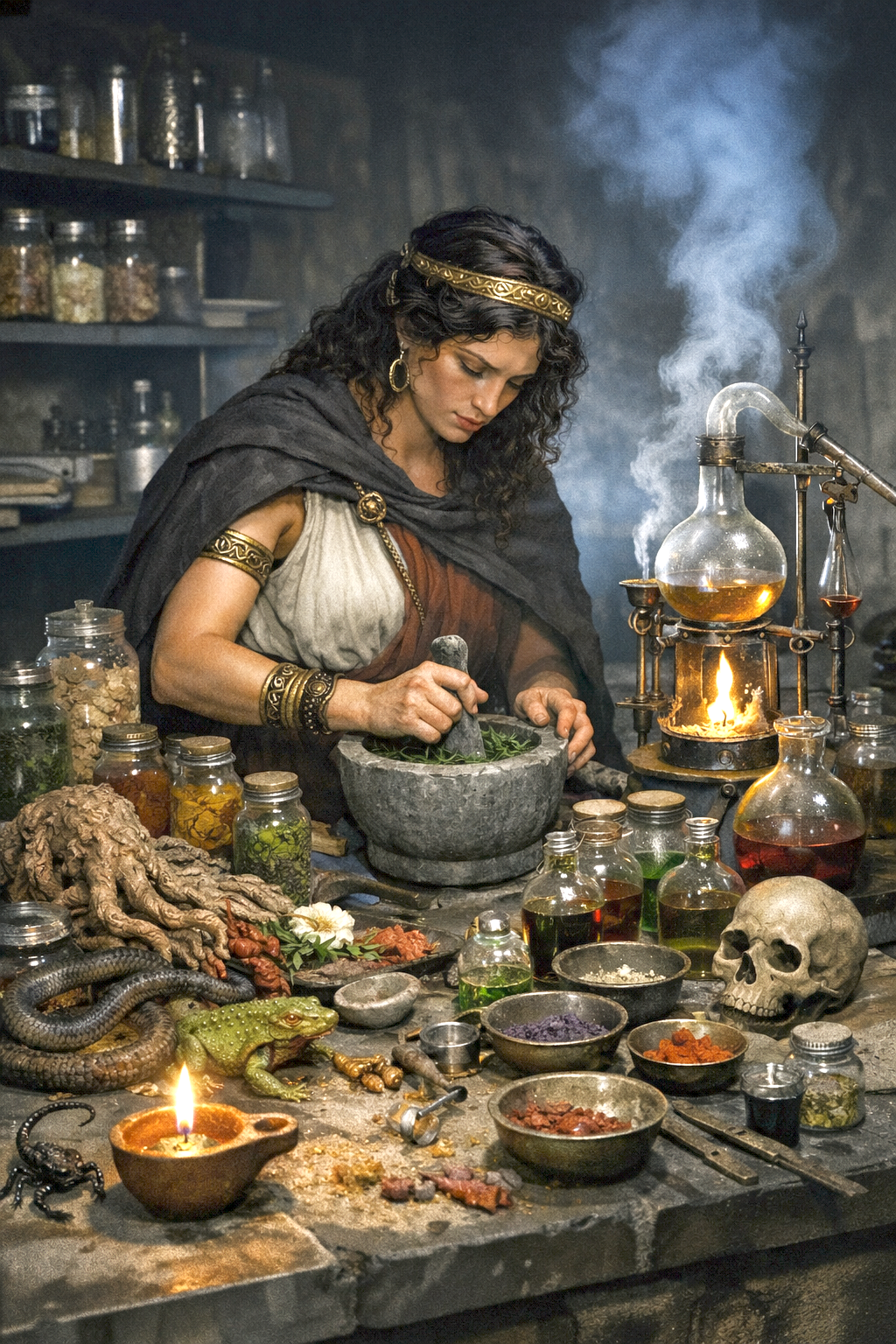
pharmakeia, a practitioner wielding the pharmakon
- Terms
- Pharmakeia in the Pre-Christian Hellenic World
- How “Pharmakeia” became morally reframed as Witchcraft
- The Lexical Core: Pharmakon, Pharmakeus, Pharmakeia
- The Pharmakeus as a Social Figure
- Pharmakeia and Initiation
- Mythologized Figures, Technical Knowledge
- From Technique to Taboo
- What Was Lost
- What Is Being Regained
- Closing Reflection
Terms
- pharmakeía (φαρμακεία) - “the art / practice of pharmakon”; the craft, technique, or discipline of working with drugs; the technology of pharmakon
- Includes: root cutting, compounding, dosing, timing, delivery, inducing or resolving altered states
- pharmakeús (φαρμακεύς) - “pharmakon-wielder” (male); the practitioner who prepares, compounds, and administers pharmakon healer, poisoner, initiator, drug-technician
- pharmakís (φαρμακίς) - “pharmakon-wielder” (female); same technical role as pharmakeús; female drug specialist
- phármakon (φάρμακον) - drug, remedy, poison, charm; morally neutral, defined by pragmatic and practical effect / intent. Intentional and technical. Used in medical (healing) and mystical (oracular / initiatory / magical) practices, as well as poisonings, etc.
- Later: Judgment enters later (in dark ages), moralized because it bypasses priesthood authority.
see also sorcery for more on the magical side of this:
- drug practice (pharmakeia) - which we talk about in this article
- vocal enchantment (goēteia) - enchantment / bewitching through voice or performance; closer to spell-casting than drug work; more theatrical than pharmacological
- magia / magic (mageia) - Magian art / ritual practice; originally refers to Persian Magoi (remember 3 magi that visited Jesus); Denotes exotic, non-Greek ritual knowledge
Pharmakeia in the Pre-Christian Hellenic World
Technical Craft of Medicine and Mysticism
To pre-Christian Hellenic cultures, pharmakeia named a real and potent craft, not a moral category. The word is old—already present in archaic Greek (Homeric period, ca. 8th century BCE) and almost certainly older in practice than in writing. Its meaning is straightforward: the wielding of pharmakon.
A pharmakon is anything that works—a substance capable of producing change. Remedy, poison, charm, ordeal, medicine: Greek does not force these apart. What mattered was competence, not righteousness. A pharmakeus was, in modern terms, a drug practitioner: someone who knew how to prepare, combine, dose, and administer substances that altered the body, perception, or fate.
To the ancients, this art was openly acknowledged as magical—but “magical” did not mean imaginary or delusional. It meant mysterious, powerful, and not fully legible to ordinary people. Practitioners were therefore liminal figures: respected for their efficacy, feared for the same reason. They occupied the borderlands between medicine, ritual, divination, and initiation.
Crucially, pharmakeia carried no intrinsic moral judgment. It was neither virtuous nor evil by definition. It could heal or harm, enlighten or destroy. It was aligned with gnōsis—knowledge gained through encounter and transformation—rather than with doctrine or belief. The danger lay not in the art itself, but in its misuse or in the social anxiety it provoked.
How “Pharmakeia” became morally reframed as Witchcraft
From Technical Craft to Moral Accusation
What most modern readers think they know as pharmakeia is not the ancient concept at all, but a later moralized distortion. Today the term is commonly associated with pejoratives like witchcraft, sorcery, or dark magic—labels that imply fraud, superstition, or inherent evil.
This shift did not occur in classical Greece. It emerges gradually in the late Hellenistic and early Roman periods, and becomes explicit only with the rise of Christian moral theology (1st–4th centuries CE). At that point, pharmakeia is redefined not as a technical art, but as a spiritual crime.
The reason is structural, not pharmacological. Pharmakeia represents unauthorized transformation—change achieved without appeal to sanctioned divine authority or institutional control. As Christian frameworks consolidated power, any means of altering perception, body, or fate outside approved ritual became suspect. Drugs that produced visions competed directly with revelation. Initiatory knowledge competed with doctrine. Gnosis competed with obedience.
Thus pharmakeia was collapsed into a single category of transgression alongside divination and idolatry. The practitioner ceased to be a technician and became a sinner. Over time, the original technical meaning disappeared, while the accusation remained.
What survives in modern usage is therefore not a memory of the art, but a residue of fear: a word emptied of instruction and filled with moral judgment. The ancient pharmakeus knew how substances worked. The modern imagination knows only that such knowledge was once dangerous—and was condemned.
The Lexical Core: Pharmakon, Pharmakeus, Pharmakeia
Greek vocabulary keeps these terms tightly linked:
- Pharmakon — a working substance; curative, toxic, or transformative depending on preparation and dose.
- Pharmakeus / pharmakis — the practitioner who knows how to prepare and administer it.
- Pharmakeia — the practice itself: knowledge enacted, not belief professed.
Crucially, pharmakeia is procedural. It names an art performed through cutting, mixing, heating, timing, administering. The “spell” is not a spoken formula but the correct handling of matter. Greek texts assume that substances possess powers that can be unlocked or ruined depending on skill.
This is why Ancient Greek language never cleanly separates pharmacology from ritual (potion, charm, spells, incantation, etc). Both are technologies of effect.
In modern times, we've confirmed these practices are true using modern science, and we better understand the nature of those "powers", now. They're not supernatural, they're real, with concrete physical explainable (practical and now mundane) mechanisms.
The Pharmakeus as a Social Figure
The pharmakeus occupies a marginal / liminal social position.
Needed, feared, misunderstood, and rarely trusted.
They appear as:
- healers and wound-treaters
- poison-preparers and antidote-makers
- midwives and reproductive specialists
- root-cutters and collectors of rare substances
- initiators who guide dangerous transitions of mental transmutation, a type of resurrection during their life with enlightenment for the initiate, revelation for the seeker.
Pharmakeia did not exist wholly outside civic life. When embedded in temples or sanctioned cults, it functioned as part of civic authority itself. Asclepian healing centers, oracular shrines, and initiatory sanctuaries were not marginal spaces: they were institutions through which cities regulated health, legitimacy, and access to divine sanction. Rulers were often initiated through these systems, ritually “made fit to rule” via rebirth/enlightenment mental transformations, while ordinary people sought healing or rebirth through controlled guided encounters with the pharmakon.
At the same time, pharmakeia also existed outside institutional oversight. Practitioners operating without temple affiliation or civic authorization derived authority solely from effectiveness. It is this unsanctioned pharmakeia - mobile, personal, and unregulated - that provoked suspicion. Such figures were indispensable in crises, when official channels failed or were too slow, yet deeply distrusted in periods of stability, when uncontrolled transformation threatened order. Eventually outlawed during the dark ages 391-1600.
- Authorized pharmakeia
- temple-based
- ritually contained
- socially legible
- integrated into civic and royal legitimacy
- Unauthorized pharmakeia
- itinerant or domestic
- privately administered
- opaque in method
- effective without permission
- foreign (unfamiliar / untrusted / unauthorized)
Gender plays a role, but not a simple one.
Women often appear as pharmakides because domestic, bodily, and reproductive knowledge was preserved in female space.
Men appear as court toxicologists, military specialists, or temple-affiliated experts.
In both cases, knowledge without civic authorization attracts anxiety.
Drugs as Technologies, Not Metaphors
Ancient pharmakeia is not symbolic. It is chemical, botanical, and physiological.
The decisive factors are:
- collection (see Root Cutters)
- preparation (cutting, drying, fermenting, combining)
- dosage (too little does nothing; too much kills)
- timing (seasonal, bodily, ritual)
- method of delivery (christing salve / oil / ointment, ingestion (potable drink), vapor fumigation)
Plants, venoms, minerals, resins, and dyes are treated as active agents. Their effects include trance, pain suppression, disorientation, euphoria, paralysis, erotic fixation, visions, simulated death, and recovery.
The “magic” lies in knowledge. But it's not supernatural, it's drug science and practice.
Pharmakeia and Initiation
Initiation rites across the Greek world are saturated with pharmakon-logic. Transformation requires initiatory fire or danger. Knowledge is gained by survival.
Drugs are used to:
- weaken ordinary perception
- induce psychosis, ecstasy or awe
- dissolve social identity, fears, simulate death
- create connections, insights, unity
- re-pattern the initiate
Texts often describe these experiences in mythic language because ordinary language fails under altered states. The ineffable. The unexplainable. What later readers call “visions” or “divine encounters” align closely with controlled pharmacological crises.
Initiation is not safe - but it is managed. That management is part of pharmakeia.
Pharmakeia vs. Civic Order
Law codes repeatedly target pharmakeia, not because it “doesn’t work,” but because it works outside control.
The problem is not poison. States use poison. The problem is unauthorized alteration:
- of bodies
- of loyalties
- of perception
- of fate
This challenges authority because it challenges culture, causes questioning.
Accusations of pharmakeia often surface during political conflict. To call someone a pharmakeus is to say: they can change things without permission.
This is why pharmakeia sits between nature and law. It belongs to neither - and threatens both.
Mythologized Figures, Technical Knowledge
Figures like Circe and Medea are not fairy-tale witches.
They are mythologized pharmacologists.
Their stories preserve technical knowledge in narrative form:
- drugs that induce animal-like states
- e.g. Circe turning men into pigs, metaphor for a supified state that's "like livestock", or easy to keep prisoner "on a rope"
- ointments that protect or destroy
- mixtures that bind desire or loyalty
- substances that enable survival of ordeals.
- e.g. antidotes to venoms
Transformation into animals, madness, or ecstasy consistently maps onto drug-induced states, revelation or vision also from drug-induced states.
Myth encodes pharmacology where open instruction would be dangerous.
Notably, when knowledge exceeds male civic control, the figure becomes monstrous. When it serves power, it becomes medicine.
From Technique to Taboo
Over time, pharmakeia undergoes moral collapse.
What was once:
- a craft
- a profession
- a dangerous expertise
becomes:
- superstition
- criminality
- sin
As technical literacy declines, fear language replaces instruction. The healer, poisoner, and initiator merge into a single condemned figure. The art disappears - but the accusation survives.
This is how cultures forget technologies while remembering only their dangers.
What Was Lost
The loss of pharmakeia is not the loss of drugs. It is the loss of situational knowledge:
- how to guide altered states
- how to recover from them
- how to distinguish transformation from harm
Fragments survive in medicine, folklore, and demonology - but without their original coherence. We inherit fear without skill.
What Is Being Regained
What is being regained is not superstition, but continuity of knowledge - the recovery of techniques for understanding mind, body, and transformation that were fragmented, suppressed, or siloed over time.
c. 15th–17th centuries (Renaissance / Early Modern period - Dark Ages are ending)
Ancient Greek and Hellenistic texts re-enter Western Europe through manuscript recovery and translation. This does not immediately restore pharmakeia, but it relegitimizes empirical inquiry. Observation, experiment, and technique begin to matter again. Natural philosophy, medicine, alchemy, and early chemistry coexist without rigid boundaries. Knowledge is still broad, embodied, and exploratory.
Founded in 1660 in Restoration England, the Royal Society formalized a shift that had been building since the Renaissance: the revival of ancient inquiry as disciplined practice rather than inherited authority. Drawing explicitly on classical models of natural philosophy, its members rejected scholastic reliance on tradition and instead emphasized observation, experiment, replication, and open debate - principles already present in Hellenic scientific culture but long suppressed by medieval dark-ages dogma. The Society’s motto, Nullius in verba (“on the word of no one”), encapsulates this return to Greek habits of inquiry: knowledge must be tested, not believed. While the Royal Society decisively narrowed inquiry toward mechanics, chemistry, astronomy, and physiology—leaving ritual, initiation, and pharmakeia behind—it nonetheless resurrected the ancient conviction that nature is intelligible through method. Modern science emerges here not as a break from antiquity, but as a selective recovery of its empirical spine, stripped of its more dangerous and transformative arts.
19th century (Esoteric recovery alongside science)
As industrial science narrows its focus, parallel movements attempt to reclaim lost integrative knowledge. Figures like Helena Blavatsky represent a flawed but historically important effort to synthesize ancient philosophy, initiation traditions, and altered states into a single explanatory framework. While not scientific in the modern sense, these movements preserve the intuition that ancient systems encoded real psychological and experiential technologies, not mere myth.
Early 20th century (Psychology rediscovers the inner world)
With depth psychology, figures such as Carl Jung reopen territory that materialist science had abandoned. Jung treats inner archetypes, visions, symbols, and initiatory imagery not as delusions, but as structured experiences arising from the psyche. Though he avoids pharmacology, his work restores legitimacy to non-ordinary states as meaningful rather than pathological or supernatural - laying crucial groundwork for later restoration / reintegration of mental practices.
Early–mid 20th century (Gatekeeping of pharmacology)
By the early 1900s, botanical and traditional pharmacology is increasingly replaced by controlled, industrial, and patent-based medicine. This shift brings genuine safety and standardization - but also centralization. Substances that cannot be easily dosed, owned, or regulated are excluded. The pharmakon survives, but only in institutionally approved forms, often restricted or obscured from the general public.
Mid–late 20th century (Rediscovery of revelatory substances)
In the 1950s–60s, compounds such as LSD, psilocybin, and DMT reintroduce direct, reproducible access to altered states or the same mystical gnosis written about by the Ancient Greek writers - not through belief, but through chemistry. These substances prove difficult to monopolize or fully contain. For the first time in centuries, large numbers of ordinary people encounter states previously reserved for initiatory or temple contexts. Predictably, this produces both insight and chaos. Much fear from authorities who worry about dissolve of culture / authority / tyrany (losing control).
Early 21st century (Integration rather than rebellion)
From roughly the 2010s onward, psychedelic therapy emerges as a cleaned reconciliation of old technology:
- pharmacology paired with guided psychology
- altered states paired with integration
- ancient insight paired with modern safeguards
This phase does not attempt to resurrect pharmakeia as an unregulated art, nor to compete with modern culture or religions by reducing to (or even utilizing) mysticism. Instead, it recovers the ancient recognition that intentional alteration of consciousness can be therapeutic and meaningful - when guided by knowledge rather than fear.
Closing Reflection
Pharmakeia forces an uncomfortable truth: anyone who can reliably alter reality will be feared. The pharmakon itself is never good or evil. It is effective.
Every civilization decides who may wield such effectiveness - and who must be silenced, exiled, or burned for it.
That decision tells us far more about power than about drugs.