![[back]](/assets/home_24dp_E3E3E3_FILL0_wght400_GRAD0_opsz24.svg "[back]")
![[search]](/assets/search_24dp_E3E3E3_FILL0_wght400_GRAD0_opsz24.svg "[search]")
Immortality Key
- Key takeaways
- Triptolemus spread the Eleusinian Mystery
- Triptolemus's son being forged in the fire
- Archeological Evidence
- Brian Muraresku's Research
- The Science
- 2026 paper shows plausibility
- See Also
Key takeaways
- The religion with no name was psychedelics induced mystical experience, and is ancient going back to Bronze Age or before, and centered around "Knowing Thyself", a saying inscribed on the Temple of Delphi, seen as you entered it.
- There was a psychedelic / entheogenic sacrament called the kykeon in the elusinian mysteries, an event people did once in their lifetime and with a mystical experience (epoptoi)
- The archaeological evidence for ergot consumption linked to the Eleusinian Mysteries in Spain comes from the ancient Greek colony site of Mas Castellar de Pontós in Girona, Catalonia.
- Triptolemus spread the Eleusinian Mystery to other regions.
- There were greater and lesser mysteries.
- Ergot seems to be the greater (used at Eleusis and closely guarded)
- Pramnian Wine mixed with scopalomines and other drugs seem to be the lesser (used by maenids and dionysian events). You must dilute by 20x and even then the 1st cup will inebriate you the 2nd cup will knock you out and the 3rd cup will kill you.
- Seems that the recipe for the greater mystery "got out" and was practiced in people's homes, and among christians.
- One hypothesis is that Christianity "stole" this sacrement initially, and over time "hid" it from the masses, putting a priest between "us" and "god".
- The pope still takes the original sacrement.
Triptolemus spread the Eleusinian Mystery
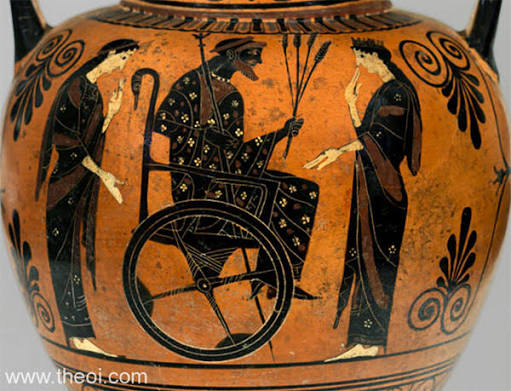
The Greek envoy from Eleusis depicted driving a chariot is Triptolemus.
Who is Triptolemus?
- Divine Mission: Demeter gave him a winged chariot drawn by dragons to fly across the world and teach "agriculture to mankind".
- Eleusinian Mysteries: He is a central figure in Eleusinian mythology, often shown receiving the first grain from Demeter and the sacred wand from Persephone.
- Artistic Depiction: In ancient Greek pottery, he is almost always depicted as a young prince seated in his winged, snake-entwined chariot, ready to distribute the grain harvest.
- Torch Bearer
Triptolemus was a demi-god of the Eleusinian mysteries who presided over the sowing of grain-seed and the milling of wheat.
He was one of the Eleusinian princes who hospitably received the goddess Demeter when she was mourning the loss of her daughter. After Persephone was returned from the underworld Demeter, in her munificence, instructed Triptolemos in the ways of agriculture and provided him with a winged, serpent-drawn chariot to spread her gift across the earth. He travelled through many lands but when he reached the cold realm of the Skythians, King Lynkos (Lyncus) slew one of his dragon-serpents and drove the hero away. Deventer transformed the king into a lynx and denied the Skythians the gift of agriculture.
In ancient Greek vase painting Triptolemos is usually depicted seated on his winged chariot in the company of the goddesses Demeter, Persephone and Hekate. He also appears amongst larger gatherings of the Eleusinian gods.
Triptolemos' name is derived from the Greek words triptos and lemma meaning "He who Pounds the Husks."
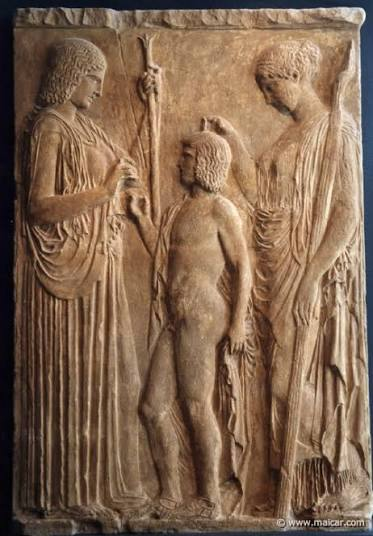
Copy of Eleusinian relief, ca. 440 BC, depicting Demeter, Triptolemus and Persephone. Original in marble at the National Archaeological Museum, Athens. Archaeological Museum of Eleusis.
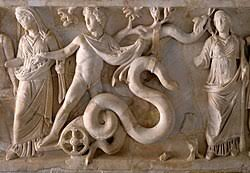
Triptolemus on a 2nd-century Roman sarcophagus (Louvre Museum).
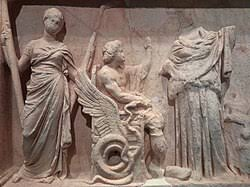
Triptolemus about to depart on his mission. Behind him is Persephone with torches. 6516: Votive relief depicting Triptolemus being sent on his mission. Early 4C BC. Archaeological Museum of Eleusis.
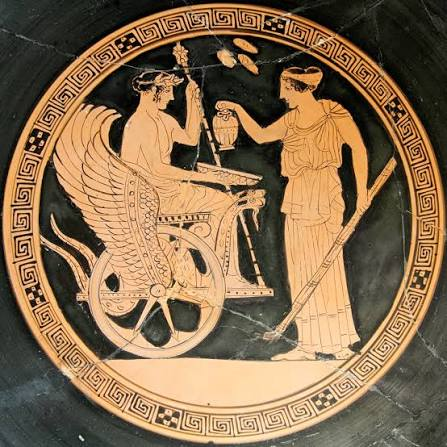
Triptolemus and Persephone, tondo of a red-figure Attic cup, ca. 470 BC–460 BC
Triptolemus (detail), Athenian red-figure skyphos C5th B.C., British Museum
Triptolemus's son being forged in the fire
This story depicts Initiatory Fire, a rite used to scrub one of their mortality, to harmonize their Daimones.
In Greek mythology, Triptolemus was a prince of Eleusis whom the goddess Demeter raised and taught the secrets of agriculture. While the famous "forging in the fire" to grant immortality is most widely attributed to his younger brother Demophon, some ancient traditions state that Demeter placed Triptolemus in the fire to strip away his mortality.
The Descent and the Nursing
During her desperate search for her abducted daughter, Persephone, the goddess Demeter wandered the earth in the guise of an old mortal woman named Doso. She arrived in the city of Eleusis, where King Celeus and Queen Metanira offered her shelter and hospitality. In gratitude, the grief-stricken goddess took on the role of nursemaid to the royal couple's sons, Triptolemus and Demophon.The Fire Ritual
Demeter grew profoundly fond of the family and secretly resolved to reward them by elevating the baby into a god. Every night, she would feed the infant divine ambrosia and perform a sacred ritual. To purge the child of his mortal, earthly flesh, she would bury him in the blazing, purifying flames of the family hearth.The Interruption
One night, Queen Metanira crept into the nursery to watch the nursemaid. To her absolute horror, she saw the old woman burying her infant son in the roaring fire. In a state of sheer panic, Metanira screamed out, causing the goddess to pull the child from the flames.Because the ritual was broken, Demeter could not complete the process of making the child a god. In some tellings of the myth, Demophon was consumed by the fire. In others, the interruption proved fatal to his chances at immortality.
The Aftermath and the Gift of Agriculture
Enraged that her divine gift had been ruined by mortal interference, Demeter revealed her true form as the goddess of the harvest. To compensate the royal family for the tragedy, she focused her attention on the older brother, Triptolemus.Demeter fed Triptolemus divine breast milk, which healed his ailments and instantly grew him into a man. She then blessed him with the sacred knowledge of grain and agriculture. To ensure this gift would benefit all of humanity, she gave him a spectacular, winged chariot drawn by a pair of dragons.
Triptolemus flew across the skies of the ancient world, scattering seeds, teaching mankind how to plow, harvest, and establish stable, civilized societies.
You can read between the lines here, that Demophon was forged in Initiatory Fire, a rite used to scrub one of their mortality, to harmonize his Daimones. And Triptolemus spread the rite around to other sites to purify the world to Know Thyself and become better humans.
Archeological Evidence
The archaeological evidence for ergot consumption linked to the Eleusinian Mysteries in Spain comes from the ancient Greek colony site of Mas Castellar de Pontós in Girona, Catalonia.
- Artifacts: Excavators found fragments of ergot (Claviceps purpurea) inside a ceremonial vase (a kernos) directly resembling the chalices used in Greece to consume the sacred kykeon potion.
- Human Remains: Traces of ergot alkaloids were identified in the hardened dental plaque (dental calculus) of a 25-year-old male buried at the site.
Brian Muraresku's Research
Investigative scholar Brian Muraresku, author of The Immortality Key, highlights this specific Girona discovery. He uses the Mas Castellar site to argue that ancient Greek citizens—who couldn't travel to the primary Temple of Eleusis—established a sanctuary for Demeter and Persephone and recreated the psychoactive rites locally. Muraresku proposes that ancient initiates brewed ergot-infused beer to induce visions.
The Science
Because raw ergot is highly toxic and associated with severe illness, the hypothesis that it served as a hallucinogen was historically met with skepticism. However, recent research has explored how ancient people might have navigated these risks.
A study published in Scientific Reports investigated whether traditional preparation techniques could have rendered the fungus psychoactive while minimizing its lethal toxicity. The researchers demonstrated that through specific, controlled processes, the chemical profile of the fungus can be altered. While these laboratory results do not prove the ancient Greeks used these exact methods, they suggest that a chemically modified ergot preparation was scientifically possible within the technological constraints of the era.
2026 paper shows plausibility
A 2026 experimental chemistry paper added a new dimension to the kykeon hypothesis by demonstrating that alkaline lye solutions made from ash were capable of chemically transforming some of the more toxic ergot alkaloids into compounds associated with psychoactive lysergic acid amides (LSA). The study proposed that a simple ancient technique involving ash-derived lye, something readily obtainable in Bronze Age and Classical ritual settings, could potentially reduce vasoconstrictive toxicity while preserving or generating visionary psychoactive effects. This has led some researchers to speculate that the preparation of kykeon may have involved alkaline processing using wood ash or plant ash as part of the brewing or extraction method.
While still hypothetical and highly debated, the findings strengthened the plausibility that ancient practitioners could have intentionally manipulated ergot chemistry using relatively simple ritual technologies rather than consuming raw toxic ergot directly.
- mirror here PDF
See Also
- The Immortality Key by Brian Murarescu - book
- Search for immortality key here across YouTube LadyBabylon - see where Dr Hillman's mentioned it.
Ergot Related:
- Threshing Floors
- Eleusinian Mysteries
- Road to Eleusis (Ruck/Wasson/Hoffman) book
- Mixing the Kykeon (Webster/Perrine/Ruck) - ELEUSIS: Journal of Psychoactive Plants and Compounds New Series 4, 2000 paper
- 13 February 2026, Investigating the psychedelic hypothesis of kykeon, the sacred elixir of the Eleusinian Mysteries, mirror here PDF
- The Mystery of Manna - The Psychedelic Sacrament of the Bible - Dan Merkur
- The Elixir - An Alchemical Study Of The Ergot Mushrooms - William Scott Shelley