![[back]](/assets/home_24dp_E3E3E3_FILL0_wght400_GRAD0_opsz24.svg "[back]")
![[search]](/assets/search_24dp_E3E3E3_FILL0_wght400_GRAD0_opsz24.svg "[search]")
Mark 14:33-35 Translation from Source - Jesus enters an ecstatic death state
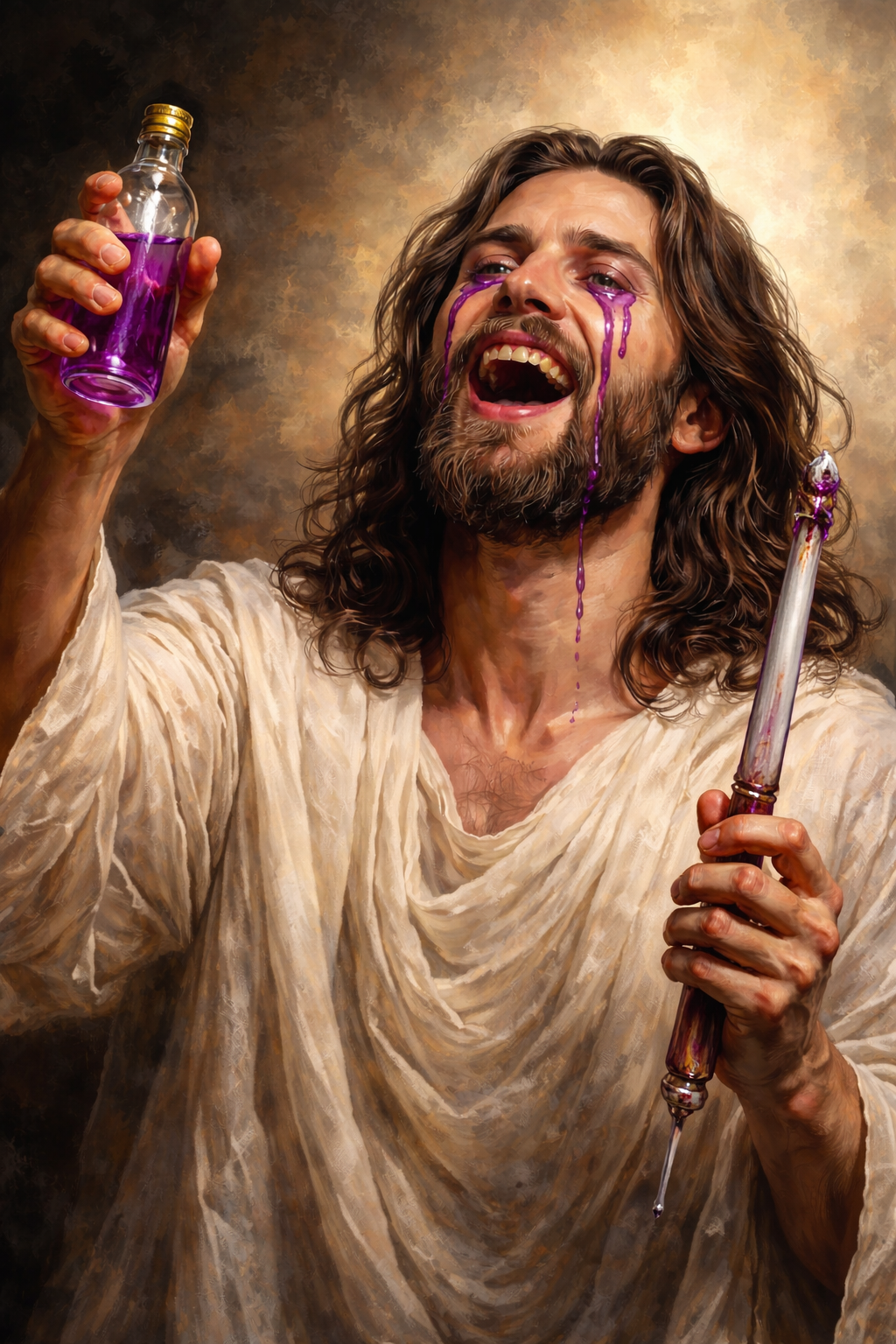
- Mark 14:33–35 - A private, pre-arrest episode. Jesus alone, with selected witnesses, enters an ecstatic destabilizing death-proximate state.
- Mark 16:18 - A post-resurrection address to followers. It describes what his followers can now endure or survive, the thanasimon drug. These are words spoken after the arrest / crucifixion / cave scenes that authorize or task followers to act going forward.
Table of Contents
- Mark 14:33-35 - entering a death state
- Mark 14:48 - garden, arrest, crucifixion, cave, see ya later
- Mark 16:18 - thanasimon now wont hurt you
- See Also
Mark 14:33-35 - entering a death state
Passage:
33 καὶ παραλαμβάνει τὸν Πέτρον καὶ τὸν Ἰάκωβον καὶ τὸν Ἰωάνην μετ’ αὐτοῦ, καὶ ἤρξατο ἐκθαμβεῖσθαι καὶ ἀδημονεῖν,
34 καὶ λέγει αὐτοῖς Περίλυπός ἐστιν ἡ ψυχή μου ἕως θανάτου· μείνατε ὧδε καὶ γρηγορεῖτε.
35 καὶ προελθὼν μικρὸν ἔπιπτεν ἐπὶ τῆς γῆς, καὶ προσηύχετο ἵνα εἰ δυνατόν ἐστιν παρέλθῃ ἀπ’ αὐτοῦ ἡ ὥρα,
33 And he takes along Peter and James and John with him, and he began to be greatly amazed/astonished and anguished,
34 and he says to them, “My psyche/soul is overwhelmed with grief, unto death; remain here and keep watch.”
35 And going forward a little, he was falling upon the ground, and he was praying that, if it is possible, the hour might pass away from him.
- perilupos (Περίλυπός) - overwhelmed with grief
- heous (ἕως) thanatou (θανάτου) — unto death
- ekthambeou (ἐκθαμβέω) - amazed/astonished
- ademoneou (ἀδημονέω) - anguished
When Jesus says “My soul is overwhelmed with grief, unto death”, the Greek does not suggest poetic exaggeration.
- heous (ἕως) thanatou (θανάτου) marks proximity to death.
- Not metaphorical grief, but real overwhelm to the point of anguish.
Focus now on the amazed/astonished (ἐκθαμβεῖσθαι) and (καὶ) anguished (ἀδημονεῖν):
A.to be amazed, Orph.A.1218(tm.).
II. trans., amaze, astonish, LXX Si.30.9 :—Pass., Ev.Marc.9.15, Gal.16.493.
A.to be sorely troubled or dismayed, be in anguish, Hp.Virg. 1; “ἀδημονῶν τε καὶ ἀπορῶν” Pl.Tht.175d, cf. D.19.197; “ἀδημονῆσαι τὰς ψυχάς” X.HG4.4.3: c. dat. rei, “ἀδημονεῖ τᾗ ἀτοπίᾳ τοῦ πάθους” Pl.Phdr. 251d; ὑπό τινος to be puzzled by . ., Epicur.Nat.11.8; “ἐπί τινι” D.H. 3.70; “χάριν τινός” POxy.298.45 (i A.D.). (Eust., 833.15, derives it from ἀδήμων, which is found only as v.l. in Hp.Epid.1.18 (cf. Gal.17 (1).177), and is itself of doubtful derivation.) [“α^δ-” Nic.Fr.16.]
noun
severe mental or physical pain or suffering.
"she shut her eyes in anguish"
This sounds like a drug trip, a descent into a death-state.
Why? What was jesus doing?
He mentions the drug is a death inducer or thanasimon (θανάσιμον / θανάσιμα) in Mark 16:18 to his apostles after the garden, crucifixion, and cave scenes - that they can take it and it will not harm them!
Mark 14:48 - garden, arrest, crucifixion, cave, see ya later
Starting with Mark 14:48 - through Mark 16:7, we see Jesus's death state get interrupted.
- See Mark 14-51 Translation from Source, for the full deep dive, for what happens
- In summary:
- Mark 14:43–52 Arrest in Gethsemenie, at 4am, with a naked (gumnos) boy youth (neaniskos) leaving his surgical-grade fine linen bandage (sindon) behind, reacting "why are you coming at me like i'm some kind of lestes". Not murderer, not insurrectionist, not anything else, he makes a guilty slip and names "lestes".
- There's some thought that the apostles were young Eunuchs "for the kingdom of heaven". To quote Jesus "there are eunuchs who made themselves eunuchs because of the kingdom of the heavens", and says essentially: "for those with ears to hear this, hear this".
- Mark 15:27 Hanging on the cross between two other lestes. Not murderers, not insurrectionists, not anything else, there's lestes here. Julius Ceasar also tells us that crucifixion is reserved for the most heinous of crimes like lestes / trafficking, plundering of souls.
- Having all the thirst-symptoms of dipsas poisoning
- John 19:28 - says he's thirsty - screams out "i thirst!"
- Mark 15:36 / John 19:29 - dipsas therapy - oxos sour wine/vinegar sponge, a common therapy to endure dipsas poisoning.
- Mark 15:34 Invoking cthonic magic words before his last perceptible breath (Mark 15:37).
- Mark 15:44-45 - early death - very surprisingly appears dead before the other convicts, notable to Pontus Pilate. Thus they dont break his legs to speed his death along, as is custom. John 19:32–33 also notes the others are still alive and have their legs broken.
- John 19:34 - so thirsty he drank a lot of water - bloody water pours out after being stabbed - evidence that he drank a ton of water - a sign of thirst)
- Mark 15:37–47 Being put into a tomb
- Mark 16:1–6 Finding the tomb empty after 3 days, locked inside there was another neaniskos, all the fine linens piled up in the corner.
- Mark 16:7 Telling us that Jesus will see you in Galilee.
- Mark 14:43–52 Arrest in Gethsemenie, at 4am, with a naked (gumnos) boy youth (neaniskos) leaving his surgical-grade fine linen bandage (sindon) behind, reacting "why are you coming at me like i'm some kind of lestes". Not murderer, not insurrectionist, not anything else, he makes a guilty slip and names "lestes".
And then Next, Jesus tells his followers that the pharmakon death inducing thanasimon wont hurt you...
Mark 16:18 - thanasimon now wont hurt you
a speech scene, describing what will be possible afterward, no physical location, text is no longer anchored to a place because the action phase of the story is over. Who's there? Jesus as a speaking figure, no mention of his post-cave state, and generalized followers / disciples as a group. Basically is saying "Given what has already occurred, here is what now no longer harms you."
After his event
Jesus addresses his followers as a group and declares the death-inducing (Thanasimon) agents no longer harm those who act in the same way that Jesus just demonstrated. "You may now take up snakes, and have the death inducer, and it will not harm you, and it will heal the unwell".
- Jesus is the healer, who applies the salve to the surface of the skin. Literally. It's what his name means.
17 σημεῖα δὲ τοῖς πιστεύσασιν ταῦτα παρακολουθήσει, ἐν τῷ ὀνόματί μου δαιμόνια ἐκβαλοῦσιν, γλώσσαις λαλήσουσιν καιναῖς,
17 And these signs will follow the ones having trusted (pistis): in my name they will cast out daimones; with new words/terminology they will speak;
18 ὄφεις ἀροῦσιν κἂν θανάσιμόν τι πίωσιν οὐ μὴ αὐτοὺς βλάψῃ, ἐπὶ ἀρρώστους χεῖρας ἐπιθήσουσιν καὶ καλῶς ἕξουσιν.
18 they will carry serpents, and if they should drink anything death-inducing (thanasimon), it will by no means harm them; they will place hands (exercise their power) upon the unhealthy, and they will be well.
- Using a beast based, venom based pharmakon: something snake related, that induces "death" when drunk.
- The "death inducing" thing "Will not harm you" implies there is no actual death: but alludes to immunity, or, neardeath or mystical death, with recovery (coming back to life from that death state).
- This mechanism heals "the unhealthy", makes them "well", so it's not just simple immunity to poisons. Unhealthy could be physical, or mental...
- See Death Cults, Near Death Experience.
- This is pharmacological trip to the rift... opening a portal in the psyche.
- no actual death is happening here...
- cast out Daimones: this is a purification, a harmonization of the inner psuche, something that happens for the initiate who undergoes the thanasimon, and the rite's guidance, who is tripping that rift in the "death state"...
- See Internal Family Systems for a modern version without pharmakon
- new words/terminology (γλώσσαις) talking about new concepts, rites, new incantations, those that Jesus taught... (not speaking in tongues, wtf people). Words that aid or guide in that purgation or harmonization of Daimones.
A.deadly, fatal, Hp.Aph.2.1, Pl.R.610e, etc.; “τύχαι” A.Ag.1276; “πέσημα” S.Aj.1033; “χείρωμα” Id.OT560; “πέπλος” Id.Tr.758; “φάρμακα” E.Ion616, Ph.Bel.103.31, cf. Metrod.53, etc.; θηρία θ., of poisonous reptiles, Plb.1.56.4: θανάσιμα, τά, poisons, Ev.Marc. 16.18, Dsc.4.108, Gal.14.154. Adv. -μως, τύπτειν to strike with deadly blow, Antipho 4.3.4: neut. pl. as Adv., “ἀσπίδες -μα δάκνουσαι” D.S.1.87.
2. belonging to death, θ. αἷμα the life-blood, A. Ag.1019 (lyr.); μέλψασα θ. γόον having sung her death-song, ib.1445; “θ. ἐκπνοαί” E.Hipp.1438.II. of persons, near death, S.Ph.819; “θ. ἤδη ὄντα” Pl.R.408b; liable to the death-penalty, Abh.Berl.Akad. 1925(5).21 (Cyrene).2. dead, S.Aj.517; “θ. βεβηκότα” Id.OT959.
- thanasimos (θανάσιμος) - Mark later uses it explicitly (in 16:18) for deadly substances / poisons. In Greek medical and ritual language, thanasimon (θανάσιμον) does not always mean “kills”; it means to induce a death-state (thanasimon == death inducer), brings one to the boundary. Galen uses it this way. So do tragedians.
In Mark 14:33-35, Jesus intentionally enters a state of extreme physiological and psychic destabilization. The language matches induced descent, not passive emotion. Falling to the ground, loss of composure, repeated prayer, bodily collapse—all align with ritualized approach to a death-state. The “hour” is not just execution time; it is the onset window of the state he is entering. This reads as voluntary exposure to a thanasimos condition—a controlled approach to death before arrest, not merely fear of what is coming later.
in Mark 14:33-35 with amazed/astonished (ἐκθαμβεῖσθαι) and (καὶ) anguished (ἀδημονεῖν) is not the vocabulary of ordinary fear or anticipatory anxiety. In Greek narrative, those verbs mark acute destabilization, not reflective emotion. ἐκθαμβεῖσθαι is used where perception itself is disrupted—astonishment that overwhelms orientation, often bordering on terror or trance. It is the word used when someone is struck out of normal cognitive alignment, not when they are merely worried. ἀδημονεῖν intensifies this: it names a state of oppressive distress where the subject cannot remain settled in themselves, a condition that medical and philosophical writers associate with pathological or induced crisis rather than metaphorical sadness. Together, the pair describes a body–mind entering overload, not a person calmly anticipating suffering.
That reading is reinforced by the syntax and action that follow. “ἕως θανάτου” is not poetic exaggeration but a boundary marker: up to the point of death, to the threshold. Jesus does not say he is sad about death; he states that his psyche/soul (ψυχή) is pressed to the death-limit. The physical behaviors—progressive withdrawal, collapse to the ground, repetition, inability to remain upright—are exactly how Greek texts describe entry into extreme states, whether pathological, ecstatic, or pharmacologically induced.
Galen (medical) and the tragedians both preserve this boundary sense: a controlled nearness to death that transforms perception and agency.
Mark 14:33–35 describes intentional exposure, not passive fear.
The text shows Jesus actively initiating a descent—isolating witnesses, submitting the body, enduring psychic rupture.
The passage reads as a voluntary approach to a thanasimos state, a ritualized crossing toward death.
ψυχὴν ἀντὶ ψυχῆς καταθέσθαι δικαιοῦντος τοῦ νόμου.
(279) Φάρμακον μήτε θανάσιμον μήτε τῶν εἰς ἄλλας βλάβας πεποιημένων Ἰσραηλιτῶν ἐχέτω μηδὲ εἰς· ἐὰν δὲ κεκτημένος φωραθῇ
the law justifying the giving up psyche/soul in exchange for psyche/soul (similar to zoe / ζωη - animated life force).
(279) “Let no one possess even a single pharmakon/drug that is neither death-inducing nor among those prepared for other harms by Israelites; but if one is discovered being in possession…”
- ψυχή = similar to zoe / ζωη - animated life force
- φάρμακον θανάσιμον = a drug that brings one to the death boundary, not merely “poison” in a modern sense
Josephus is also talking about the psyche/soul (ψυχὴν) and thanasimon (death inducing) pharmakon (Φάρμακον μήτε θανάσιμον).
Mark’s later, explicit use of thanasimon (θανάσιμον) in 16:18 shows that the author is comfortable with this semantic field: substances and conditions that bring one to the boundary. Josephus’ pairing of psyche/soul (ψυχή) with thanasimon (death-inducing) pharmakon (φάρμακον μήτε θανάσιμον) confirms the same conceptual structure - death-inducing agents understood as legally, medically, and ritually significant.
Read together, the passage does not present Jesus as passively overwhelmed by future events. It presents him actively entering a state of extreme destabilization: submitting the body, collapsing posture, enduring perceptual rupture, and naming the moment as an onset. The language matches induced descent, not anticipatory fear. This is a voluntary approach to a thanasimos condition - a controlled nearness to death that disrupts agency and perception, before the arrest scene.
In short:
- Mark 14:33–35 describes intentional exposure, not emotional weakness.
- The Greek marks entry into a death-boundary state, not metaphorical anguish.
- What Jesus is doing is initiating a descent, not merely reacting to one.
See Also
- Mark 14-51 Translation from Source - what was jesus doing at 4am with a naked bandage-wearing little boy?
- Thanasimon - the death inducer
- Pharmakon - drugs in antiquity
- Jesus - all about Jesus, and what his name means, "the god of healing who christs"
- christing - all about christing! (To apply the salve to the surface of the skin)