![[back]](/assets/home_24dp_E3E3E3_FILL0_wght400_GRAD0_opsz24.svg "[back]")
![[search]](/assets/search_24dp_E3E3E3_FILL0_wght400_GRAD0_opsz24.svg "[search]")
Kyphi
- Introduction
- Mental State
- Research / Reading
- Recipe
- Analysis
- I. INDIVIDUAL INGREDIENT EFFECT PROFILES
- 1. Cambodian Oud / Agarwood (ἀγαρόξυλον)
- 2. Frankincense (λίβανος): Omani Black + Sultan’s White
- 3. Yemeni Myrrh (σμύρνα)
- 4. Pine Resin (πίττα)
- 5. Cyperus Root (κύπειρος)
- 6. Mysore Sandalwood (σάνταλον)
- 7. Labdanum Resin + Absolute (λάβδανον)
- 8. Persian Galbanum (χαλβάνη)
- 9. Turkish Liquidambar (Styrax)
- 10. Chios Mastic (μάστιχα)
- 11. Agarwood Powder
- 12. Saigon Cinnamon (κιννάμωμον)
- 13. Cardamom (καρδάμωμον)
- 14. Anise (ἄνησον)
- 15. Borneol Camphor (καμφορά)
- 16. Nard Root (νάρδος)
- 17. Honey (μέλι)
- 18. Golden Raisins soaked in Calvados
- II. MENTAL & PHYSICAL EFFECT ANALYSIS (SUMMARIZED)
- III. HOW THE INGREDIENTS WORK TOGETHER (THE “KYPRIOTIC FIELD”)
- IV. OVERALL PSYCHOACTIVE PROFILE OF THIS KYPHI
- V. FINAL SYNTHESIS
- PGM
- I. INGREDIENT-BY-INGREDIENT PARALLELS IN THE PGM
- 1. Frankincense (λίβανος) — PGM: Vision, Theophany, Purification
- 2. Myrrh (σμύρνα) — Grounding, Stabilizing, Chthonic Contact
- 3. Labdanum / Storax / Liquidambar (λάβδανον / στόραξ) — Erotic, Ecstatic, Binding
- 4. Mastic (μάστιχα) — Sharp Awakening, Clarity, Voice-opening
- 5. Galbanum (χαλβάνη) — Boundary-crossing, Exorcistic, Penetrating
- 6. Cinnamon, Cardamom, Aromatic Spices — Warmth, Erotic Charge, Emotional “Fire”
- 7. Anise (ἄνησον) — Breath Purification and Light Euphoria
- 8. Nard (νάρδος) — Bridal, Erotic, Dreamlike Softening
- 9. Sandalwood, Cyperus, and Calmative Roots — Sleep, Trance, Hypnosis
- II. WHAT THE PGM REVEALS ABOUT
- III. BOTTOM LINE: THE PGM VALIDATES AND SHARPENS THIS KYPIOTIC ANALYSIS
- κυφι in the PGM
- I. THE GREEK WORD: ΚΥΦΙ (κυφί, κυφίν, κυφίου, etc.)
- II. WHERE KYΦΙ APPEARS IN THE PGM
- III. WHAT KYΦΙ MEANS IN USE IN THE PGM
- IV. SEMANTICS AND GRAMMAR: HOW KYΦΙ IS USED
- V. WHY KYΦΙ IN THE PGM IS IMPORTANT FOR UNDERSTANDING GREEK MAGIC
- VI. KYΦΙ AS A GREEK WORD: PRONUNCIATION AND REGISTER
- VII. THE BOTTOM LINE
- see also
Introduction
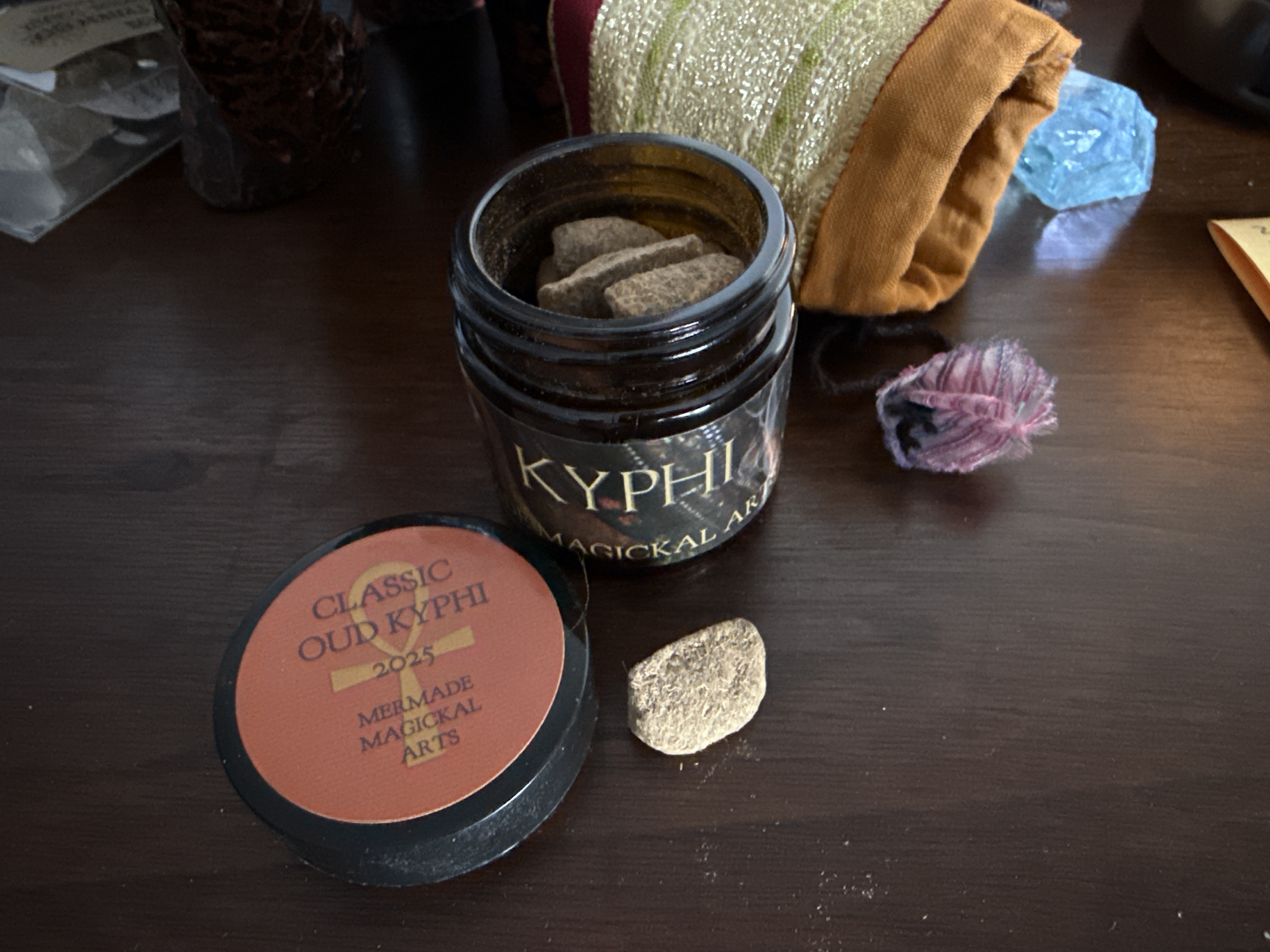
Kyphi is made of powdered resins, spices, woods, and botanicals, carefully melded together over time to create a classic incense solid, the small cakes are semi-soft, dark, sweet, and resinous.
Kyphi is the powerful fumigation from the ancient temples of Horus and Isis. Based on the latest research from the Edfu temple and a recent study of ceramic dishes used in the preparation of kyphi.
Created in the Egyptian sacred tradition, its aroma is luscious and sensuous. The process requires a great deal of time, intention.
On Kyphi:
It is the ultimate Temple Incense...
When burned in the evening, kyphi was believed to restore the sexuality of the gods or departed dead. Recent Egyptology has closely tied scent and sexuality together in ancient culture. Funerary beliefs and spiritual doctrines also place a strong emphasis on the life-giving force of sexuality. This is quite appropriate as the kyphi formula comes to us from the temples of gods associated with creation, life, and the afterlife.
"At nightfall, they burned Kyphi, the famous compound incense, which was made of sixteen ingredients. Most of the ingredients that are taken into this compound, in as much as they have aromatic properties, give forth a sweet emanation and a beneficent exhalation, by which the air is changed, and the body moved gently and softly by the current, acquires a temperament conducive to sleep; and the distress and strain of our daily cares, as if they were knots, these exhalations relax and loosen without the aid of wine"
Mental State
Kyphi is a substance selected to promote:
- emotional softening
- dreaminess
- imaginal activity
- transition toward incubation and sleep
- relaxes
- eases anxieties
- prepares for dreams
- loosens the tensions of the day
A softening of ordinary mental rigidity. The day’s concerns begin to lose their grip. Thoughts become less linear, less task-oriented, less defensive. Emotional material rises more easily. Memory becomes more associative. Imagery becomes richer. The boundary between waking thought and dream-thought becomes thinner.
kyphi creates liminality.
Kyphi: emotional softening, dreamward attention, imaginal openness, memory, liminality, release of the day’s tensions, incubation-temple feeling. It says: “The sun has set. Let go. Listen. Enter the between-world where dreams, symbols, ancestors, daimones, and forgotten parts of yourself may speak.”
The hard edges become less important.
Grievances lose urgency.
The nervous system stops preparing for battle.
The mind becomes more willing to generate images.
The sort of mental state in which myth naturally becomes meaningful.
The boundaries between individuals become less important.
The group settles into a common emotional field.
Research / Reading
If you want to delve deeper into the making and history of this renowned incense, we recommend the book:*- "Kyphi: The Sacred Scent" by Karl Vermillion
Recipe
Here is one faithful list of ingredients from a modern vendor (Mermade Magickal Arts) that gets their Kyphi recipe from the research from Edfu.Traditional Ingredients in Mermade Kyphi:
Cambodian Oud, Oman Frankincense(Black and Sultan's White), Yemeni Myrrh, Pine Resin, Cyperus root, Mysore Sandalwood, Labdanum Resin and Absolute, Persian Galbanum, Turkish Liquidambar, Chios Mastic, Agarwood powder, Saigon Cinnamon, Cardamom, Anise, Borneol Camphor, Nard Root
Bound with dark fixed Honey and Golden Raisins soaked in Calvados for over a year, dusted with fine Agarwood
Analysis
Below is an analysis of each ingredient’s mental / bodily psychoactive profile as attested in Greek, Roman, Near Eastern medical-ritual sources (Hippocratic corpus, Theophrastus, Dioscorides, Galen, Orphic and Egyptian temple-practice parallels).
Here we will only highlight effects that track ancient pharmacology and the sensory-ritual vocabulary used in Hellenistic kyphi (κυφί).
Then we will explain what these do together—because kyphi is not additive; it is synergistic, producing a unified psychophysical state used in Egyptian and Hellenistic night-rite katharsis.
I. INDIVIDUAL INGREDIENT EFFECT PROFILES
Below are the effects framed in ancient technical vocabulary: εὐωχία (euphonic pleasure), ἡσυχία (calm), θάλπος (warmth), πνευματώδης φρόνησις (airy/cognitive lift), μανία ἱερά (sacred frenzy), etc.
1. Cambodian Oud / Agarwood (ἀγαρόξυλον)
Ancient profile:- Visionary, dream-enhancing (mentioned in Arabic and Indian medical traditions; parallels to Greek φαντασία-inducing aromatics).
- Warm, grounding euphoria; mild aphrodisiac.
- Slows breathing; deepens meditative trance.
- Associated with ritual purity and θεωρία—the seeing of sacred images.
Modern corollary:
Deep parasympathetic activation, slight hypnotic quality.
2. Frankincense (λίβανος): Omani Black + Sultan’s White
Ancient profile:
- Clears “phlegmatic heaviness” in the head (Dioscorides I.82).
- Elevates mood, produces a sense of mental brightness (γλαυκότης φρενῶν).
- Used in temples to induce euphoric serenity, not sedation.
- Stimulates deep breathing → subtle energizing calm.
Modern corollary:
Mild anxiolytic; mild antidepressant aroma; increases attention.
3. Yemeni Myrrh (σμύρνα)
Ancient profile:
- Intensely grounding; slows thought; mild analgesic.
- Used to stabilize ecstatic or visionary states (Galen notes its “firming of the pneuma”).
- Gently hypnotic at higher exposure.
- Deeply sensual (not overtly erotic), opens emotional warmth.
4. Pine Resin (πίττα)
Ancient profile:
- Clears respiration; stimulating without jitter.
- Associated with mountains, vitality, and “pneumatic expansion.”
- Lifts mood upward: ἀναθυμίασις, rising of the spirit.
5. Cyperus Root (κύπειρος)
Ancient profile (Dioscorides I.6):
- Calming, sedative, good for anxiety.
- Anti-spasmodic; softens the body.
- Faintly aphrodisiac in some Egyptian sources (linked to festival perfumes).
- Used for meditative smoothing of emotional agitation.
6. Mysore Sandalwood (σάνταλον)
Ancient profile:
- Profoundly cooling and calming; enhances contemplation.
- Associated with ἡσυχία—quietude—ideal for nocturnal rites.
- Smoothes emotional intensity; mildly aphrodisiac in a tender, “heart-opening” way.
7. Labdanum Resin + Absolute (λάβδανον)
Ancient profile:- Thick, sensual, warming; evokes emotional depth.
- Aphrodisiac; associated with Dionysian rites.
- Grounding; helps anchor visionary or ecstatic states.
- Provides a feeling of “earthy presence” and bodily fullness.
8. Persian Galbanum (χαλβάνη)
Ancient profile (Dioscorides I.95):
- Sharp, green, “opening” to the senses.
- Clears mental fog.
- Stimulates subtle alertness without anxiety.
- Used in exorcistic / purification rites because of its penetrating vapors.
9. Turkish Liquidambar (Styrax)
Ancient profile:
- Sweet, soothing, warm; increases pleasant, dreamlike mental imagery.
- Very mild euphoric haze.
- Gently hypnotic; supportive of inner-visualization rites.
10. Chios Mastic (μάστιχα)
Ancient profile:
- Bright, crisp, cleansing; improves focus.
- Used for “clarity of voice and mind.”
- Not sedative—sharpening.
11. Agarwood Powder
See Cambodian Oud above; powdered form intensifies grounding, meditative stillness, and dream imagery.
12. Saigon Cinnamon (κιννάμωμον)
Ancient profile:
- Warming stimulant, raises “inner fire.”
- Aphrodisiac in Greek and Near-Eastern materia medica.
- Encourages emotional enthusiasm and gentle excitement.
- Lifts mood strongly.
13. Cardamom (καρδάμωμον)
Ancient profile:- Clears the chest and breath; mildly stimulating.
- Light euphoria, social warmth.
- Considered “joy-giving” in Arabic medical texts.
14. Anise (ἄνησον)
Ancient profile:
- Clears respiratory passages; calms the stomach and nerves.
- Gives a sweet, bright mental lift; improves concentration.
- Considered mildly aphrodisiac.
15. Borneol Camphor (καμφορά)
Ancient profile:
- Strongly clarifying; awakens awareness.
- Mild visionary sharpening: “opening the inner eye” (in later Arabic pharmacology).
- Cooling, anti-sedative; counters too much heaviness.
16. Nard Root (νάρδος)
Ancient profile:
- Deeply sedative and emotionally softening.
- Sensual and aphrodisiac; associated with bridal and ritual anointing.
- At higher doses: dream-inducing, slows time perception.
Key feature:
Balances frankincense’s brightness with underworld-depth.
This is why nard + frankincense is a classic ritual pairing.
17. Honey (μέλι)
Ancient profile:- Binder of opposites; “harmonizer of ingredients.”
- Sweet, warming, emotionally uplifting.
- Slow, sticky combustion prolongs trance state.
18. Golden Raisins soaked in Calvados
While Calvados is modern, dried grapes (σταφίδες) + wine were classical binders for kyphi.
Effects:
- Mood-brightening sweetness.
- Gently soporific (wine residue).
- Embeds fruit-warmth into the incense.
II. MENTAL & PHYSICAL EFFECT ANALYSIS (SUMMARIZED)
Below is a distilled table:
| Ingredient | Primary Effects | Secondary Ritual Effects | ||||
| Oud/Agarwood | Visionary, euphoric, meditative | Deep grounding | ||||
| Frankincense | Bright, uplifting, focused | Purificatory, opens breathing | ||||
| Myrrh | Grounding, calming, analgesic | Stabilizes ecstasy | ||||
| Pine Resin | Vitalizing, respiratory opening | Lifts mood upward | ||||
| Cyperus | Sedative, smoothes emotions | Quiet mind | ||||
| Sandalwood | Deep calm, emotional ease | Supports contemplation | ||||
| Labdanum | Sensual, grounding, warm | Mystical, Dionysian depth | ||||
| Galbanum | Sharp clarity, stimulation | Exorcistic purity | ||||
| Liquidambar | Sweet, dreamy | Light hypnotic | ||||
| Mastic | Crisp focus | Purifies mind | ||||
| Cinnamon | Warm excitement, libido | Emotional fire | ||||
| Cardamom | Joy, social warmth | Breath opening | ||||
| Anise | Clear mind | Soft euphoria | ||||
| Borneol Camphor | Sharpens perception | Vision-opening | ||||
| Nard Root | Hypnotic, sensual | Dream + time dilation | ||||
| Honey/Raisins | Unifying sweetness | Prolongs effects |
III. HOW THE INGREDIENTS WORK TOGETHER (THE “KYPRIOTIC FIELD”)
1. Balanced Duality: Bright → Dark, Upper → Lower
Kyphi is engineered as a two-directional psychoactive:
- Upward / luminous / noon-solar: frankincense, mastic, pine, cardamom, cinnamon, galbanum, anise.
- Downward / chthonic / night-solar: myrrh, labdanum, oud, nard, sandalwood, liquidambar.
This creates a harmonic tension that ancient writers associated with ecstatic calm—a paradoxical state where the mind is alert yet serene.
This is the ideal state for ritual incubation (ἐγκοίμησις): temple sleep, dream oracular work, and visionary rites.
2. The Signature Psychoactive Arc
Phase 1 – Cognitive Clarity & Uplift (Frankincense, Mastic, Galbanum)
- Clears the head
- Expands breath
- Brightens mood
- Initiates alert euphoria
This matches the ancient description:
Phase 2 – Warm Emotional Expansion (Cinnamon, Cardamom, Anise, Liquidambar)
- Body warmth
- Emotional opening
- Pleasant sociability
- Sensual receptivity
Phase 3 – Deep Calm, Trance, Vision (Oud, Nard, Myrrh, Sandalwood, Labdanum)
- Slow breathing
- Temporal distortion
- Dreamlike imagery
- Mystical inward focus
This matches Plutarch’s testimony: kyphi is used in the evening to “soothe anxieties and bring about dreams that are not empty.”
3. Stabilizing Ecstasy (Myrrh + Labdanum + Cyperus)
The heavy resinous components prevent the uplifting aromatics from becoming scattered or manic.
Ecstasy becomes contained, not chaotic—ideal for sacred vision rather than frenzy.
4. Aphrodisiac Paradox
The recipe contains both warming aphrodisiacs (cinnamon, cardamom, labdanum, nard) and cooling calmatives (sandalwood, cyperus).
The result:
erotic charge without agitation—an embodied mystic sensuality prized in Orphic and Egyptian night rites.
5. Respiratory Dynamics
Pine, mastic, cardamom, frankincense → open breath.
Oud, nard, sandalwood → deepen and slow breath.
This creates a breathing-cycle entrainment similar to yogic or mystery-cult trance induction.
6. The Role of Honey and Raisins
- Smoothing of combustion curve.
- Slow release of aromatics.
- Creates a wave-like evolution of effects over 20–60 minutes.
Honey is explicitly cited in kyphi texts as the “harmonizer” that binds spirits (vapors) into a unified medicine/perfume.
IV. OVERALL PSYCHOACTIVE PROFILE OF THIS KYPHI
- Emotional State
- Calm
- Euphonic joy (gentle happiness)
- Warmth
- Safety
- Mild sensuality
- Openness to vision
- Cognitive State
- Clear mind
- Elevated attention
- Non-intrusive thoughts
- Increased capacity for inner imagery
- Bodily State
- Warm limbs
- Slow, deep breathing
- Decreased muscle tension
- Slight dreaminess
- Sense of floating heaviness/lightness combined
- Spiritual / Ritual State (Ancient Vocabulary)
- Καθαρὸν πνεῦμα – purified breath/spirit
- Πρᾶος νοῦς – gentle mind
- Ὄψις ἱερά – sacred sight / visionary capacity
- Ἡσυχία – serene stillness
V. FINAL SYNTHESIS
This kyphi is constructed to produce:
An initial euphoria → emotional warmth → deep contemplative calm → visionary dream-state.
In mystery-cult terms, it moves the initiate from
ordinary awareness → liminal threshold → inner temple → dream-vision.
It is neither purely stimulating nor sedating—it is architectural: a three-stage psychoactive ritual atmosphere.
PGM
The PGM actually gives surprisingly specific, pharmacologically meaningful, psycho-ritual insights into the same families of aromatics that appear in kyphi.
While the PGM never gives a single “canonical kyphi recipe,” it quotes its ingredients, its effects, and its ritual logic, and it uses the same plant-resin pharmaka for:
- theophany (theouria/θεωρία: seeing gods)
- incubation (egkoimesis/ἐγκοίμησις: ritual sleep)
- opening the inner eye (opsis/ὄψις)
- purification (katharsis/κάθαρσις)
- ecstatic ascent (anabasis/ἀνάβασις)
- binding (katadesmos/κατάδεσμος)
- chthonic contact (nukterine/νυκτερινή theouria/θεωρία)
Below is a breakdown by ingredient, then a synthesis of PGM insights about kyphi as a whole.
I. INGREDIENT-BY-INGREDIENT PARALLELS IN THE PGM
1. Frankincense (λίβανος) — PGM: Vision, Theophany, Purification
PGM uses λίβανος constantly:
- PGM IV.1596–1715 (“Rite for obtaining a daimōn as assistant”):
Used to make the space ritually bright and open to divine presence.
- PGM VII. 756–794:
- PGM IV. 930–1114 (the “Headless Rite”):
Psychophysical insight:
Frankincense = mental brightness, breath-opening, and theophanic clarity.
Exactly the “upper-solar” function in kyphi.
2. Myrrh (σμύρνα) — Grounding, Stabilizing, Chthonic Contact
PGM uses myrrh for:
- Ancestral invocation
- Dream contact with spirits
- Stabilizing ecstatic or daimōnic energy
In PGM IV. 2145–2240, myrrh is burned before katabatic operations (chthonic descent).
Psychophysical insight:
Myrrh = anchoring resin, toning down manic ecstasy, enabling deep-contact rather than frenzy.
This mirrors its kyphi role as “depth” and “underworld balance.”
3. Labdanum / Storax / Liquidambar (λάβδανον / στόραξ) — Erotic, Ecstatic, Binding
The PGM speaks constantly of storax (στωραξ), which is the same family as Liquidambar and labdanum:
- PGM XII.14–95 — erotic and binding spells.
“Draw the daimōn of desire.”
- PGM IV. 1496–1595:
Psychophysical insight:
Labdanum / Liquidambar = warm, sensual, ecstatic, used in rites of attraction, possession, and deep emotional arousal.
4. Mastic (μάστιχα) — Sharp Awakening, Clarity, Voice-opening
The PGM uses mastic in:
- PGM VII. 505–528:
- PGM XII. 401–44:
Psychophysical insight:
Mastic = brightening, sharpening, breath-clearing, a clarity-inducer used before vocalized spells.
The same “crisp focus” we see in kyphi.
5. Galbanum (χαλβάνη) — Boundary-crossing, Exorcistic, Penetrating
Galbanum appears in:
- PGM V. 96–172 (Dream oracle ritual):
- It is regularly paired with sulfur and asafoetida in banishing rites.
Psychophysical insight:
Galbanum = piercing, threshold-opening, good for crossing boundaries between states (sleep/wake, mortal/divine).
This is why it is often connected to exorcism and revelation.
6. Cinnamon, Cardamom, Aromatic Spices — Warmth, Erotic Charge, Emotional “Fire”
Spices occur often in the erotic papyri:
- PGM IV. 2441–2621 (“Love spell of attraction”):
- PGM XII. 14–95:
Psychophysical insight:
These spices = warming, stimulating, libido-enhancing, exactly their role in kyphi’s heart-opening phase.
7. Anise (ἄνησον) — Breath Purification and Light Euphoria
Mentioned in passing in fumigations for:
- PGM VII.
Insight:
Anise = clear, sweet, uplifting, mild euphoria.
Fits kyphi’s “social warmth.”
8. Nard (νάρδος) — Bridal, Erotic, Dreamlike Softening
Nard in the PGM is:
- Linked to beauty, erotic charm
- Used in consecrated oils for dream and sleep rites
In PGM IV. 2145 nard appears in a dream-inducing anointing oil.
Psychophysical insight:
Nard = dreamy, sensual, time-slowing.
The PGM confirms the classical notes from the GNT (e.g., νάρδος in John 12).
9. Sandalwood, Cyperus, and Calmative Roots — Sleep, Trance, Hypnosis
Though sandalwood is more Indian than Egyptian-Greek, cyperus (κύπειρος) is explicitly noted:
- PGM XII. 401–44:
Insight:
Cyperus = soothing, sedative, supportive of incubation.
II. WHAT THE PGM REVEALS ABOUT
KYPHI AS A WHOLE
The PGM does not give a single recipe called “kyphi,” but it preserves the theory of kyphi-like incense blends used in temple magic.
Here are the core insights:
1. Kyphi-type blends induce “Theophanic Trance”
The PGM repeatedly describes incense blends that:
- calm the mind
- elevate the breath
- produce visions (ὄψεις)
- summon gods or daimōns
- induce dream oracles (ἐγκοίμησις)
This exactly matches Plutarch’s kyphi description:
“Kyphi gladdens, loosens the limbs, sweetens sleep, and bestows good dreams.”
The PGM provides the operative mechanism:
Kyphi = a gateway to controlled, artful altered states.
2. Kyphi works in three phases (the PGM model)
Phase 1 – Purification (κάθαρσις)
Frankincense, mastic, galbanum
→ clears breath, sharpens mind, removes harmful daimōnes.
Phase 2 – Enthusiasm / Divine Influx (ἔνθεος ἕξις)
Cinnamon, labdanum, liquidambar
→ warms the heart, opens the “inner chambers,” stirs emotional/mystical sensitivity.
Phase 3 – Incubation / Vision (ἐγκοίμησις)
Oud, myrrh, sandalwood, nard
→ deep calm, inner imagery, dreamlike perception, oracular sleep.
This is exactly how kyphi functions in Egyptian temple ritual according to the Edfu and Philae texts — and the PGM’s spells mirror it.
3. Kyphi creates a “container” for daimons
In ancient Greek texts (including the PGM), a daimōn is not an evil spirit but harmonized or opposing force(s) within the soul/psyche - We can think of these as personas within us or parts of mind that appear to you in liminal states (dream-like awareness) as entities or manifestations. Those daimons represents the parts within you across the range of normal "self" consciousness and the "divine" consciousness (unity mind) and "shadow" consciousness (fear or conflicted mind); And in later Christian reframing, “demon” becomes a wholly externalized, hostile being opposed to God.
- Ancient daimones = inner mediators of fate, inspiration, and trance-wisdom;
- Christian demons = external moral enemies.
A daimōn in the Hellenic mystery sense is the activated, autonomous layer of your own psyche — the deep mind that arises in ritual, dream, trance, and vision — not a monster, but the part of you that knows more than you consciously do.
The PGM frequently instructs the practitioner to burn a blend that creates:
- a stable psychological equilibrium
- neither mania nor sleep
- neither fear nor apathy
Kyphi’s blend in PGM logic produces controlled enthusiasm — an ideal middle state (μεσότης).
4. Kyphi’s purpose is
not just fragrance — it is a pharmakon
The PGM’s language calls incense a φάρμακον — a drug, remedy, or agent that alters the pneuma.
The purpose:
- change consciousness
- alter breathing
- modulate emotion
- open dream or vision channels
Kyphi is a psychoactive pharmacology of ritual trance.
5. Kyphi’s resins map perfectly to PGM cosmology
The PGM sees resins as belonging to cosmic zones:
- Frankincense = solar, upper aether
- Myrrh = underworld and mummy-rites
- Labdanum / storax = earth’s “warm blood”
- Mastic / pine = airy clarity
- Spices = fire
- Honey / raisins = harmonizer of elements
Kyphi is literally a cosmos in smoke — exactly what the PGM uses to create ritual space for divine contact.
III. BOTTOM LINE: THE PGM VALIDATES AND SHARPENS THIS KYPIOTIC ANALYSIS
Kyphi is not perfumery.
Kyphi is a precision psychoactive ritual drug (φάρμακον τελεστικόν).
The PGM confirms:
- Frankincense produces clarity and theophanic brightness.
- Myrrh + nard + sandalwood + oud deepen trance and vision.
- Labdanum / storax / liquidambar unlock erotic, ecstatic receptivity and emotional openness.
- Galbanum and mastic cleanse boundaries and sharpen breath.
- Cinnamon / cardamom / spices ignite heart-fire (emotional energy).
- Cyperus steadies and calms the nervous system for dream rites.
- Honey and raisins unify and prolong the effects.
Together in the PGM model, kyphi opens the practitioner to:
- vision (ὄψις)
- divine presence (ἐπιφάνεια)
- incubatory dreams (ἐγκοίμησις)
- controlled enthusiasm (ἔνθεος φρόνησις)
- ritual purity (κάθαρσις)
κυφι in the PGM
κυφί / κυφίον / κυφιν in the PGM is one of the clearest proofs that the Greek magical papyri preserve direct knowledge of Egyptian kyphi (Egyptian kapet / kuphi). The PGM uses it as a technical term — not a poetic one — meaning a specific ritual incense blend with psychoactive and theurgic effects.
I. THE GREEK WORD: ΚΥΦΙ (κυφί, κυφίν, κυφίου, etc.)
Form: κυφί (neuter)
Variants:
- κυφίν (acc.)
- κυφίου (gen.)
- κυφίον (diminutive or variant form)
Meaning in Greek:
Not a generic term for incense, but a specific Egyptian incense, directly identified with the Egyptian kpṯ / kapet, Greek-transliterated as kyphi.
Source of the word:
Greek scribes in Egypt writing magical papyri simply preserve the Egyptian name with Greek phonetics:
k-p-t → ky-phi (kuph-).
II. WHERE KYΦΙ APPEARS IN THE PGM
Kyphi appears explicitly in the PGM, most importantly in:
(“Rite for summoning a god in a bowl of water”)
καὶ θῦε κυφίον ἀρίστης ποιότητος
“And burn a kyphi-incense of the finest quality.”
This is the clearest formula:
kyphi = the incense burned to bring about the direct manifestation of a god.
III. WHAT KYΦΙ MEANS IN USE IN THE PGM
This is key:
In the PGM, κυφί is not a flavoring incense. It is an operator that causes a specific state of mind and environment necessary for theophany.
The PGM’s use shows three major properties:
1. ΚΥΦΙ = THE INCENSE OF EPIPHANY (θεοφάνεια)
Whenever the papyri instruct you to summon a god:
“Burn kyphi.”
Meaning:
kyphi’s psychoactive effect facilitates visible presence, vision, or auditory manifestation.
The PGM sees kyphi as a drug that opens the practitioner to:
- altered perception
- visions
- oracular communication
- daimonic presence
This aligns perfectly with Plutarch’s testimony that kyphi “gladdens the soul, loosens the body, and brings true dreams.”
2. ΚΥΦΙ = A COSMICALLY BALANCED PHARMAKON
Egyptian liturgical descriptions (mirrored word-for-word in Greek kyphi formulations) say that kyphi’s ingredients represent the cosmic elements.
In the PGM context:
- Frankincense = solar
- Myrrh = chthonic
- Spices = fiery
- Resins like labdanum = terrestrial blood
- Wine/honey = harmonious binder
Thus kyphi becomes a cosmic map in smoke, a perfect microcosm for the god to descend into.
This cosmological reading is implied in the PGM by its use in all “god descent” (κατάκλησις θεοῦ) rites.
3. ΚΥΦΙ IS ALWAYS CONNECTED TO HEKA / MAGIC IN THE EGYPTIAN SENSE
In Egyptian temple ritual, kapet (kyphi) was burned at:
- sunset
- during healing rites
- at the approach of dream oracles
- at “opening of the mouth” rites
- during embalming (the pneuma of transformation)
The PGM replicates these contexts:
- evening rituals
- dream-inducing rites
- rites of transformation or shape-shifting
- rites of the dead and the underworld
Whenever a rite enters liminal space, kyphi appears.
IV. SEMANTICS AND GRAMMAR: HOW KYΦΙ IS USED
A) As a concrete noun (substance)
“Burn kyphi-incense.”
B) As a descriptor of blend quality
“of the finest quality.”
Kyphi was graded.
High-quality kyphi = ritual-grade, psychoactive potency.
C) As a ritual category
The PGM sometimes distinguishes λίβανος (frankincense) vs. κυφί (the mixed Egyptian incense).
Kyphi is not a simple resin:
it is a specialized compound incense used for major rites.
V. WHY KYΦΙ IN THE PGM IS IMPORTANT FOR UNDERSTANDING GREEK MAGIC
The presence of the term κυφί is one of the strongest evidences of the Egyptianization of Greek magic, because:
- Greek vocabulary rarely transliterates Egyptian in magic (exception: names of gods and kyphi).
- When it does, it signifies a direct import of an Egyptian ritual technology.
Kyphi’s appearance shows:
✔ Greek magicians preserved the actual Egyptian recipe tradition
✔ They knew kyphi was a pharmakon for inducing dream-visions
✔ They understood the Egyptian cosmology behind its ingredients
✔ Kyphi was central to rites of invocation, incubation, and epiphany
VI. KYΦΙ AS A GREEK WORD: PRONUNCIATION AND REGISTER
Pronunciation (Koine/Egyptian Greek):
/ky-PHI/ (with phi aspirated)
or
/KÜ-fee/ (in later non-aspirating Greek)
Register:
- technical
- sacred
- Egyptian-derived
- associated with priests, temple-magicians, and scribes
In the PGM, κυφί is a specialized technonym, not a general household term.
VII. THE BOTTOM LINE
In the Greek magical papyri:
ΚΥΦΙ = the Egyptian psychoactive incense used to open the gateway to the divine.
It is:
- the incense of invocation
- the incense of dream-visions
- the incense of divine manifestation
- the incense of cosmic harmony
- a pharmakon for controlled altered states
- a ritual bridge between Greek theurgy and Egyptian temple science
It is not merely a scent.
It is a technology of consciousness preserved verbatim into Greek.