![[back]](/assets/home_24dp_E3E3E3_FILL0_wght400_GRAD0_opsz24.svg "[back]")
![[search]](/assets/search_24dp_E3E3E3_FILL0_wght400_GRAD0_opsz24.svg "[search]")
Demons
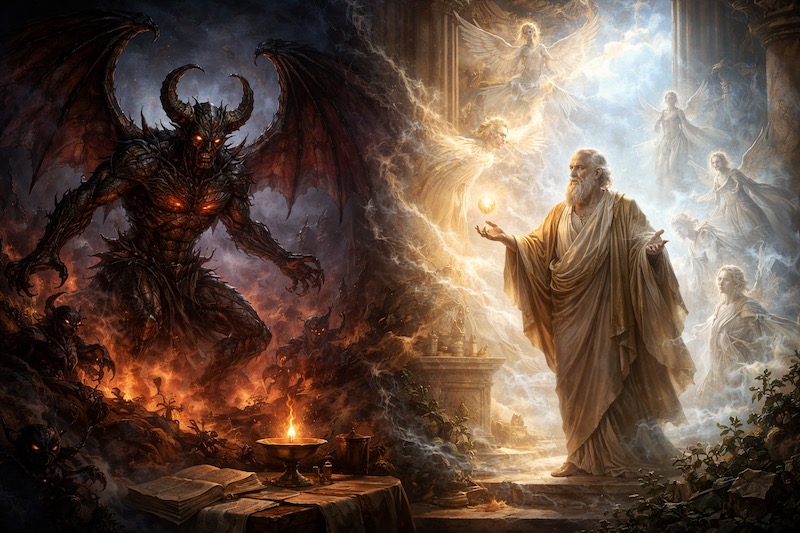
DEMONS - an oversimplified degraded reframing
a flattened version of earlier daimonic nuanced sophistication
made external as evil alien forces to fight
Introduction
In later Abrahamic frameworks—especially within strands of Christianity—a “demon” is typically defined as a hostile, disembodied intelligence opposed to God, aligned with a cosmic rebellion (often associated with Satan), and active in tempting, deceiving, or corrupting human beings. These beings are framed as morally fixed in evil, operating within a dualistic system: God versus adversary, salvation versus damnation. The psychological and experiential language is externalized—temptation is not merely internal conflict but the intrusion of an alien will. The stakes are absolute and often eternal, so the demon becomes not just a misguiding influence but an existential threat tied to judgment and post-mortem consequence.
A pre-Christian Hellenic thinker—working within the conceptual world of Daimon and Plato—would find this framing both reductive and misassigned. For them, a daimōn is not inherently evil, nor is it necessarily external in the crude sense; it is an intermediary force, a structuring pattern, or a distributive intelligence that participates in shaping events, character, and perception. These forces can elevate or degrade depending on alignment, cultivation, and context. What later monotheism isolates as a “demon” would, in this older lens, be recognized as a misaligned or disordered daimonic influence—something closer to a pathological pattern within the psyche, or a destructive relational force between people, rather than a permanently damned being. The moral absolutism collapses into a spectrum of function and harmony.
From that pagan perspective, the Abrahamic “demon” concept reads as a polemical compression: a reclassification of a wide range of daimonic forces into a single category of “enemy.” What had once been a nuanced ecology of influences—some guiding, some distorting, all intelligible within the fabric of φύσις (nature) and ψυχή (soul/mind)—is reframed into a moralized opposition narrative. The inner experience of conflict, compulsion, or destructive impulse is externalized and dramatized as warfare against hostile agents. A Hellenic interpreter might say: what you call a demon is a daimōn whose pattern has fallen into disharmony—within you, between you, or in the field you inhabit—and instead of understanding and reordering it, you have mythologized it as an absolute adversary.
So the difference is not merely theological but structural. The Abrahamic model tends toward dualism and moral fixity; the earlier pagan model tends toward plurality, gradation, and integration. Where one sees invasion, the other sees imbalance. Where one sees an enemy to expel, the other sees a force to understand, name, and either harmonize with—or consciously restrain.
Reframing
The church reframed an earlier neutral concept of Daimones into something evil and to be avoided. This is misguided. But it wasn't always this way. They demonized the term, when in truth, daimones simply is an anthropomorphized consciousness, that simply "is", no judgement, as parts of our perception and agency of our inner self (inner psyche) and of our social self (collective psyche) which includes our outer world.
The word demon reflects a pejorative monotheistic worldview from misunderstanding - particularly reflecting how they prefer to foster fear (villain and victim), rather than fostering trust (empathy and coaching), they instead advocate to suppress and stuff their fears down into oblivion, rather than reform them. This is the monotheist doctrine, a villain and victim below the line mentality. And they're missing something very important.
The ancient priesthood that came before, and non-monotheists now, have a more constructive way to deal with daimones, which is to work with them instead of stuffing them down into suppression. Realizing the simple fact that only when suppressed in that way, they can truly become demons, wound tight they can spring forth unexpectedly in a way that drives us to seem like demonic villains, which produces an endless cycle of fear and dread driving further suppression, a loop that ultimately leads to loss of connection to a part of your self, limiting your humanity, and causing traumatic erroneous cycles within you and echoing out to cause that same thing between others.
What was suppressed and demonized is the practice of reorganizing your daimons (inner parts) to work for you, rather than vigilantly silencing them. Reorganize your world view, and your daimones behaviors, into constructive, by working with them and organizing them and accepting them. You get better results, and less surprises, and whole human experience, this way.
In the Bible, there's daimonic practice happening
What's ironic, is that Jesus himself demonstrates the practice of reorganizing daimones in the original primary source "Greek New Testament" in Luke 11:20-17.
This lines up with standard contemplative discipline of inner purification and release, the letting go of attachments, fears, and constricting influences or named inner personas. It's a common thread seen across spiritual systems, seen in meditation practice in e.g. Buddhist teaching and other traditions of inner release (various Shamanic practice). In the mysteries, an expression of the cathartic discipline (κάθαρσις) — the mystery’s central act of releasing inner daimonic forces to enter a "unity mind" we can call "divine awareness". Divine refers to a particular elevated state of mind, one purged of fears and able to see universal connections.
We can safely say, this is the the practice Jesus is guiding here. Or. Is possibly being misinterpreted by Jesus here. It's difficult to read, specifics are lacking, but safe to say removing lower daimonic forces is exactly equivalent to elevating to a higher consciousness.
But this gets interpreted and flattened as exorcising literal alien external "demons", which loses the nuance of the mental harmonizing happening here.
All these cults were doing catharsis to people, raising their consciousness, and calling it "born again", with evidence in previous religions, and in other non-monotheistic religions.
What's unique is the gross misframing into alien supernatural enemies... This separates humanity from experience, and causes trauma.
Simplification leads to Error
Instead of constructively working with your parts of yourself, those with the demon viewpoint instead advocate fighting through suppression, silence, dominance - a fear-based approach instead of a trust-based approach.
As we know, however, trust is a divine mindset, and fear is a lower mindset, and fear leads to error and suffering. A mentality that frames demons as the only limited concept of the greater field of daimones, is missing something important, and will be doomed to suffer.
A reframing that's designed to keep you in the dark, from reaching higher consciousness, the demonic worldview has reframed higher consciousness (trust mind) as authoritarian and villainous (fear mind), actually as a lower consciousness! As you've no doubt noticed by now.
This is why the 'god' of the Abrahamics (that simple lord Kurios of Eden), is called the false god, or the demiurge, by the gnostics and pagans.
Relevant reading
- Theos and Daimones - learn about the original Theoi and Daimones, higher and lower consciousness parts of you, and a more productive framing.
- Internal Family Systems - learn about how to organize your daimones to be trusted and virtuous.
- Satan - similarly, another misunderstood and later reframed figure.