![[back]](/assets/home_24dp_E3E3E3_FILL0_wght400_GRAD0_opsz24.svg "[back]")
![[search]](/assets/search_24dp_E3E3E3_FILL0_wght400_GRAD0_opsz24.svg "[search]")
Centaur
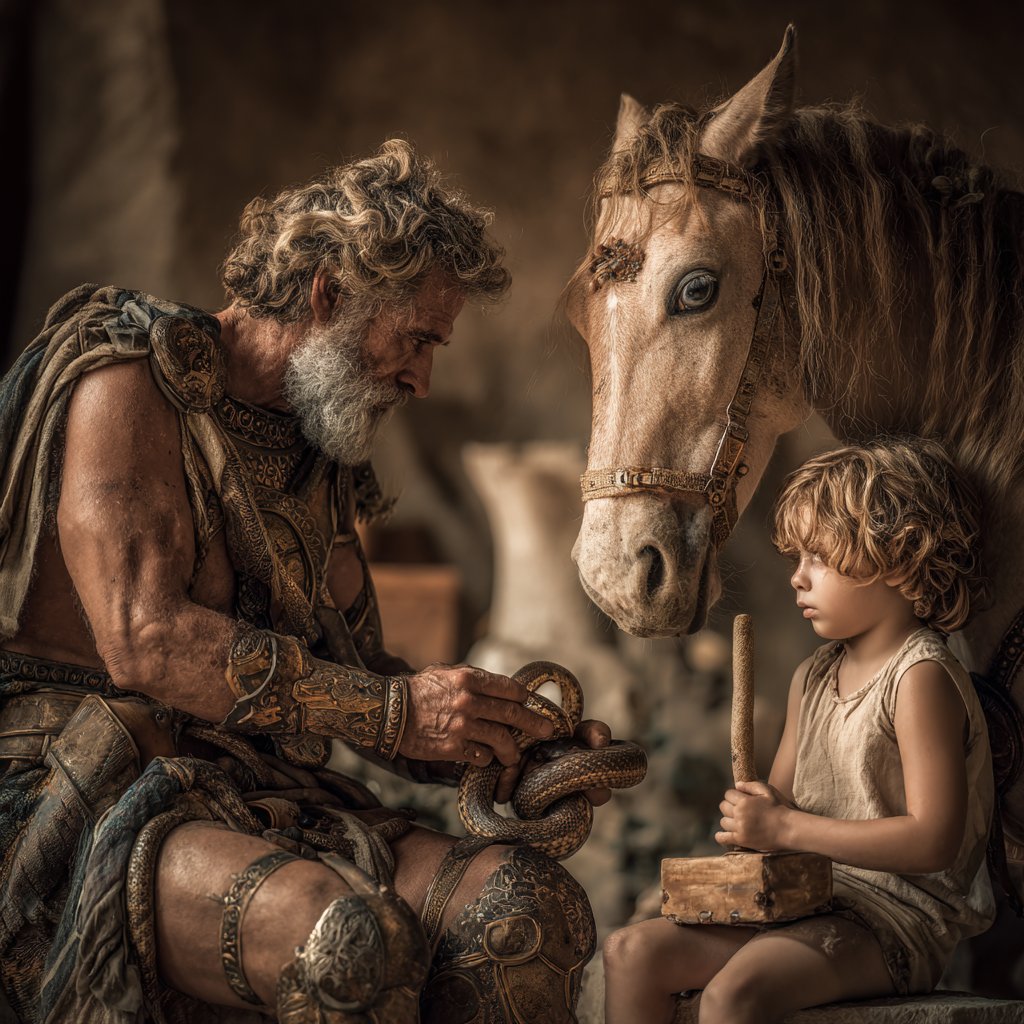
A centaur teaching a boy the venom healing arts
- Intro
- As Educators and Pedarrasts
- Initiatory / Civilizing Centaurs (Teachers & Hosts)
- Violent / Transgressive Centaurs (Ritual Antagonists)
- Heroic / Emotional Centaurs (Mythic Depth Figures)
- Other Named or Attested Centaurs
Intro
Centaurs in Greek myth are traditionally read as monstrous hybrids, embodiments of excess and violence set against the civilizing order of the polis. Yet this surface reading obscures a deeper and older pattern: centaurs function not as a biological “species,” but as roles within an initiatory landscape. They occupy liminal spaces—mountains, forests, borders of human settlement—and mediate between wild power and cultivated knowledge. In this role-based reading, the centaur is comparable to other mythic titles such as the dragon: not merely a creature, but a guardian and transmitter of restricted knowledge, positioned outside ordinary social structures. A priesthood role.
Within this framework, centaurs appear repeatedly in proximity to children and youths destined for priestly or heroic functions. The clearest case is Chiron, who is consistently portrayed as the educator of young heroes before their entry into public life. His domain includes paideia (παιδεία) (education or formation of the young), mousike (μουσική) (any art over which the Muses presided; discipline of mind and body), medicine, and ritual ethics—precisely the competencies required for future leaders, healers, and founders of cultic lineages. Chiron’s dwelling on Mount Pelion, far from the polis yet not hostile to it, marks the centaur as an initiatory instructor, shaping children who will later serve either within temples or beyond them as founders of new ritual traditions.
This distinction helps explain why centaurs in myth divide so sharply into civilizing and destructive figures. Chiron and, more ambiguously, Pholus function as hosts and teachers, while figures such as Nessus and Eurytion represent the failure or corruption of this same liminal power. Heracles’ mythic trajectory illustrates the pattern: he does not simply “fight centaurs,” but passes through centaur spaces, encountering instruction, hospitality, transgression, and pharmakon/venom/poison in different forms. Within this framework, Asclepius institutionalizes what Chiron teaches into healing centers and temple medicine; Heracles survives, weaponizes, and redistributes the same initiatory forces through ordeal and male-only rites. Read this way, centaurs emerge not as narrative monsters, but as custodians of childhood formation and initiatory transmission, standing at the threshold where wild potency is either transformed into sacred knowledge—or unleashed as catastrophe.
- Centaurs are not a species — they are roles
- Chiron = initiatory priest-educator
- Heracles moves through centaurs, not against all of them
- Asclepius institutionalizes Chiron’s teaching
- Heracles weaponizes and survives it
Positioned outside ordinary social structures, functioning as a priesthood role rather than a zoological category
- Centaurs are the teachers of the priesthood.
- Dragons guard the secrets.
As Educators and Pedarrasts
Priesthood roles included young children, for their ability to produce the serum needed for the venom healing. This is why the historical pedarrasty in those topics.
Dr Hillman states from Transcript - WTD ep117 Dr Ammon Hillman Medea the real Mystery Babylon
Dr Hillman states from Ammon Transcript - Danny Jones Interview with DC Ammon Hillman
Hesychius Lexicon - Centaur (κένταυροι)
- Lestai (λῃσταί) - pirate/lestes, plunderers of souls as booty, traffickers
- paiderastai (παιδερασταί) - pedarasts
LSJ Lexicon - Centaur (κένταυροι)
I. in Ep., a savage race, dwelling between Pelion and Ossa, Il.11.832, Od.21.295 sq. (opp. ἄνδρες, ib.303), Hes.Sc.184, h.Merc.224 (perh. in signf. 11), Batr.171: hence, brigands, Hsch.
II. later, monsters of double shape, half-man and half-horse, Pi.P.2.44, etc., cf. Arist. Insomn.461b20, D.S.4.69: prov., οὐπαρὰ Κενταύροισι 'we don't live in fairyland', Telecl.45.
III. the constellation Centaurus, Eudox. ap.Hipparch.1.2.20.
IV. = παιδεραστής, from the brutal sensuality ascribed to the Centaurs, Hsch.2. the pudenda, Theopomp.Com.89.
- paiderastes (παιδεραστής)
A.lover of boys, mostly in bad sense, Ar.Ach.265(lyr.), X.An.7.4.7, Pl. Smp.192b, Eub.130, etc.
Do you wonder what a lestai is? We have a whole book on Lestai by Lucian called Alexander the False Prophet. And there's an article on Lestes with more information as well.
Initiatory / Civilizing Centaurs (Teachers & Hosts)
Chiron
Status: Primary initiatory educator
Students (explicit): Achilles, Asclepius
Students (late tradition / cohort): Heracles (scholia-level)
Domains: medicine, music (μουσική), child teaching (παιδεία), ritual ethics
Notes:
- Only centaur consistently called dikaios (δίκαιος) (“just”)
- Dwells on Mount Pelion (off-polis, initiatory space)
- His wound (Hydra venom) refers to the beastly pharmakon: poison / medicine
- Dies / is translated → constellation (ritual closure)
Pholus
Status: Secondary civilizing centaur
Relation to Heracles: ritual host (wine episode), not explicit teacher
Domains: hospitality, sacred wine, boundary-keeping
Notes:
- Keeper of communal wine jar belonging to all centaurs
- His death triggers the centaur conflict with Heracles
- Represents failed mediation between wild and initiatory orders
Interpretive note: Pholus functions as a threshold guardian, adjacent to Chiron’s pedagogical role.
Violent / Transgressive Centaurs (Ritual Antagonists)
These centaurs define what Chiron is not.
Nessus
Status: Transgressive centaur
Relation to Heracles: antagonist; vector of delayed venom
Domains: sexual violence, deceit, pharmakon-as-curse
Notes:
- Hydra-tainted blood → Deianira → Heracles’ death
- Negative mirror of Chiron’s medicinal venom
- Shows misuse of sacred substances
Eurytion
Status: Wedding violator
Domains: drunkenness, boundary violation
Notes:
- Triggers the Centauromachy
- Represents collapse of ritual order (wedding feast → violence)
Heroic / Emotional Centaurs (Mythic Depth Figures)
Cyllarus
Status: Idealized centaur
Domains: beauty, loyalty
Notes:
- Killed in Centauromachy
- His death is mourned, marking lost nobility among centaurs
Hylonome
Status: Female counterpart
Domains: devotion, suicide, lament
Notes:
- Lover of Cyllarus
- Dies by suicide upon his death
- Rare emotional interiority among centaurs
Other Named or Attested Centaurs
Rhoecus
- Appears in mythographic catalogues
- Minimal narrative role, but attested by name
Nessoi
- Generic plural used in epic and mythography
- Represents centaurs as a class, not individuals