![[back]](/assets/home_24dp_E3E3E3_FILL0_wght400_GRAD0_opsz24.svg "[back]")
![[search]](/assets/search_24dp_E3E3E3_FILL0_wght400_GRAD0_opsz24.svg "[search]")
Amanita muscaria: Fly Agaric, Muscimol, and the Red Mushroom of Sacred Intoxication
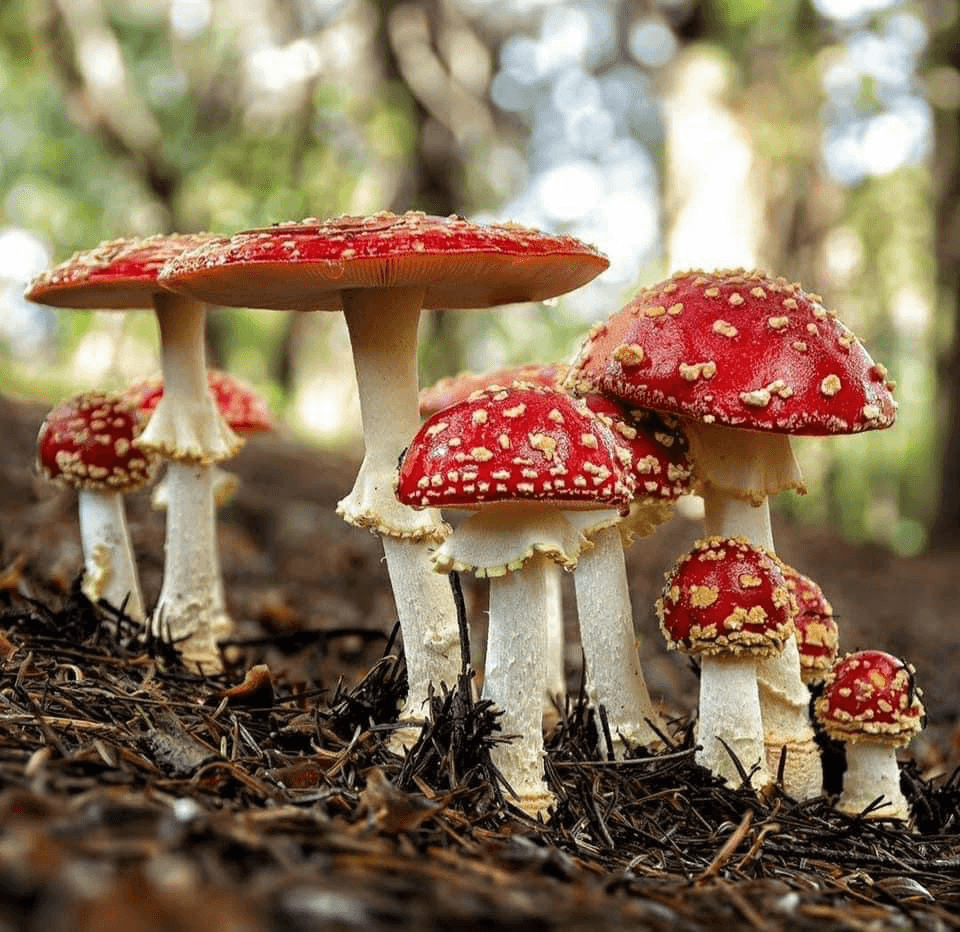
Amanita Muscaria
- Abstract
- The “Good” Amanitas: Fly Agaric and Its Close Relatives
- The “Bad” Amanitas: Intoxication Versus Organ Destruction
- Fly agaric intoxication
- Ibotenic Acid and Muscimol
- Psychological Effects
- The Ibotenic Acid Brain-Lesion Problem
- Preparation Methods
- Trent Austin's Patent
- Celts, Druids, Brigid, Birch, Oak, and the Otherworld
- Santa Reindeer Shamanism, and the Red Mushroom Myth
- Soma in the Rigveda
- Conclusion: The Red Mushroom as Pharmakon
- Source notes:
- See Also
Abstract
Amanita muscaria, the fly agaric, is the red-and-white mushroom of fairy-tale imagery, northern forest religion, reindeer folklore, and modern Soma speculation. It is not a psilocybin mushroom. Its main active chemistry is the ibotenic acid / muscimol system: ibotenic acid is more stimulating, nauseating, and physiologically rough; muscimol is more sedating, dreamlike, dissociative, and oneirogenic. The central practical issue is conversion: drying, heating, acidification, digestion, and some fermentation methods can shift ibotenic acid toward muscimol.
This mushroom belongs to the genus Amanita, a dangerous genus that also contains death caps and destroying angels. That distinction matters. The “good” psychoactive amanitas are not harmless, but they are chemically different from the amatoxin-bearing amanitas that destroy the liver and kidneys. Fly agaric intoxication (the good kind) is usually a neurochemical intoxication, not the (bad kind of) slow organ-destruction syndrome of death cap poisoning.
Confusing those categories creates fear, but confusing the mushrooms themselves can kill.
The “Good” Amanitas: Fly Agaric and Its Close Relatives
When people speak positively about “amanita” in an entheogenic or Soma-like context, they usually mean Amanita muscaria and close relatives such as Amanita pantherina, Amanita regalis, and some regional varieties of the fly agaric complex. These mushrooms contain the isoxazole compounds ibotenic acid and muscimol. They do not work like psilocybin mushrooms, cannabis, opium, alcohol, or classical serotonergic psychedelics. Their intoxication is its own category.
Muscimol is the more desired compound in most modern discussions. It acts primarily through GABA-A receptor activity, producing sedation, altered perception, dreamlike consciousness, bodily heaviness, dissociation, trance, sleep, and sometimes visionary or delirious states. Ibotenic acid is more excitatory, more glutamate-like, and is usually treated as the rougher part of the pharmacological package. It can contribute stimulation, nausea, twitching, discomfort, and confusion, while also serving as a precursor that can decarboxylate into muscimol.
So the basic fly agaric problem is not “poison or medicine” in a simplistic sense. It is preparation, dose, species, chemistry, and context. The raw mushroom gives one chemical profile. A dried mushroom gives another. A cooked acidic extraction gives another. A fermented preparation may give another.
Ancient ritual traditions, if they used this mushroom, would almost certainly have cared about preparation.
The “Bad” Amanitas: Intoxication Versus Organ Destruction
The genus Amanita contains both psychoactive mushrooms and deadly mushrooms. This is where the public discussion often becomes confused. Amanita muscaria is not the same as Amanita phalloides, the death cap. Death caps and destroying angels contain amatoxins, especially alpha-amanitin, which can cause catastrophic liver failure, kidney injury, and death. This is not merely “getting too high.” This is delayed organ destruction.
Amatoxin poisoning is especially dangerous because the first symptoms may be gastrointestinal, then temporarily improve, while liver injury continues underneath. By the time the person realizes the danger, the poisoning may already have moved into a life-threatening hepatic phase. Cooking, drying, and freezing do not make death caps safe.
Fly agaric intoxication
Fly agaric intoxication is different. Amanita muscaria ingestion is primarily a nervous-system intoxication involving ibotenic acid and muscimol. It may involve nausea, vomiting, sweating, agitation, confusion, delirium, sleep, dreamlike visions, loss of coordination, and altered consciousness. It can be dangerous, especially with poor identification, excessive dose, children, mixed substances, or commercial products of unknown strength. But chemically it is not the same syndrome as death cap poisoning.
This distinction should be carried through the whole discussion: fly agaric has real risk, but it should not be lazily collapsed into the organ-destroying amanitas. A death cap is a liver-killer. Fly agaric is an intoxicating mushroom with a rough pharmacology that must be understood on its own terms.
Ibotenic Acid and Muscimol
The two central compounds are ibotenic acid (IBO) and muscimol (MUS). Ibotenic acid is structurally related to glutamate and can act at excitatory glutamate receptors. Muscimol is structurally related to GABA and acts as a powerful GABA-A agonist. In plain language: ibotenic acid leans toward excitation and toxic roughness; muscimol leans toward inhibition, sedation, trance, and dream-state intoxication.
Ibotenic acid can decarboxylate into muscimol. This can happen through drying, heating, acidic conditions, and to some degree in the body after ingestion. That means preparation matters enormously. A raw mushroom is not pharmacologically identical to a dried mushroom, and a dried mushroom is not necessarily identical to a carefully heated acidic preparation.
This is also why some ancient descriptions of pressing, soaking, filtering, drying, and mixing with milk are interesting in the Soma debate. These are not random kitchen details. They may be pharmacological details. If Soma was fly agaric, then the ritual processing would not be ornamental. It would be the technology.
Psychological Effects
The fly agaric state is not a clean “psychedelic” state in the LSD or psilocybin sense. It can be visionary, but it is often stranger, heavier, more bodily, more dreamlike, and more unstable. Users report sedation, warmth, sleepiness, euphoria, size distortion, looping thoughts, changes in bodily scale, trance, dream intrusion, vivid internal imagery, dissociation, and sometimes a sense of mythic or spirit contact.
At higher or poorly prepared exposures, the state can become confused, delirious, nauseating, dysphoric, or physically unpleasant. People may become uncoordinated, agitated, sweaty, sleepy, or unable to track ordinary reality clearly. The mushroom can produce an oneirogenic state: not just “seeing visuals,” but crossing into dream logic while still partially awake.
This is one reason fly agaric fits certain shamanic and mythic patterns better than modern recreational categories. It is not simply fun, medicinal, toxic, or hallucinogenic. It is a consciousness-disordering mushroom. In the right ritual frame, that disorder could be interpreted as sacred travel, death-and-return, spirit flight, or entry into the Otherworld. In the wrong frame, it can simply be poisoning, confusion, and risk.
The Ibotenic Acid Brain-Lesion Problem
Ibotenic acid has a frightening reputation because scientists have used it as a brain-lesioning agent in animal research. But the key detail is route of administration. Injecting ibotenic acid directly into the brain is not the same as eating a mushroom and passing its compounds through the stomach, liver, blood, kidneys, and ordinary metabolism.
That does not make ibotenic acid harmless. It means the “brain lesion” rhetoric is often exaggerated when applied directly to oral fly agaric use. The body is not a skull syringe. Oral ingestion involves absorption, conversion, excretion, and dose limits. Some ibotenic acid may convert to muscimol before or after ingestion. Some is excreted. The risk profile should be discussed honestly, not mythologized into instant brain destruction.
A useful comparison is alcohol. Alcohol is toxic to the brain, liver, gut, sleep architecture, endocrine system, and whole body. Yet society understands that alcohol risk depends on dose, frequency, person, and context. Fly agaric deserves the same chemical seriousness. It is not harmless. It is not automatically catastrophic. Its risks are real, but they must be described accurately.
Preparation Methods
The simplest method is raw consumption. This preserves the broadest raw mushroom profile, including ibotenic acid and whatever muscimol is already present. Pharmacologically, this is the roughest and least refined approach. It is more likely to emphasize nausea, excitation, bodily discomfort, and unpredictable intoxication.
A second method is drying. Drying can convert some ibotenic acid into muscimol, but not necessarily all of it. This is why dried fly agaric is usually considered pharmacologically different from raw fly agaric, but not automatically “fully converted.” Traditional accounts often emphasize drying near heat, in the sun, near a fire, or strung up for preservation. The drying process is both storage technology and drug conversion technology.
A third method is a cooked liquid preparation, especially one using heat and acidity. The basic pharmacological idea is to encourage decarboxylation of ibotenic acid into muscimol, then consume the liquid preparation rather than the raw tissue (which can upset the gut). This resembles the general logic of processing: reduce the rougher precursor, increase the more sedative active compound, and make the experience more muscimol-dominant.
A fourth method is using controlled conversion using either enzymes or fermentation. Trent Austin’s patent describes 2 methods:
- Acid + Heat Conversion (as already discussed above).
- Dry the mushroom.
- Rehydrate it.
- Lower the pH (acidify).
- Heat it.
- This promotes decarboxylation of ibotenic acid (IBO) into muscimol (MUS).
- Enzymatic Conversion using GAD
- Use glutamate decarboxylase (GAD) to increase the muscimol-to-ibotenic-acid ratio.
Fermentation is often discussed in connection with this second approach because some fermentation microorganisms naturally produce glutamate decarboxylase (GAD). As a result, some modern Amanita practitioners have experimented with lactic-acid bacterial fermentations, particularly using Lactobacillus species, in an attempt to increase conversion of ibotenic acid to muscimol. The effectiveness of these methods has not been studied nearly as extensively as the better-understood acid-and-heat conversion process.
The goal is clear: reduce ibotenic acid (IBO) and increase muscimol (MUS). Fly agaric preparation is chemistry. The mushroom can be processed toward a different active profile.
Trent Austin's Patent
US20140004084A1 - Austin, Trent. Method for Producing Muscimol and/or Reducing Ibotenic Acid from Amanita Tissue. U.S. Patent Application US20140004084A1, published January 2, 2014.
US8784835B2 - Austin, Trent. Method for Producing Muscimol and/or Reducing Ibotenic Acid from Amanita Tissue. U.S. Patent US8784835B2, issued July 22, 2014.
Austin claimed two approaches:
- Use of glutamate decarboxylase to increase the muscimol-to-ibotenic-acid ratio.
- A process involving drying, reconstitution, acidification below pH 4.5, and heating above 175°F (79°C) to increase conversion.
- particularly relevant because it resembles the low-pH heat decarboxylation methods that have become most common in Amanita preparation discussions.
Celts, Druids, Brigid, Birch, Oak, and the Otherworld
Birch-centered symbolism makes Amanita an attractive candidate for interpretation within Celtic forest religion.
- The clustering of birch, oak, mistletoe, poetic inspiration, Otherworld journeys, and a psychoactive forest mushroom is suggestive.
- Ogham symbolism may preserve ecological memory of important trees.
The basic idea is that northern European ritual specialists, including druids or pre-Christian Celtic religious figures (perhaps Goddess Brigid herself), may have known and used red-and-white fly agaric in sacred forest contexts. Birch and oak matter because Amanita muscaria is mycorrhizal: it lives in relationship with trees, especially birch, pine, spruce, and sometimes oak-associated woodland ecologies.
Brigid is associated with fire, poetry, healing, smithcraft, inspiration, and liminal sacred power. A fly agaric reading would see the mushroom as a red fire-bearing forest sacrament, a substance of poetic inspiration and Otherworld crossing.
What we know for sure: the ecology, symbolism, and northern visionary pattern make fly agaric a plausible candidate for some forest-based intoxication rites, especially where birch, oak, mistletoe, poetic inspiration, and Otherworld travel cluster together.
Celtic - Old Irish alphabet (400CE - 700CE)
Here is a complete list of the Ogham alphabet in Old Irish, along with their associated meanings, colors, and word ogham:
- Beithe (B) - Meaning: Beginning, Renewal / Color: Light Green / Word Ogham: Birch - forms mycorrhizal associations with Amanita muscaria, the FIRST letter!
- Luis (L) - Meaning: Healing, Protection / Color: Red / Word Ogham: Rowan
- Fern (F) - Meaning: Endurance, Strength / Color: Dark Green / Word Ogham: Alder
- Sail (S) - Meaning: Intuition, Spirituality / Color: Blue / Word Ogham: Willow
- Nion (N) - Meaning: Wisdom, Connection / Color: Silver / Word Ogham: Ash
- Uath (H) - Meaning: Change, Transformation / Color: Brown / Word Ogham: Hawthorn
- Dair (D) - Meaning: Stability, Protection / Color: Dark Brown / Word Ogham: Oak
- Tinne (T) - Meaning: Truth, Justice / Color: Holly / Word Ogham: Holly
- Coll (C) - Meaning: Hazel, Inspiration / Color: Light Brown / Word Ogham: Hazel
- Ceirt (Q) - Meaning: Love, Harmony / Color: Apple Green / Word Ogham: Apple
- Muin (M) - Meaning: Joy, Celebration / Color: Purple / Word Ogham: Vine
- Gort (G) - Meaning: Fertility, Growth / Color: Blue-Green / Word Ogham: Ivy
- Gétal (GW) - Meaning: Knowledge, Communication / Color: Yellow / Word Ogham: Reed
- Straif (ST) - Meaning: Challenge, Fate / Color: Black / Word Ogham: Blackthorn
- Ruis (R) - Meaning: Transformation, Endings / Color: Dark Red / Word Ogham: Elder
- Ailm (A) - Meaning: Healing, Protection / Color: Silver / Word Ogham: Fir - the silver fir can form mycorrhizal associations with Amanita muscaria
- interpreted to refer to the silver fir (Abies alba) or the common fir (Abies alba) which are native to Ireland and Britain.
- Onn (O) - Meaning: Energy, Inspiration / Color: Gold / Word Ogham: Furze
- Úr (U) - Meaning: Hope, Renewal / Color: Purple / Word Ogham: Heather
- Edad (E) - Meaning: Change, Growth / Color: Erc (Speckled) / Word Ogham: Brother of Birch - means amanita? (Rarely used, scholars uncertain as to meaning)
- Associated with the color "erc," in the context of Old Irish, the term "erc" can refer to a color meaning "speckled" or "variegated." It is used to describe a color pattern characterized by spots or specks of different colors or shades. The term "erc" is associated with the concept of speckling or mottling in Old Irish color vocabulary.
- The word ogham associated with "Edad" is "Bráthair" (or "bráthir") which means "brother" in English.
- The term "brother of birch" is a poetic description or metaphorical association that signifies a relationship or connection between "Edad" and the first letter of the Ogham alphabet, "Beith" (birch)
- In Irish: Eadha / Eadhadh (E) - Meaning: Poplar / Represents: change, growth, and the cycle of life / Color Gray / Word Ogham: Poplar
- Idho (I) - Meaning: Endurance, Resilience / Color: Dark Blue / Word Ogham: Yew
Hypothesis: Speckled + brother of birch = Amanita muscaria
To an Amanita researcher, the combination is striking. A speckled “brother of birch” evokes the image of a birch-associated, white-speckled forest organism. Whether this connection was ever intended by the creators of the Ogham tradition is unknown, but the symbolism is suggestive enough to invite comparison.
Celts - Edad speckled brother of birch
In some interpretations of the Ogham alphabet, the letter "Edad" is associated with the color "erc," In the context of Old Irish, the term "erc" can indeed refer to a color meaning "speckled" or "variegated" mottled or spotted. It is used to describe a color pattern characterized by spots or specks of different colors or shades. The term "erc" is associated with the concept of speckling or mottling in Old Irish color vocabulary.
Additionally, the word ogham associated with "Edad" is "Bráthair" (or "bráthir") which means "brother" in English. The term "brother of birch" is a poetic description or metaphorical association for "Edad" in some interpretations of the Ogham alphabet. It signifies a relationship or connection between the letter "Edad" and the first letter of the Ogham alphabet, "Beith" (meaning "birch").
Celtic Otherworld
Another argument for a Celtic fly agaric tradition comes from descriptions of the Celtic Otherworld itself. In Irish myth, the Land of Promise (Tír Tairngire), the realms of the Sídhe, and the domains of the Tuatha Dé Danann are repeatedly described as places of extraordinary beauty and altered reality. Colors are unusually vivid, music seems to arise from nowhere, humans and animals transform from one shape into another, and the normal rules of time and distance become unreliable. A visitor may spend what feels like a single evening in the Otherworld only to discover that years have passed in the mortal world.
None of these motifs prove the use of a psychoactive sacrament. Visionary journeys can arise through dreaming, fasting, ritual, meditation, illness, sensory deprivation, or other methods of entering altered states of consciousness. Nevertheless, when these features are viewed together, the Celtic Otherworld bears a striking resemblance to reports of Amanita muscaria intoxication and dreamlike muscimol states. Distortions of time, encounters with talking animals, transformations of form, vivid sensory experience, and immersion in a reality that feels simultaneously real and impossible are all themes found both in Celtic myth and in fly agaric accounts.
Celtic legends also place remarkable emphasis on magical foods, enchanted feasts, wisdom-granting drinks, and other substances that transport heroes into states of revelation or Otherworldly perception. This pattern parallels what is known from northern Eurasian shamanic traditions, where fly agaric was not merely an intoxicant but a vehicle for entering sacred realms, communicating with spirits, obtaining knowledge, and crossing the boundary between ordinary reality and the world beyond. While no surviving Celtic text explicitly identifies Amanita muscaria as the source of these experiences, the similarities are strong enough that researchers such as Kevin Feeney have considered the possibility that some Celtic Otherworld traditions may preserve distant memories of mushroom-assisted visionary journeys.
Kerberos
If you ever think mythology is boring...
Just remember that Cerberus, the hellhound and guard dog of the Underworld, comes from the root Indo-European word kerberos, which evolved into the Greek word kerberos, which got changed to cerberus when it went from Greek to Latin
kerberos means "spotted"
that's right
Hades, Lord of the dead, literally named his pet dog Spot
... Or... the guardian was “erc” colored, spotted, and gave access to the underworld / otherworld! Amanita Muscaria.
Santa Reindeer Shamanism, and the Red Mushroom Myth
The Santa-fly agaric theory is famous, colorful, and partly overgrown with internet mythology. The story says that northern shamans tended reindeer who ate fly agaric; that the red-and-white mushroom inspired Santa’s red-and-white clothing; that raw mushrooms were hung to dry near the fire in socks, or on evergreen branches; that snow-blocked doors led shamans to enter through roof smoke-holes; and that reindeer “flying” reflects the ecstatic or intoxicated reindeer/shamanic journey.
Some pieces of this are plausible as mythic association. Reindeer do eat fly agaric. Siberian and circumpolar mushroom traditions are real. The Koryak and other Siberian accounts are central to the ethnographic fly agaric story.
- Presents: The red and white mushroom appears under evergreen trees. Presents are often red/white.
- Stockings and Ornaments: The raw mushroom is dried for preservation in socks hung by the fire, and on branches of the tree.
- Tree: It's the tree of life, and a tree to dry mushrooms on.
- Flying Reindeer: Reindeer are drawn to it. And the sensation of flying happens when you eat it.
- Flying Santa: The shaman travels between worlds.
- Winter Solstace: Gifts arrive in the darkest season.
- Entering by Chimney: With a yurt buried under snow, the smoke-hole becomes the way for the village Shaman to deliver the psychoactive presents for the holiday.
See Also Santa Reindeer Shaman
Soma in the Rigveda
R Gordon Wasson famously argued that Vedic Soma was Amanita muscaria. The argument is not proven, but it remains one of the most important entheogenic hypotheses in religious studies. Soma is described as a divine plant, pressed, filtered, mixed, consumed, praised, and experienced as immortalizing, energizing, and visionary. Wasson saw in this not a fermented alcohol, but a sacred mushroom.
The strongest fly agaric reading focuses on preparation. Soma is pressed. Soma is filtered through wool. Soma is mixed with milk. Soma is exposed, purified, and ritually handled. Kevin Feeney later emphasized that these details may not be incidental. If fly agaric is soaked, pressed, filtered, and processed, then preparation can alter the ibotenic acid / muscimol profile and reduce some toxic effects. That helps answer one criticism of Wasson: why would a mushroom need pressing and filtering at all? Because the pharmacology changes with preparation.
The Rigvedic Soma passages do not hand us a modern botanical label. They give us ritual technology, poetic language, and pharmacological clues. The Soma plant is not merely eaten raw. It is prepared. It is filtered. It is mixed. It is made into a drink. In the fly agaric hypothesis, those ritual details become chemically meaningful.
Conclusion: The Red Mushroom as Pharmakon
Fly agaric is a pharmakon: poison, drug, sacrament, danger, medicine, and consciousness tool depending on species, preparation, dose, and frame. It is not the death cap. It is not psilocybin. It is not harmless. It is not well described by modern categories like “recreational” or “medicinal.” Its real identity is stranger: a northern forest intoxicant whose chemistry crosses excitation and inhibition, sickness and dream, poison and vision.
The ancient question is not simply “did people get high on mushrooms?” The better question is: did ritual cultures discover preparation methods that transformed a rough mushroom into a usable vehicle for sacred travel? With fly agaric, that question is chemically serious. Drying, heating, filtering, milk, acidity, fermentation, and bodily metabolism all matter.
If Soma was fly agaric, then Soma was not just a plant. It was a process. If Santa preserves a memory of amanita shamanism, then Santa is not just a children’s myth. He is a winter shaman bringing dried red forest medicine through the roof-hole. If the Celtic Otherworld has a fly agaric shadow, then the red mushroom belongs not to fantasy decoration, but to the old pharmacology of crossing.
Fly agaric sits at the threshold: under birch and pine, between poison and sacrament, between sickness and vision, between body and dream.
Source notes:
- death cap / amatoxin liver-failure distinction is supported by CDC and StatPearls.
- Ibotenic acid / muscimol pharmacology, decarboxylation, and intoxication effects are supported by recent toxicology reviews and CDC/FDA summaries.
- Trent Austin’s patent covers reducing ibotenic acid / producing muscimol using drying, reconstitution, acidic pH, and heat.
- Wasson’s Soma theory and Feeney’s preparation-focused revision are supported by Wasson’s publication record and Feeney’s “Revisiting Wasson’s Soma.”