![[back]](/assets/home_24dp_E3E3E3_FILL0_wght400_GRAD0_opsz24.svg "[back]")
![[search]](/assets/search_24dp_E3E3E3_FILL0_wght400_GRAD0_opsz24.svg "[search]")
How to Use the TLG (Thesaurus Linguae Graecae)
Thesaurus Linguae Graecae: A Digital Library of Greek Literature (TLG) is a digitized collection of most surviving Greek literary texts, written between the Archaic period (c. 800 – 600 BC) and the fall of Byzantium in 1453 AD. The corpus also contains a large number of post-Byzantine texts (16 – 20 c. AD). Some newly discovered, fragmentary, or documentary materials (such as inscriptions and papyri) are generally outside its scope and thus excluded, being instead covered in other specialized corpora. Note that the corpus is not 100% exhaustive.
The TLG itself incorporates a number of lexica (dictionaries), making individual words within the corpus searchable. Most notable is the Liddell-Scott-Jones Greek-English (LSJ) lexicon, Cunliffe's Lexicon of Homeric Greek, Powell’s Lexicon of Herodotus, the Lexikon zur byzantinischen Gräzität (LBG), and more recently the Historical Lexicon of Modern Greek.
Linguistic Terminology
It may be helpful to familiarise yourself with the following terms as you pursue Classical Philology. This is for your own interest; non-academic language is fine for this reading group!
- TLG (Thesaurus Linguae Graecae) – A digitised collection of Greek texts.
- LSJ (Liddell-Scott-Jones Greek-English) – A 19th century lexicon (dictionary) of ancient Greek words with their definitions in English.
- Attestation – An occurrence of a word, in any form/construction, in actual recorded language data, i.e., evidence of its documented use in history.
- Corpus (pl. corpora) – A collected body of texts (corpus is Latin for ‘body’).
- Lexeme (pl. lexemes) – An abstract unit of vocabulary that represents a set of related word forms sharing the same core meaning and grammatical identity. For instance, the words Σατανᾶς Satan (noun) and σατανικός Satanic (adjective) are different lexemes, each with their own set of inflected forms. The words Σατανᾶς, Σατανᾶ, Σατανᾷ, Σατανᾶν are different forms of the lexeme Σατανᾶς Satan; whereas σατανικός, σατανικοῦ, σατανικῷ, σατανικόν are different forms of the lexeme σατανικός Satanic.
- Lemma (pl. lemmata; lemmas) – The canonical form of an inflected word, usually found as the headword in a dictionary. That is, the lemma is the form of the lexeme listed in a dictionary. For instance, in English the dictionary form of a verb is its bare infinitive, e.g., write meaning ‘to write’; whereas in ancient Greek the dictionary form of verbs is not an infinitive form, e.g., γράφειν to write, but the first person singular present active indicative, e.g., γράφω I write. For Greek nouns, the dictionary form is the masculine, singular, nominative, e.g., Σατανᾶς Satan. Thus, Σατανᾶς Satan (m. nom. sg.) is the lemma (dictionary entry) for the lexeme Σατανᾶς Satan.
- Lexicon (pl. lexica) – A dictionary. The LSJ is a notable Ancient Greek lexicon.
Navigating the TLG
The following set of instructions relates to a Text Search for ‘Satan’, by which we aim to find every source that contains a reference to this word. That is, we are looking for all lexemes containing the σ-τ-ρ (s-t-r) root as it appears in various forms of the word ‘Satan’; namely, Σατανᾶς Satan, σαταναήλ Satan (a name for Satan), Σατανικός Satanic, σατανικῶς like one possessed; diabolically, and σατανοδρόμιον Satan’s race-course; as well as words compounded with these lexemes, such as σατανοδιαβολάρχην satanic-devilish overlord (< Σατανᾶς Satan + διάβολος devil, slanderer + ἄρχων ruler, leader). Compounding is a highly productive feature of Greek; elaborate compounds of this kind are frequently coined ad hoc and may appear only once in the corpus (i.e. a hapax legomena).
Note that a text search is different to a lexicographical search, which you may be more familiar with. The former shows sources for a particular lexeme (such as Σατανᾶς), while the latter gives the definition(s) of that lexeme. The two types of searches complement one another. Because we want to capture every source related to Satan, we want to search for every lexeme related to Satan (listed above) at the same time. Conveniently, this can be done by searching simply with ‘satan’ or ‘σαταν’, since these letters begin every word-form relevant to our search.
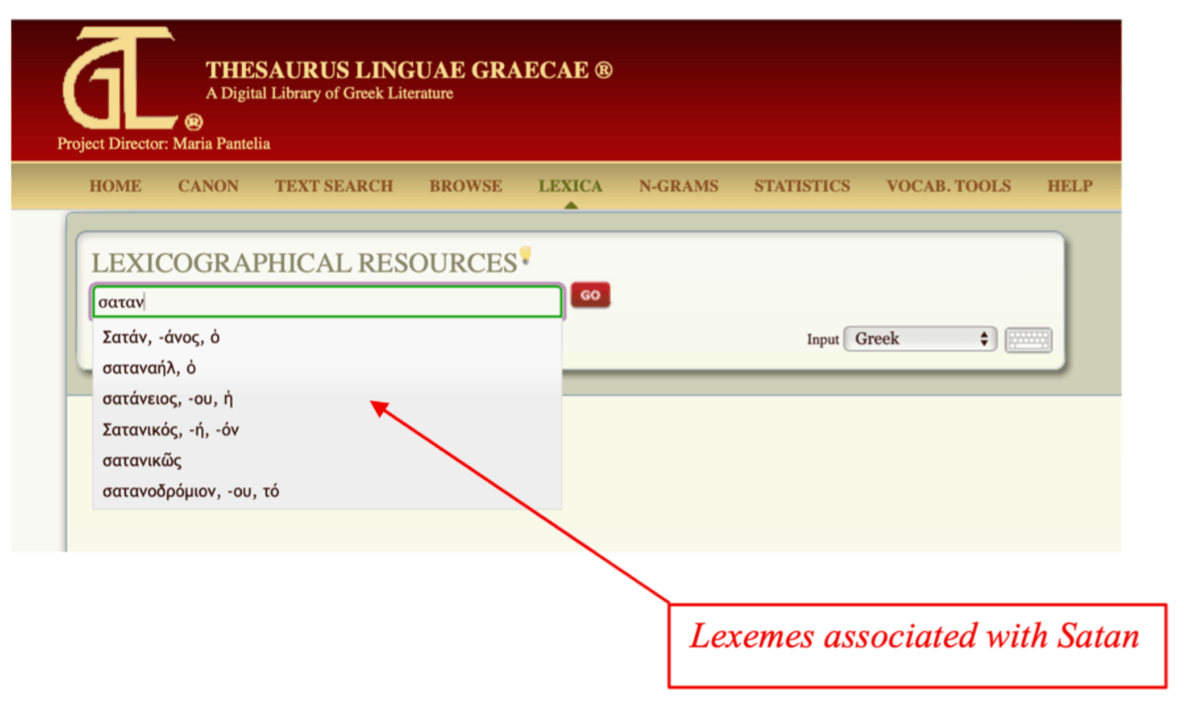
Steps for Performing a Text Search
- Go to the TLG (here) and register to create an account. A free account will provide you with access to an abridged version of the corpus, while a paid subscription will include the entire corpus. Most academic institutions have their own subscription – if you are a current student or alum, see if you can access the full version through your institution.
- Once you have created an account, navigate either to FULL CORPUS (subscription) or ABRIDGE TLG (open access). This guide will direct you through the abridged version.
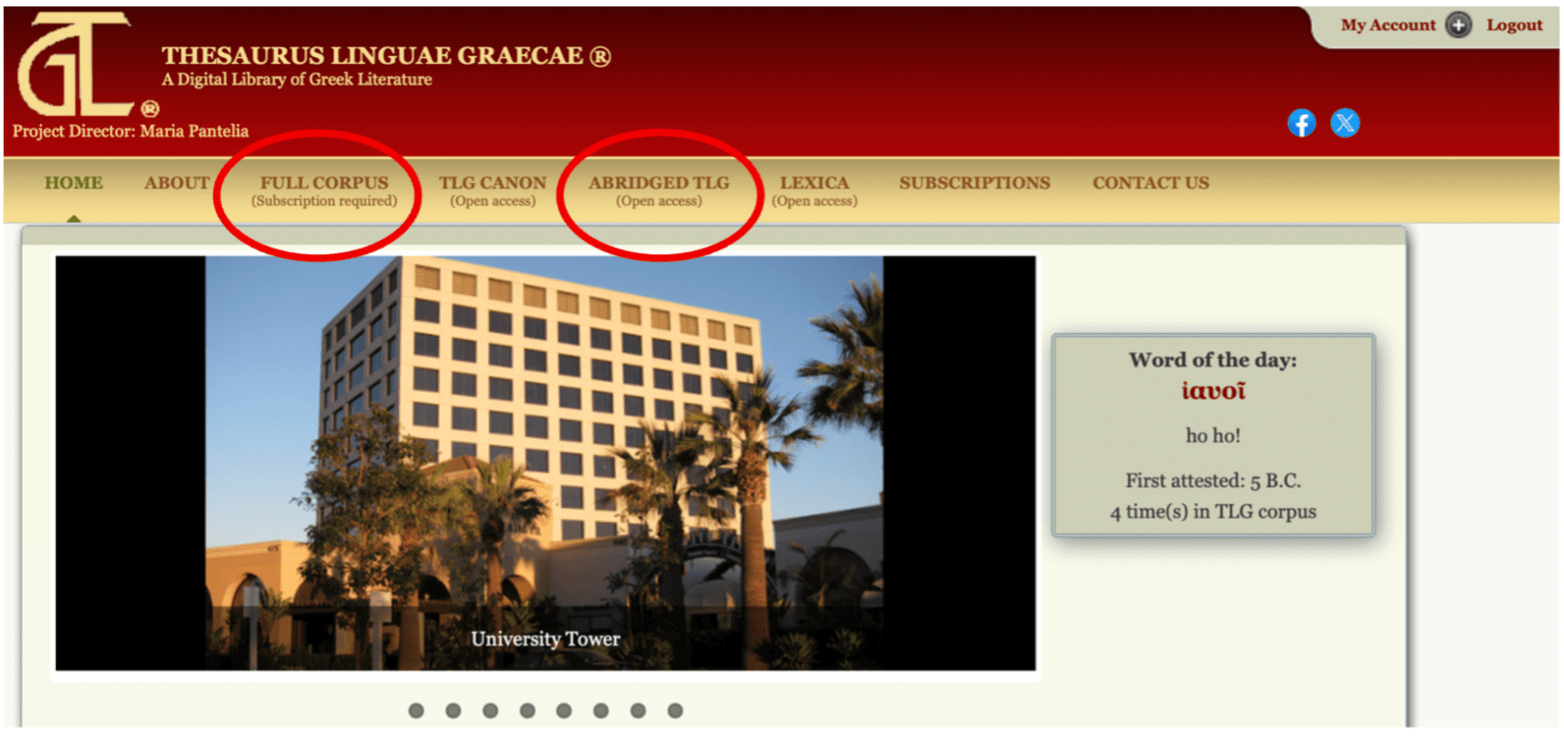
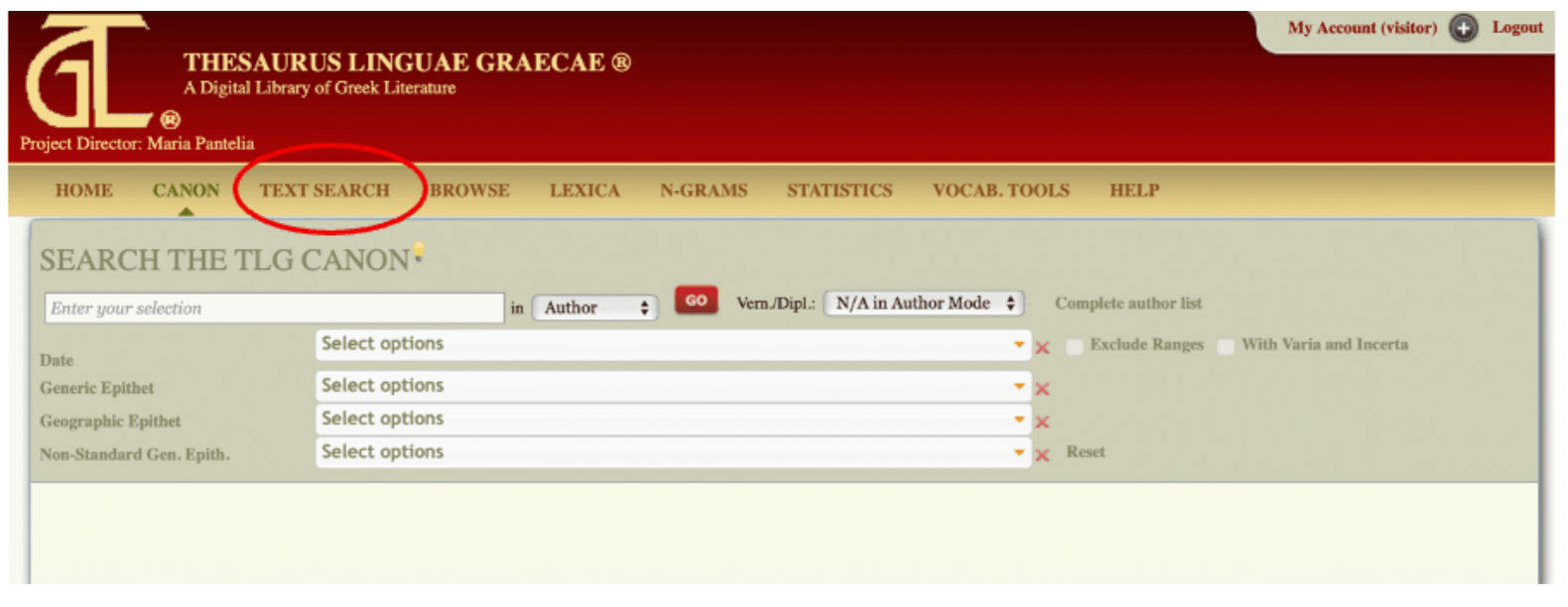
- When you have landed, click on TEXT SEARCH in the menu.
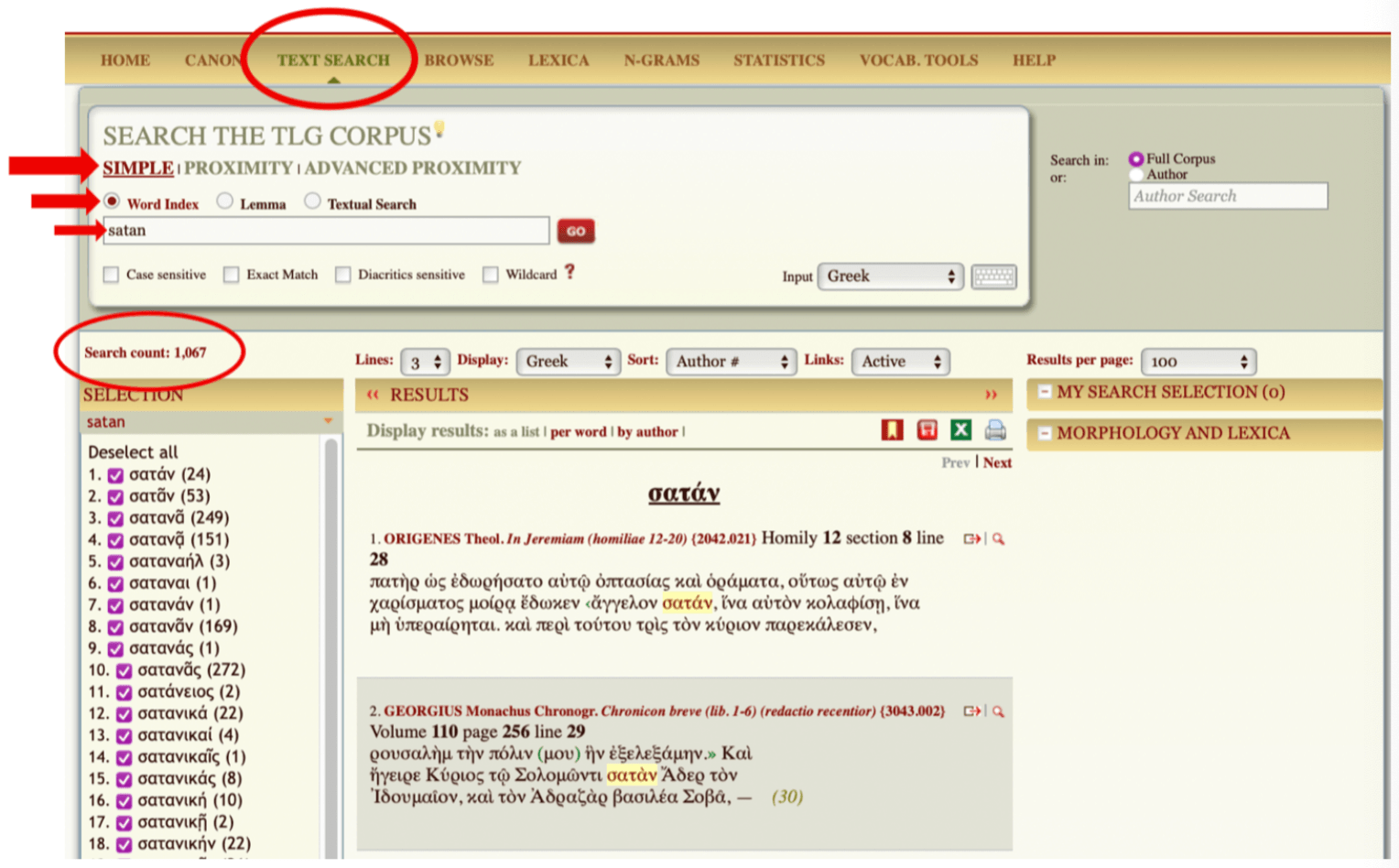
- From here, perform a SIMPLE search, for a Word Index, by typing ‘satan’ into the field and clicking GO. This will show 1,067 attestations for the word ‘Satan’ in all its forms.
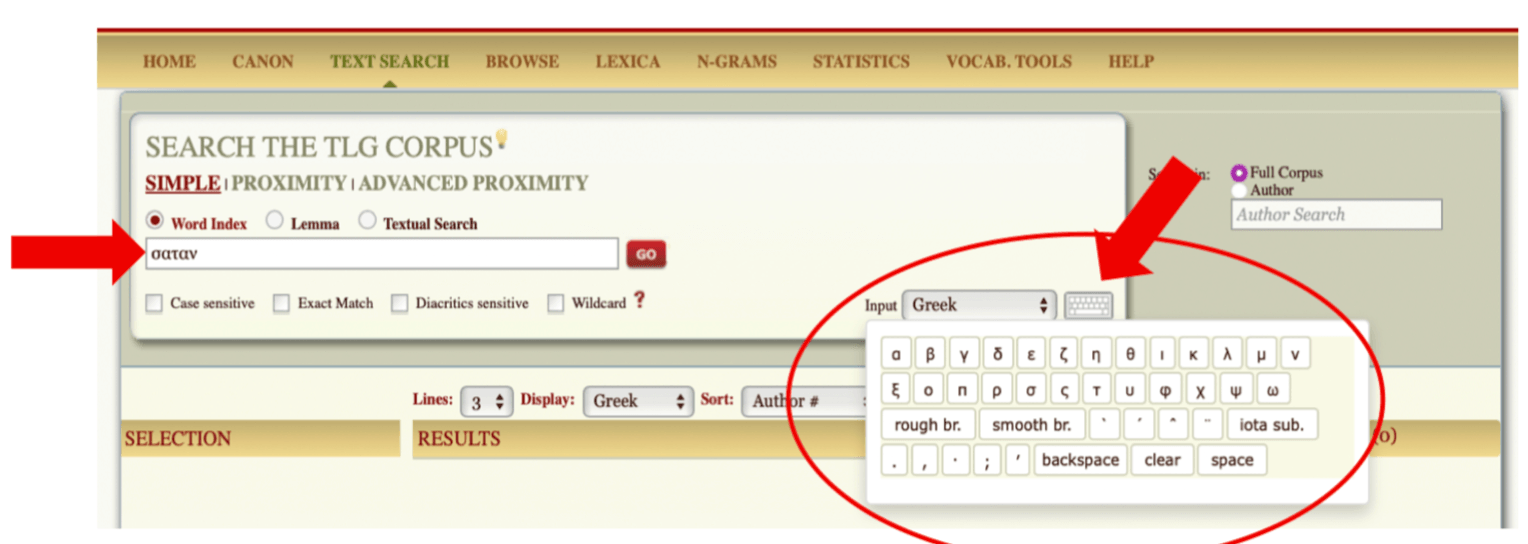
You can also use the Greek keyboard to type the word σαταν into the search box, instead of English satan – though it is not necessary for this particular search. Tap the keyboard icon, and select the letters of the word you want to type into the search box:
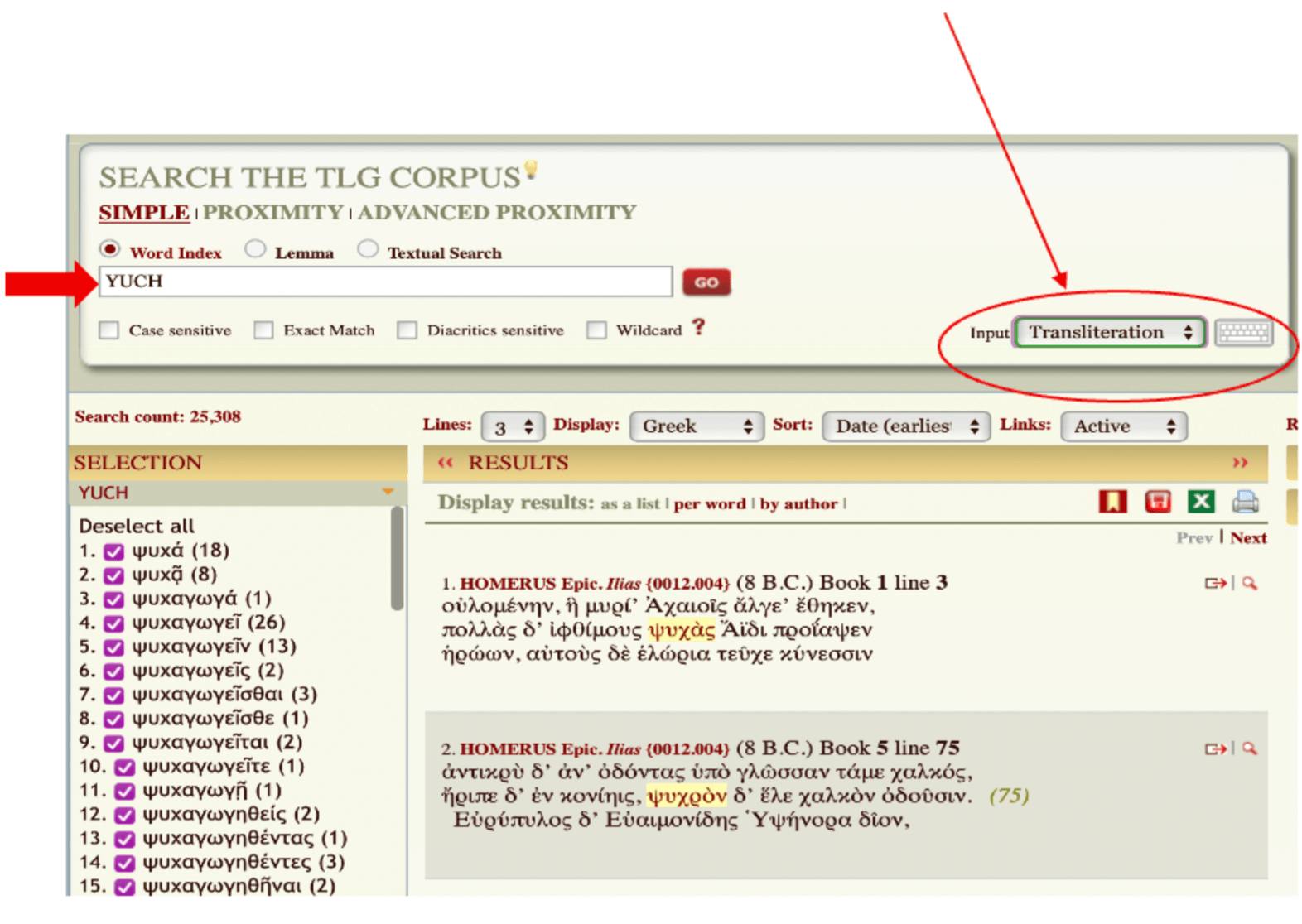
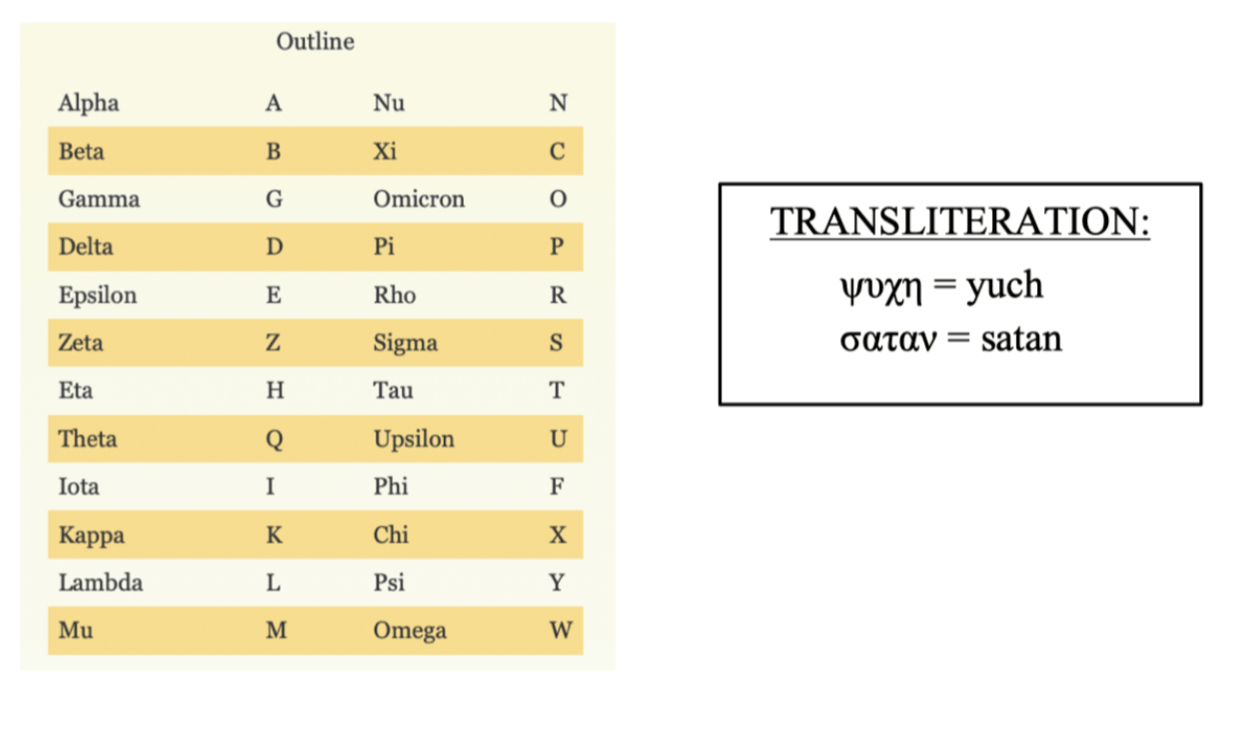
In the TLG, all Greek words can be entered using English letters because the system uses standard transliteration. A word like ‘Satan’ can be typed as satan to retrieve σαταν, but for words with letters like χ and ψ, you need to know the correct transliteration. For instance, in transliteration, the word ψυχή psyche is written as ‘yuch’. If you choose to write Greek with English letters this way, you will need to change the Input selection to ‘transliteration’. If you plan on using the TLG extensively, it is best to download and install a polytonic Greek font.
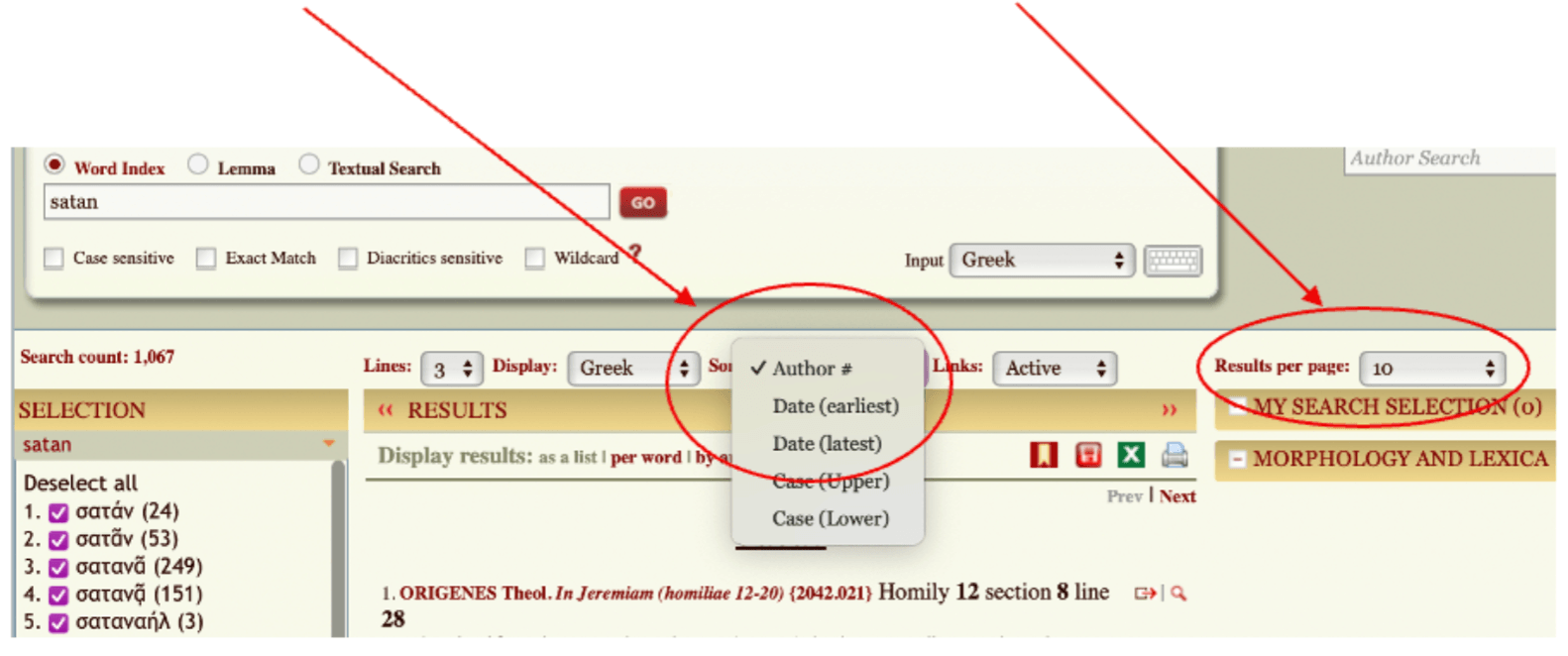
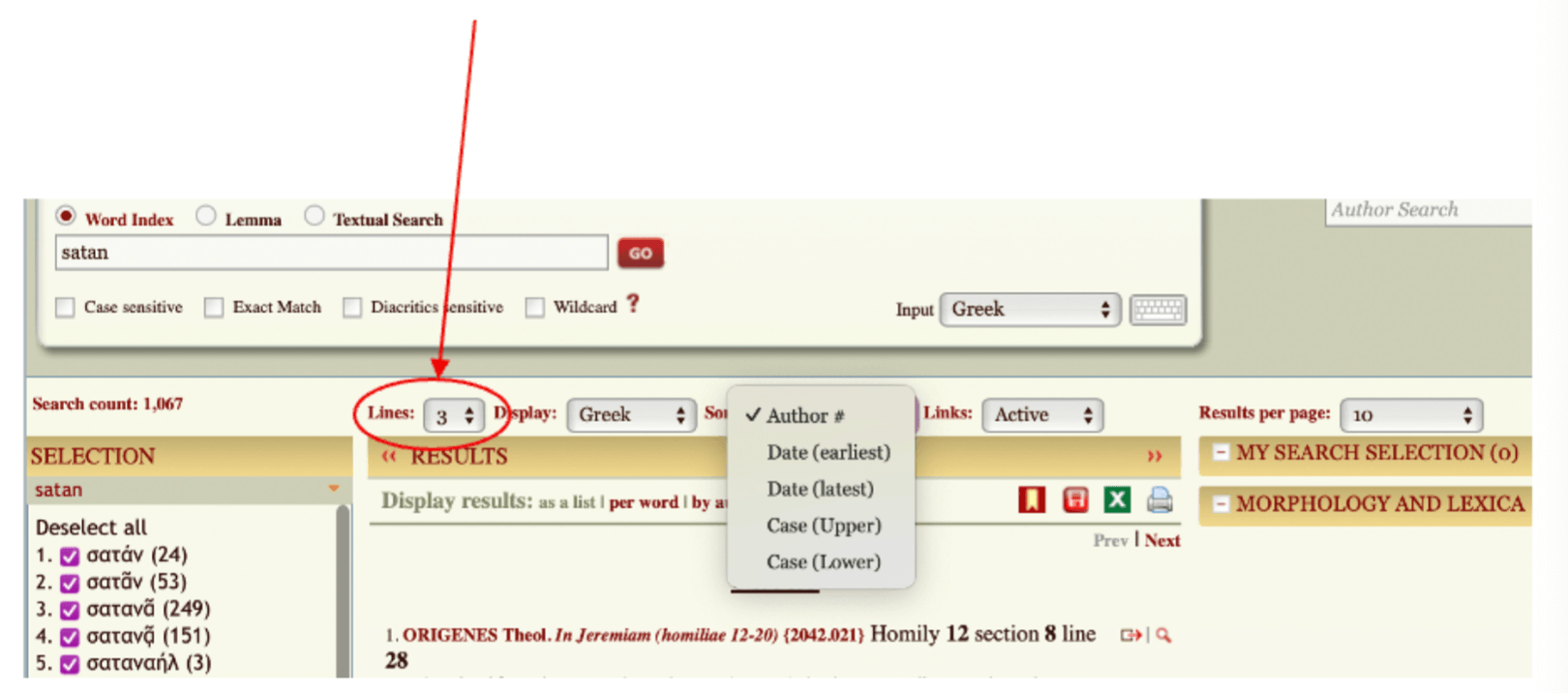
- Next, filter your search results. Organise results into chronological order by selecting Sort: Date (earliest). Then, elect to show 100 Results per page, in order to produce a decently workable list. The full corpus contains 5,727 entries for satan:
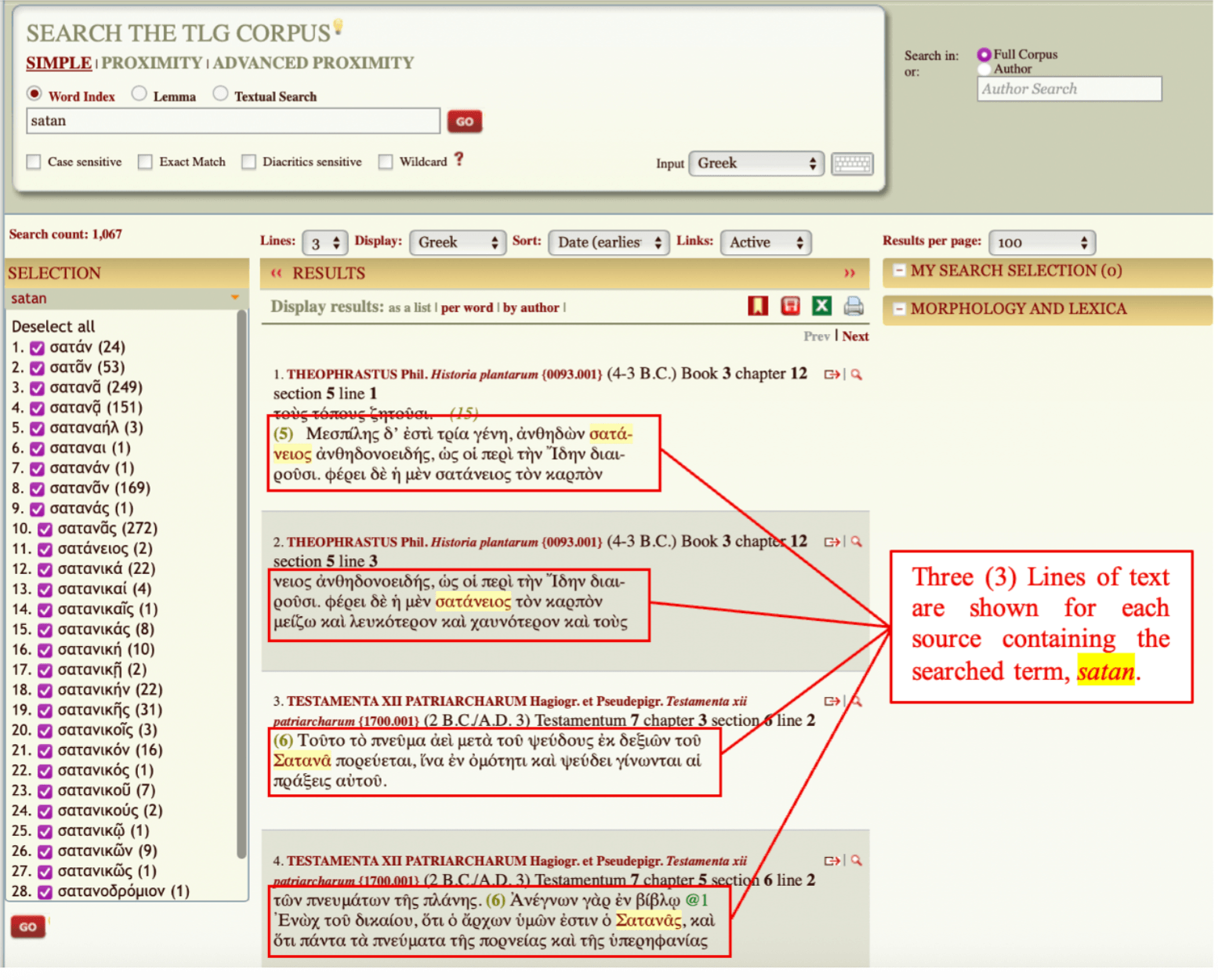
- Keep the selection of Lines per reference at 3. This will give you the three lines of Greek text from each source which surrounding, and within which, your searched word satan resides. This provides you with some quick context for each attestation/source:
Your search results should now look like this:
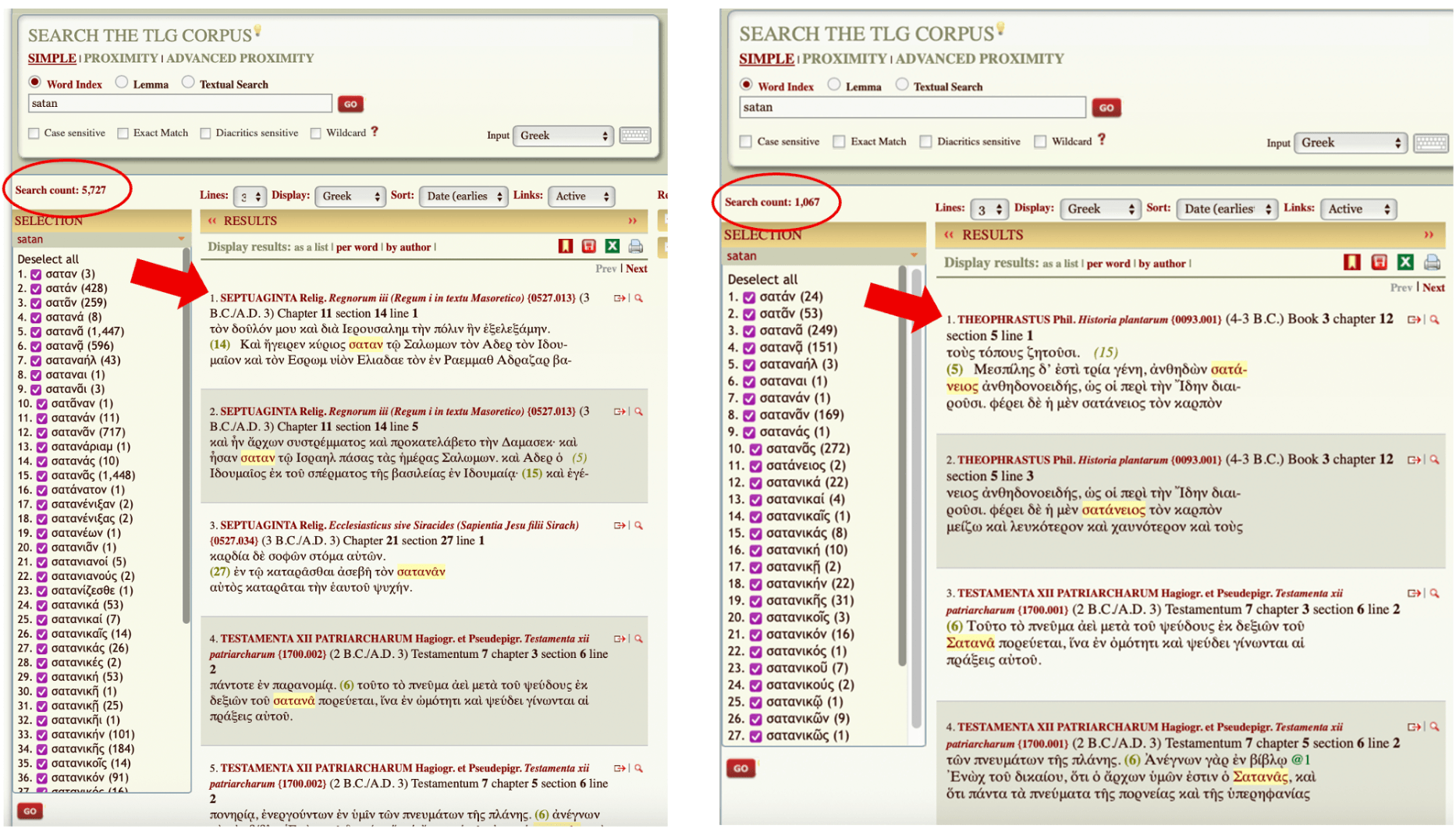
IMPORTANT: In the TLG’s full corpus, the earliest source of Satan identified by this search is found in the Septuagint. These are the results that Ammon shows us in the Reading Group. However, in the Abridged corpus the earliest attestation is identified as coming from Theophrastus. Unfortunately, you will get different search results if you are using the abridged version; this is very important to bear in mind when conducting research. Search results from the full corpus return 5727 attestations for satan, while the abridged version only returns 1067 attestations. Compare the results from the full corpus (left) with the abridged corpus (right).
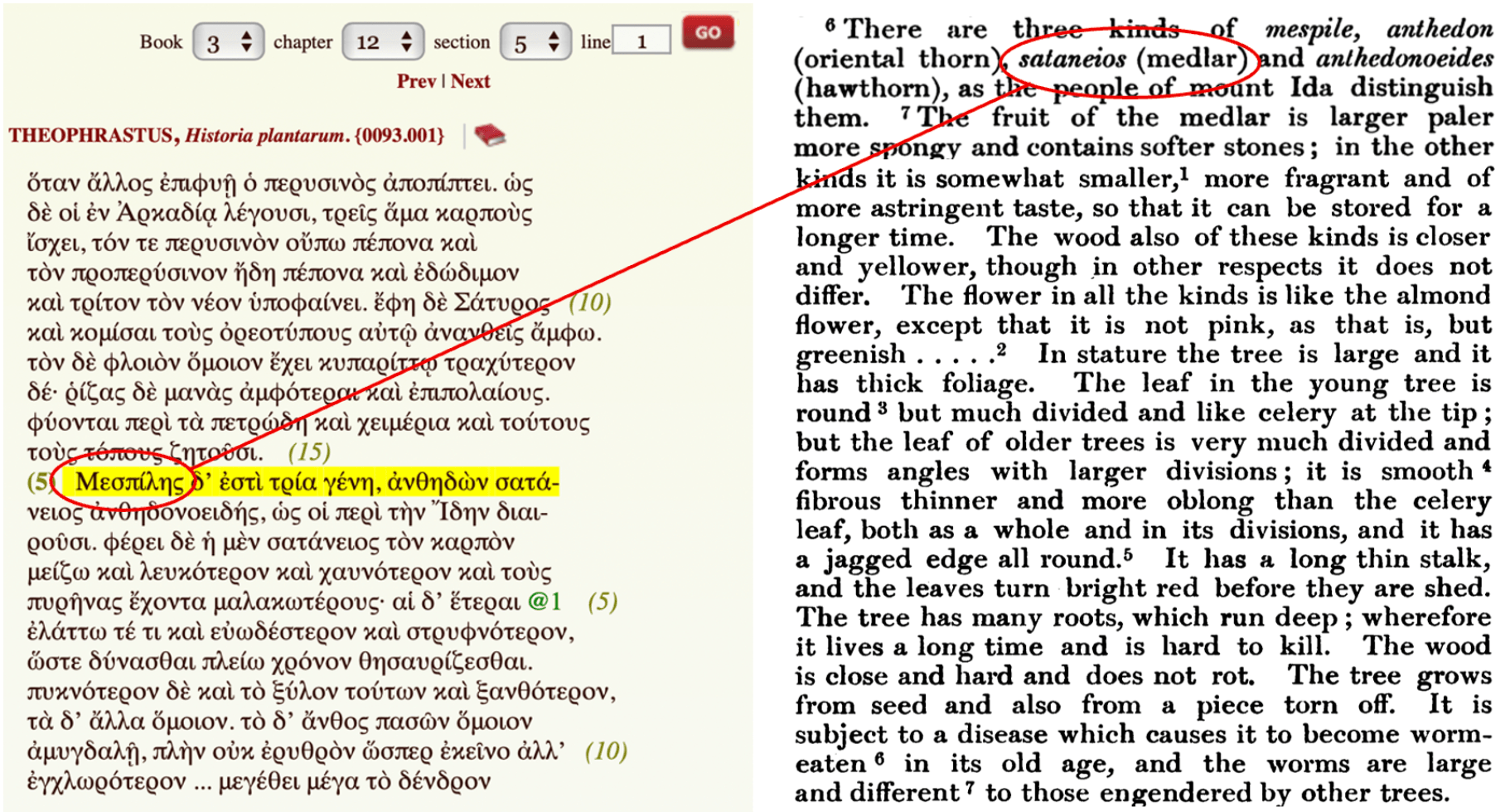
Note further that for this particular search – satan – the abridged corpus shows results for a word that the full corpus excludes! This also happens to be the first source in our list of results. The word σταἀνειος appears twice in the abridged version, but not at all in the full version:
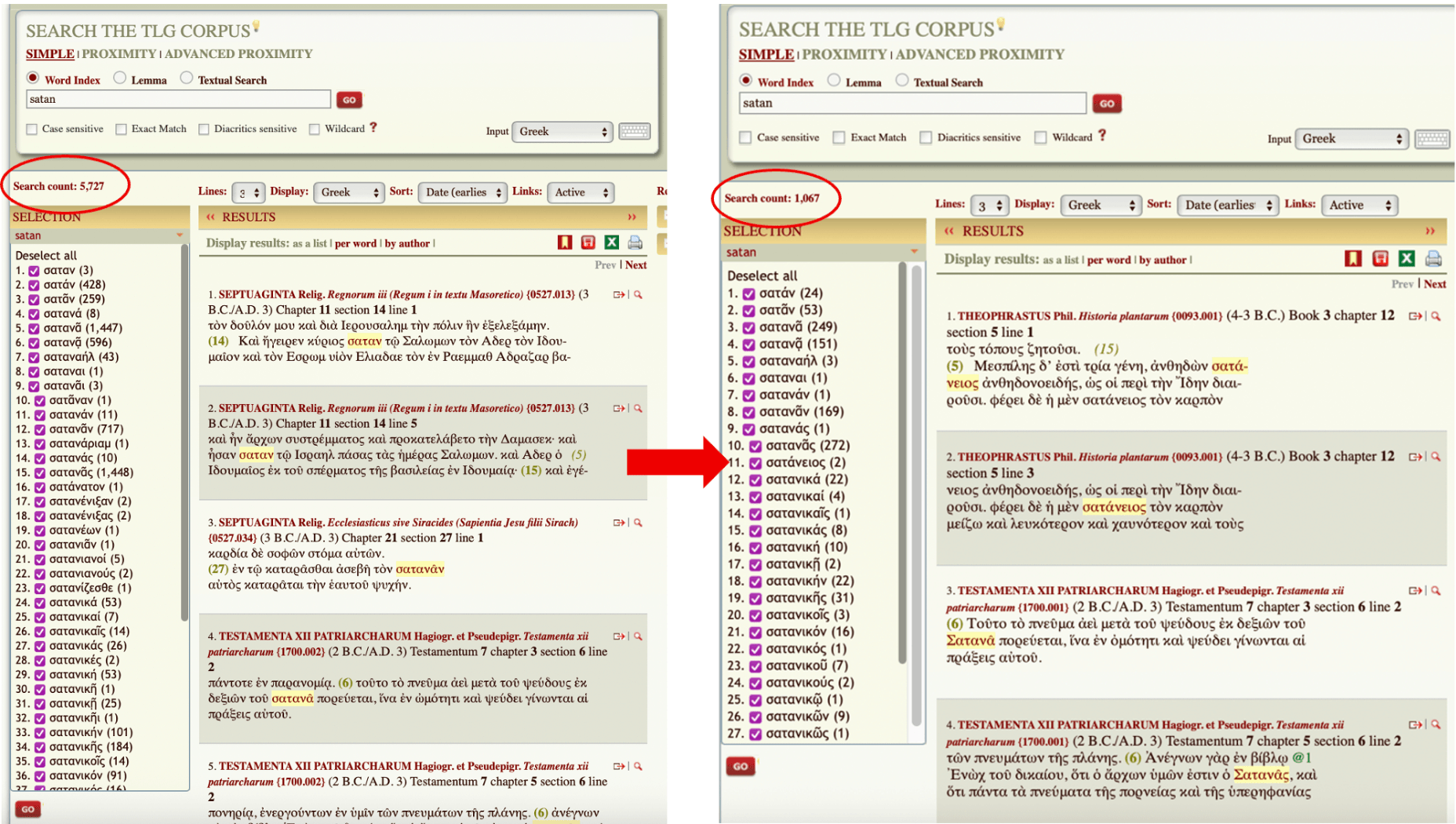
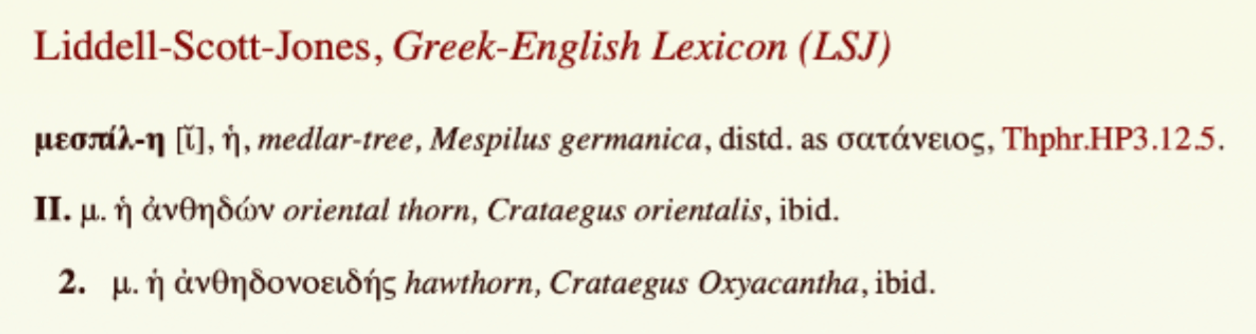
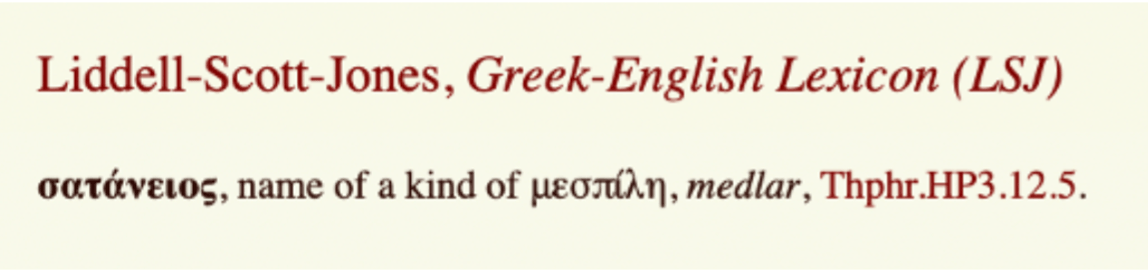
The absence of σατάνειος in the search results from the full corpus, despite appearing in the abridged corpus, reflects differences in TLG indexing rather than a true absence in the texts. Rare forms like this may be handled inconsistently – shown as surface forms in more flexible searches (abridged corpus), but in the full corpus reassigned to another lemma, grouped under a broader stem, or absorbed into a morphological category. The abridged corpus may also use more permissive matching, while the full corpus applies stricter lemma-based rules. That is, the word σατάνειος is not absent from the full corpus search results since it does not belong in the same semantic field as Σατανᾶς Satan.
σατάνειος(satnaneios) is in fact the name of a type of medlar tree (μεσπίλη mespilē, medlar) – according to Theophrastus – specifically Mespilus germanica. Galen, Dioscorides, and Hippocrates all mention the medlar as being astringent and constipative, having a “binding effect on the stomach” (Gal. 12.17).
The earliest source for satan which appears in both the full and abridged corpora search results is found in The Testament of the Patriarchs. Thus, we will look at how to examine this source in more detail. This method can be applied to any source in your results.
- In the list of results, select the source you want to examine by doing any of the following:
- Click on the name of the source, written in maroon. This will open a new page showing detailed philological data and other resources relevant to the source. This will take longer as you will ultimately need to enter the reference details manually (best to skip this option).
- Click on the magnifying glass icon to see a pop-up of the Greek text. This will keep you on the result page, while showing more Greek from the specific source.
- Click on the arrow icon. This will open a new page showing the full Greek text, which you can then navigate in sections.
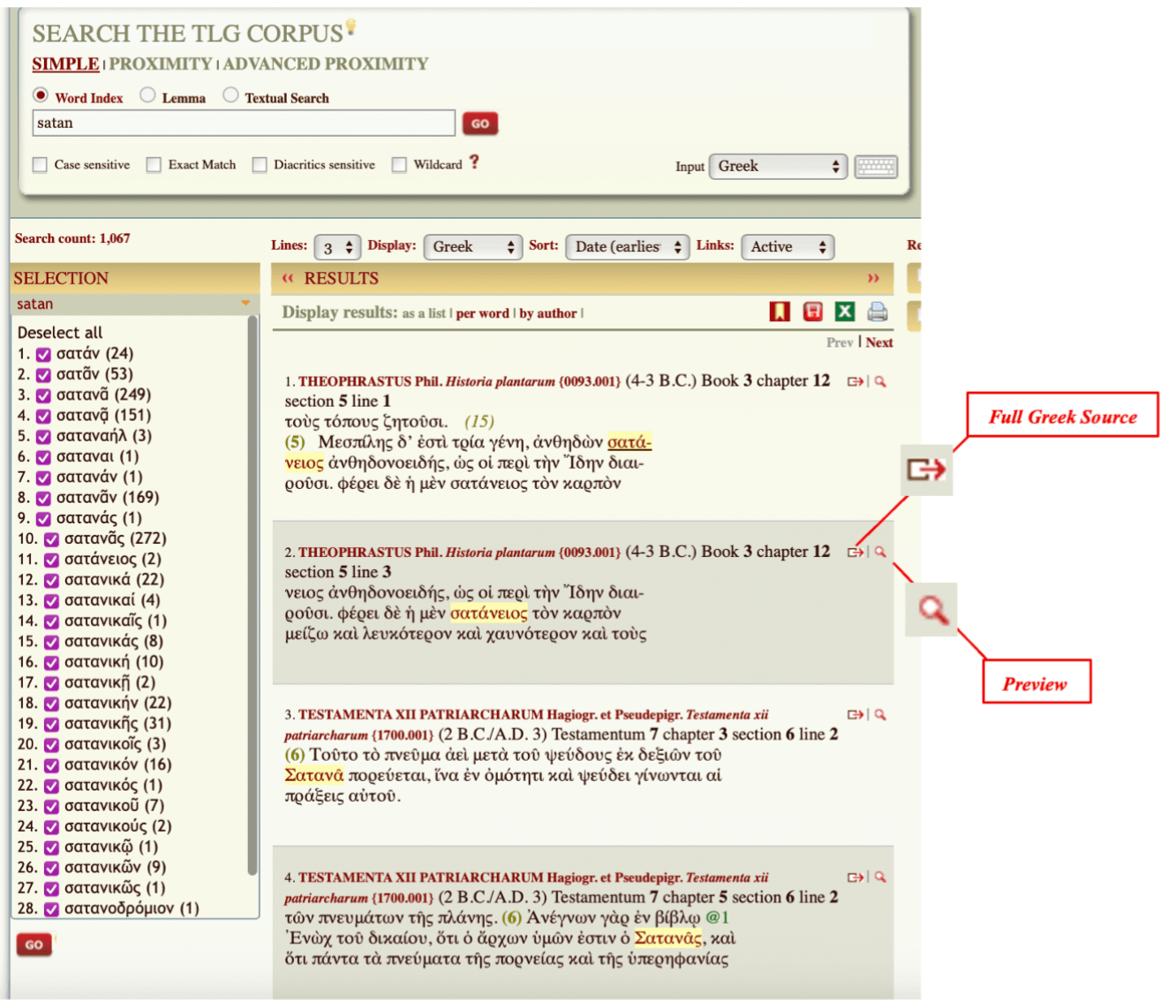
If you click on the name of the source (option i), you can navigate to the Greek text from there by clicking the arrow icon:
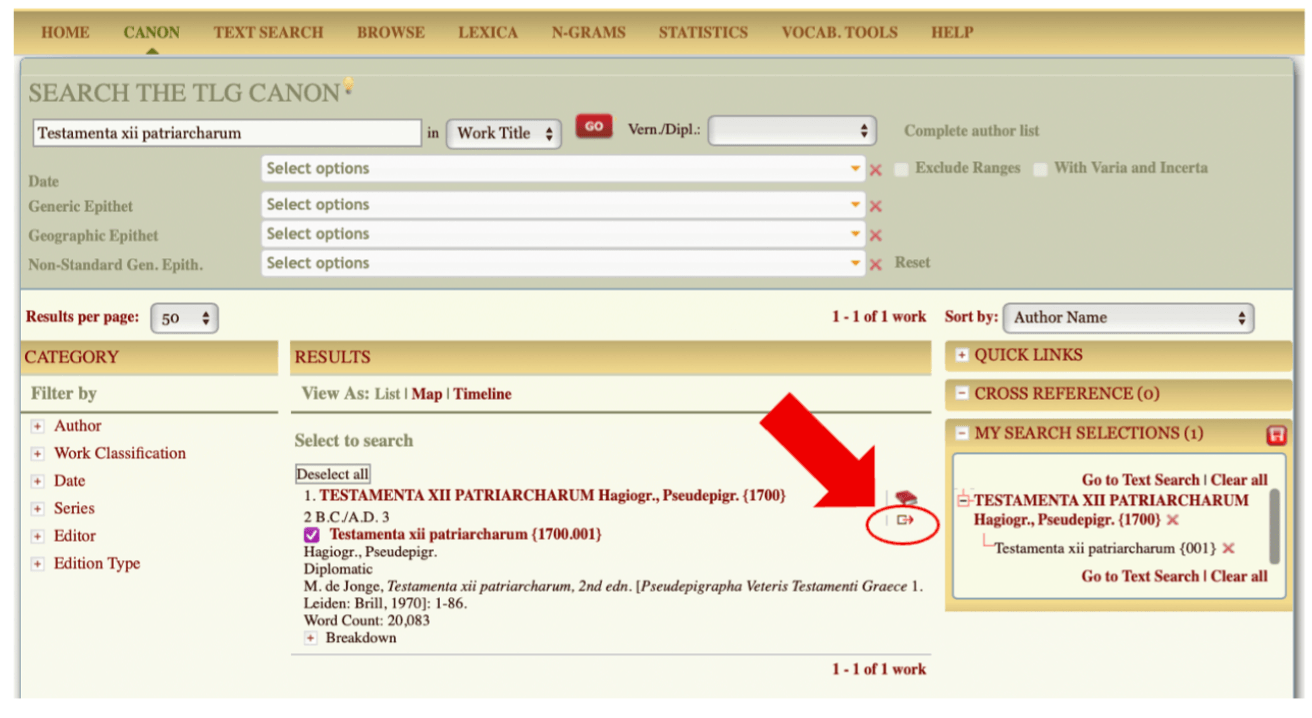
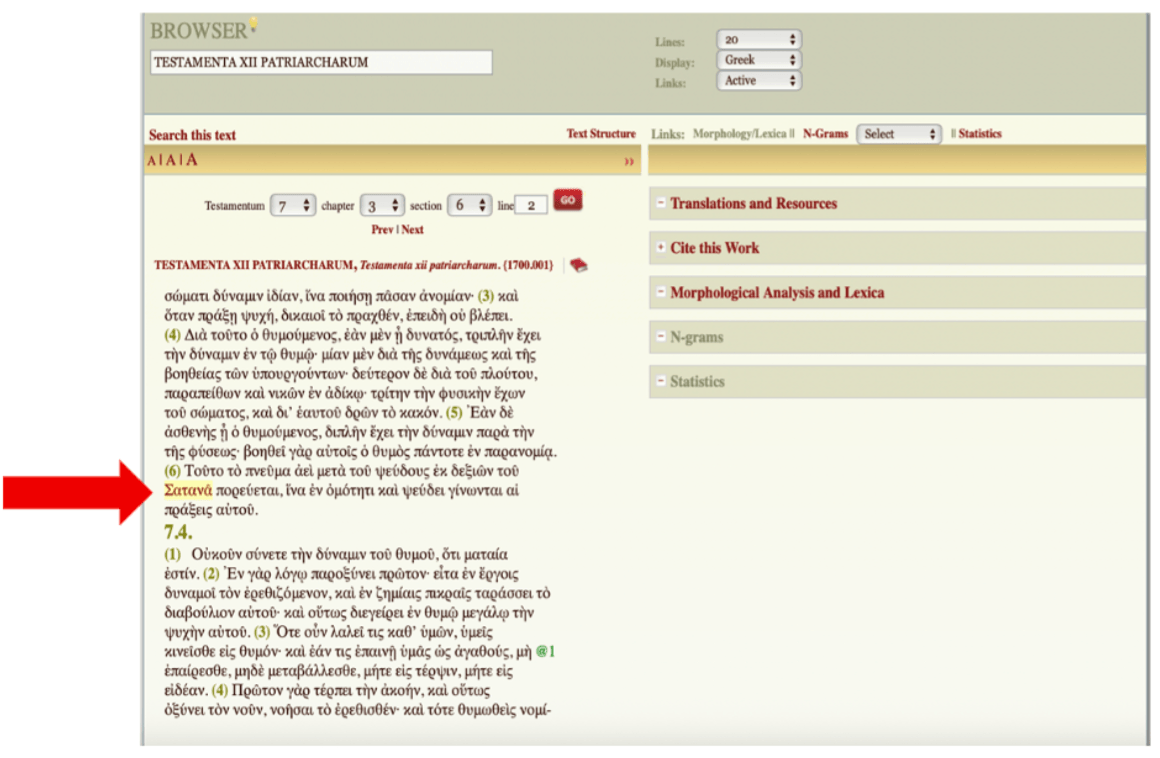
Either way (i or iii), the arrow icon will bring you to the Greek text of the source. The search term satan will be highlighted in yellow:
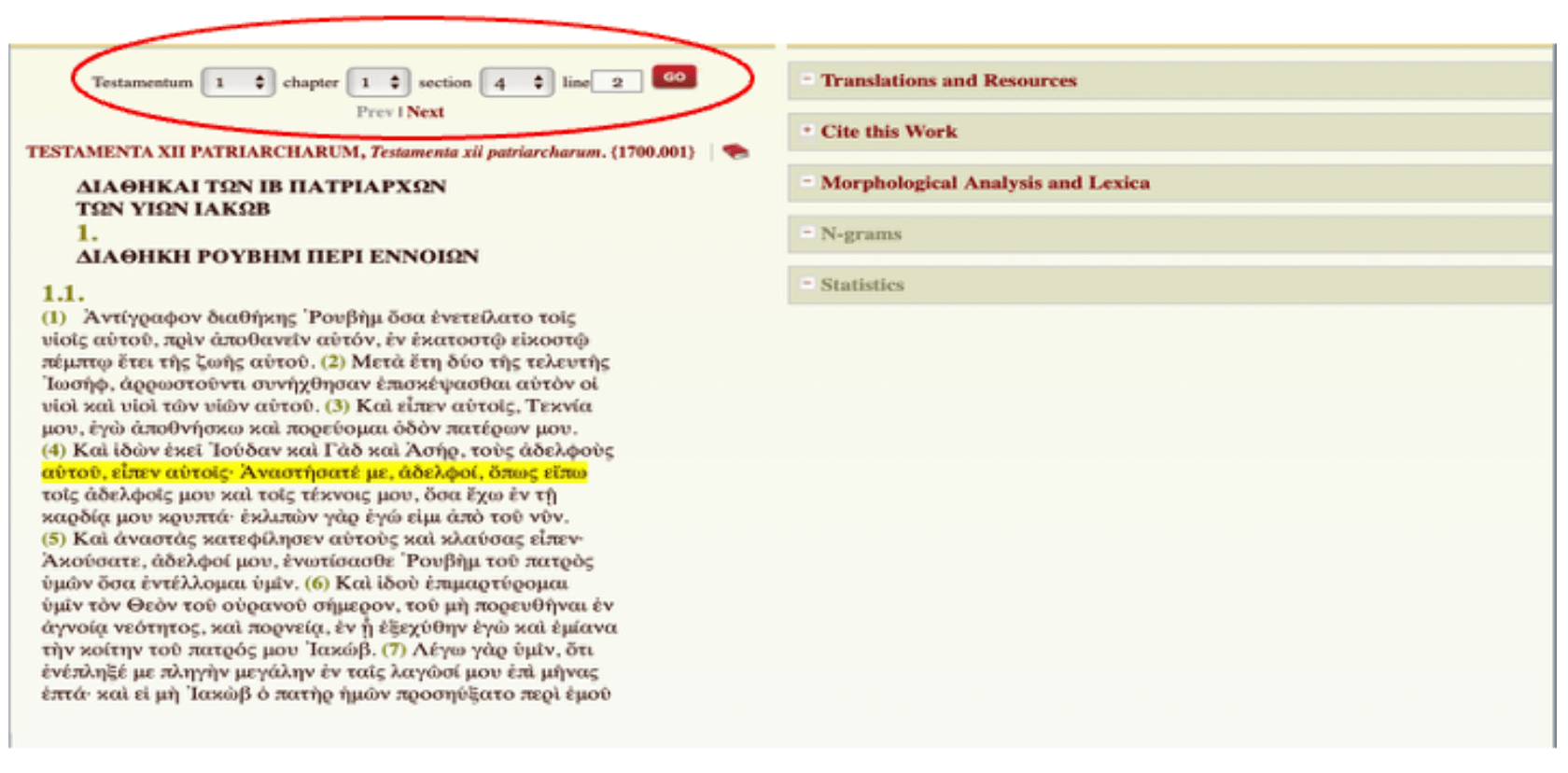
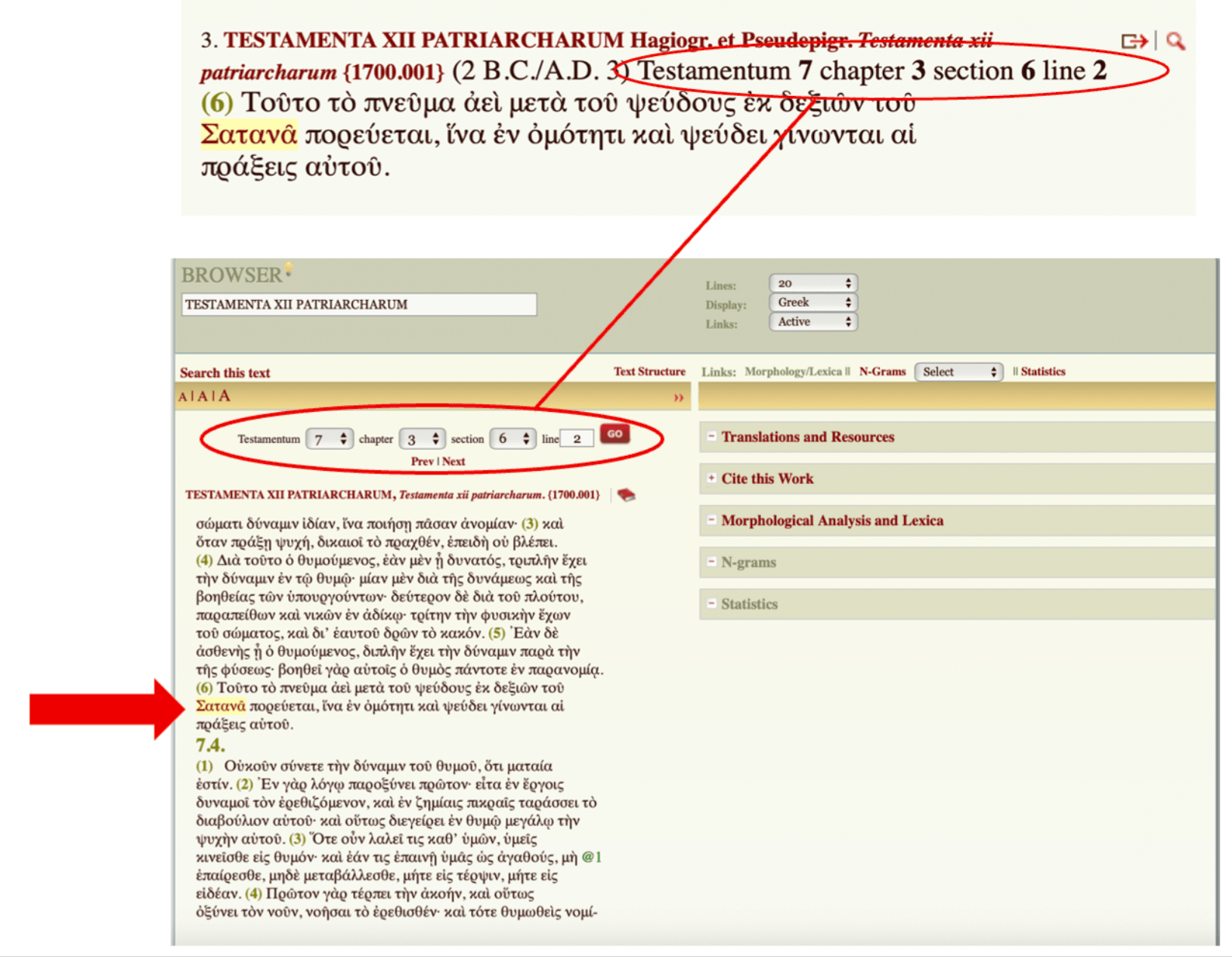
If you navigated to the Greek text by clicking on the name first (i), followed by the arrow icon on that page, you will then need to add the specific location of your word as it will default to the beginning of the text. This information is given in the original results list, so if you forget you can navigate back to check, then click the name again, or (quicker) simply click the arrow icon from the results list (ii):
The details for this particular source are Testamentum 7, chapter 3, section 6, line 2:
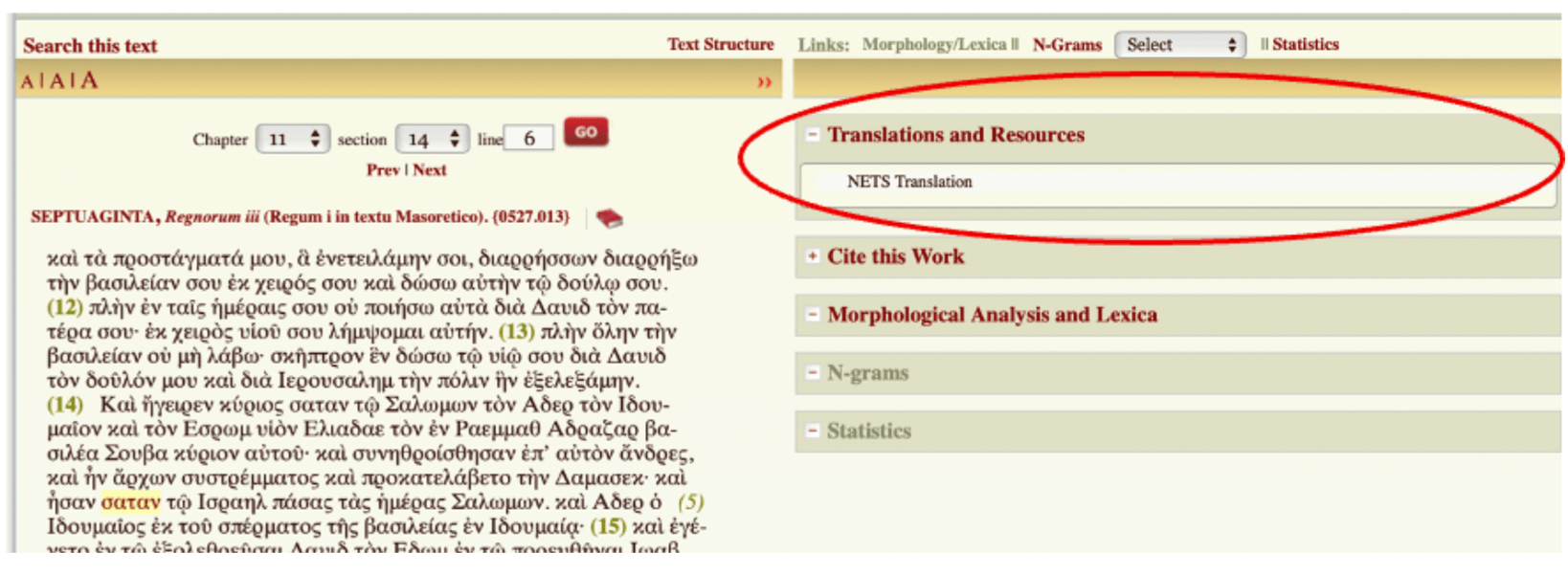
- There are several dropdown menus to the right of the text, which you can open and close by clicking on their headings. If a translation is available for a given text (not always), you can find a link to under the Translations and Resources menu. There is no link to a translation for this particular source (Testament of the Patriarchs), but when there is one available it will appear in this menu:
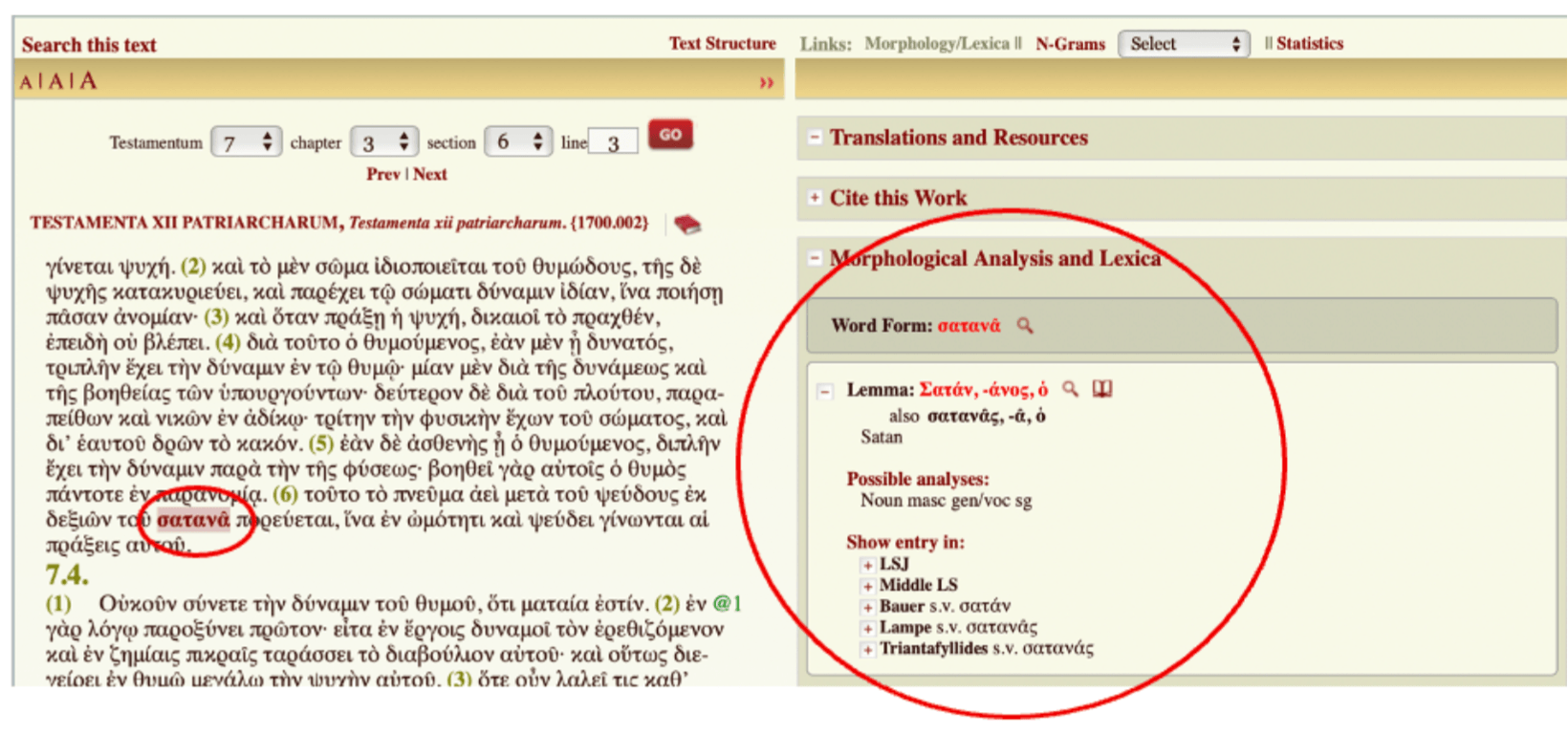
If you open the Morphological Analysis and Lexica drop down menu, it will show some basic linguistic data for the word (a morphological analysis), as well as options to navigate to various lexica (dictionaries) where you can find more information on the word’s definition. If you double click on another word in the text, the menu will show information for that word instead:
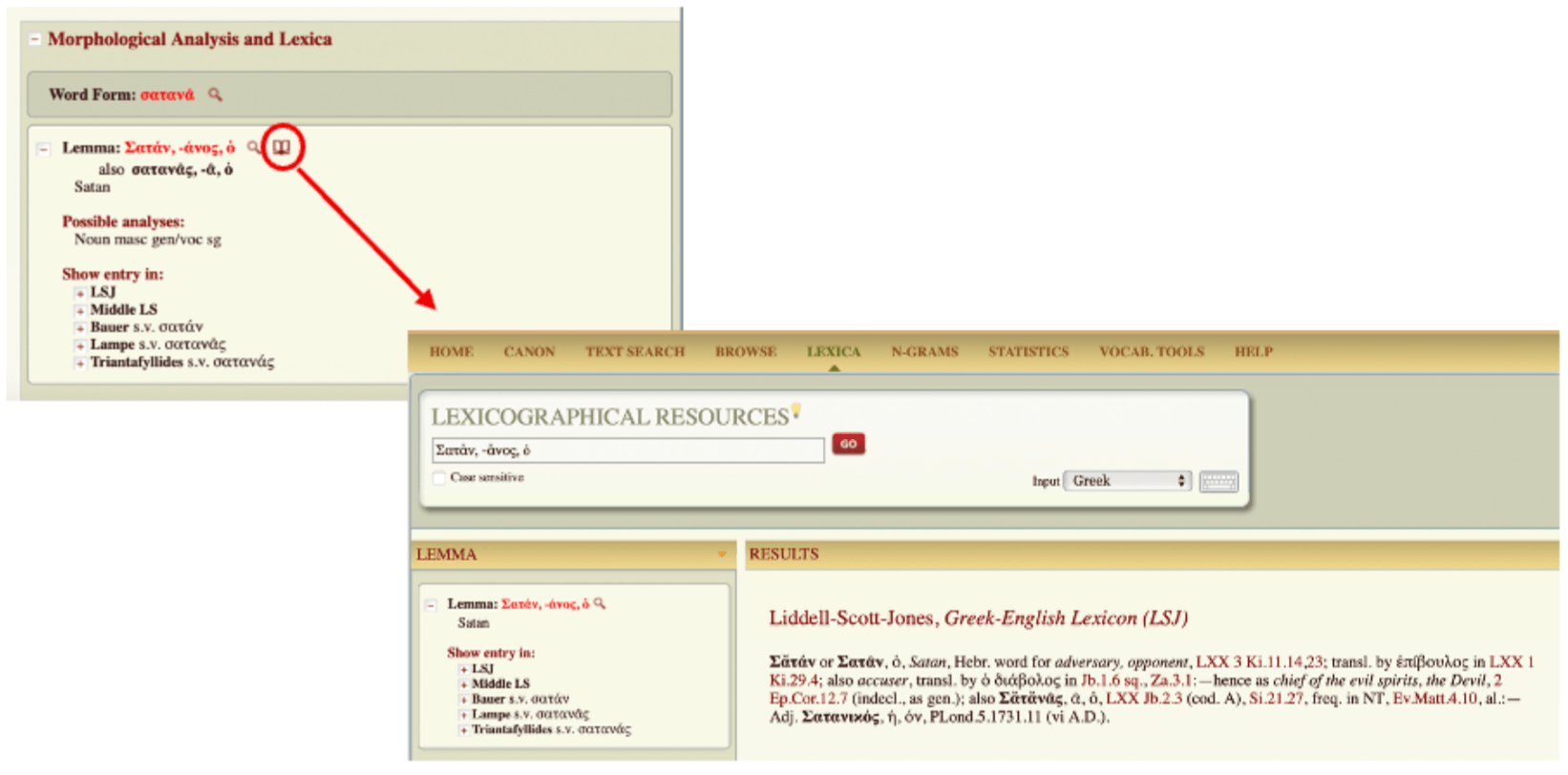
In the Morphological Analysis and Lexica menu, if you click the book icon next to the word, you will navigate to a lexical search for that lemma. This is likely the window you are already familiar with, having used it to search for the definition of various Greek words:
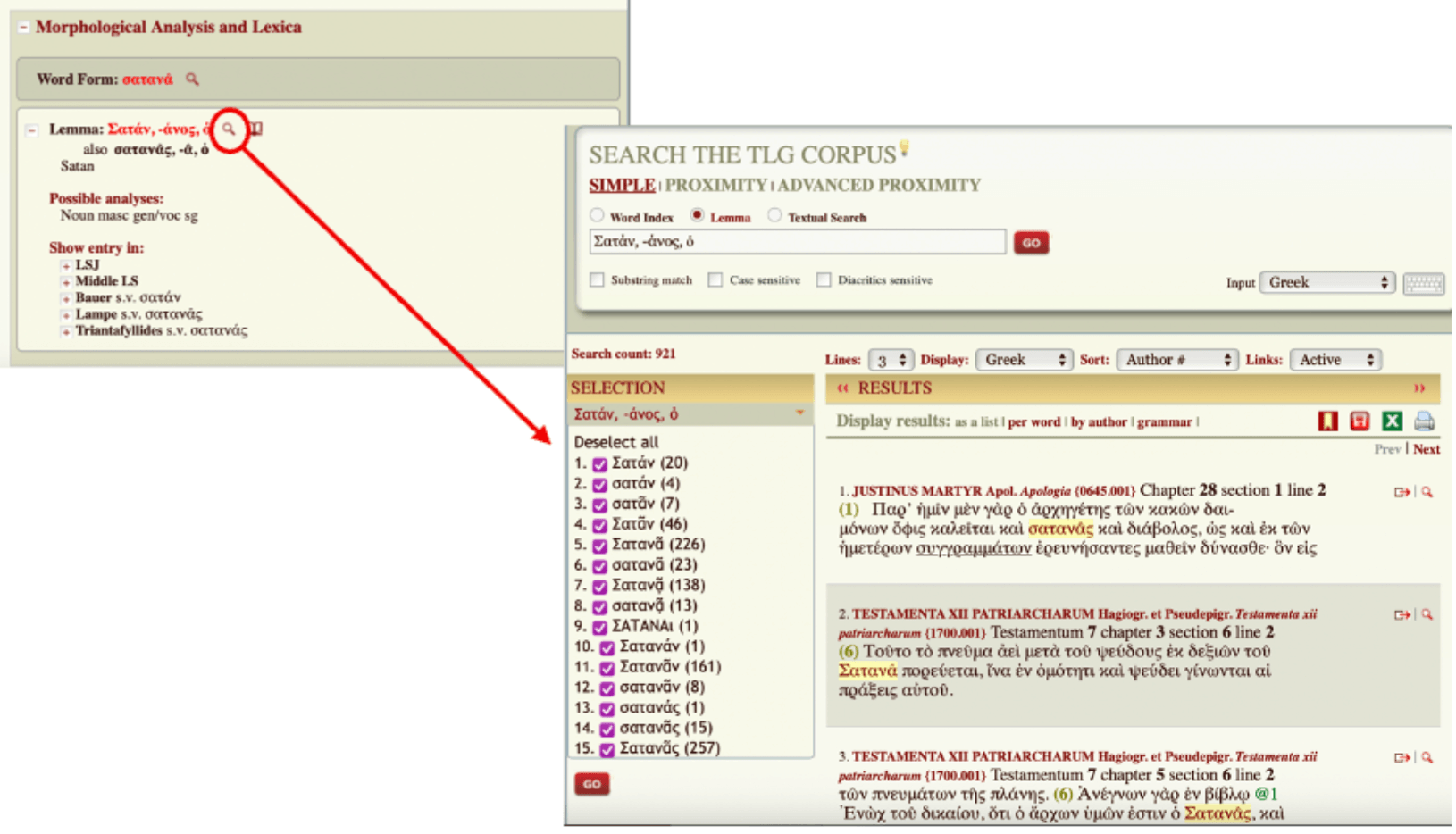
Alternatively, you click on the magnifying glass icon you will navigate to a text search for that specific lexeme (in this case, Σατάν, ‑άνος, ὁ). This is similar to the original search we started with, except this is a search for the exact lexeme Σατάν, ‑άνος, ὁ, rather than a search for every lexeme beginning with σαταν-, which, recall, includes Σατανᾶς Satan, σαταναήλ Satan (a name for Satan), Σατανικός Satanic, σατανικῶς like one possessed; diabolically, and σατανοδρόμιον Satan’s race-course:
This covers the basic navigation of a ‘text search’ for Satan within the TLG. There are numerous other tools within the platform which enhance further lexicographical analysis. As you get more familiar with the TLG you may learn how to produce statistical analyses of words, including operations like a colocation analysis, which helps to map semantic fields. For now, this basic information should assist you in using the TLG at home while you participate in Ammon’s Satanic Reading Group.
Notes by Louis Wain (2026)