![[back]](/assets/home_24dp_E3E3E3_FILL0_wght400_GRAD0_opsz24.svg "[back]")
![[search]](/assets/search_24dp_E3E3E3_FILL0_wght400_GRAD0_opsz24.svg "[search]")
Sami Shaman
Drums and Witch-hunts
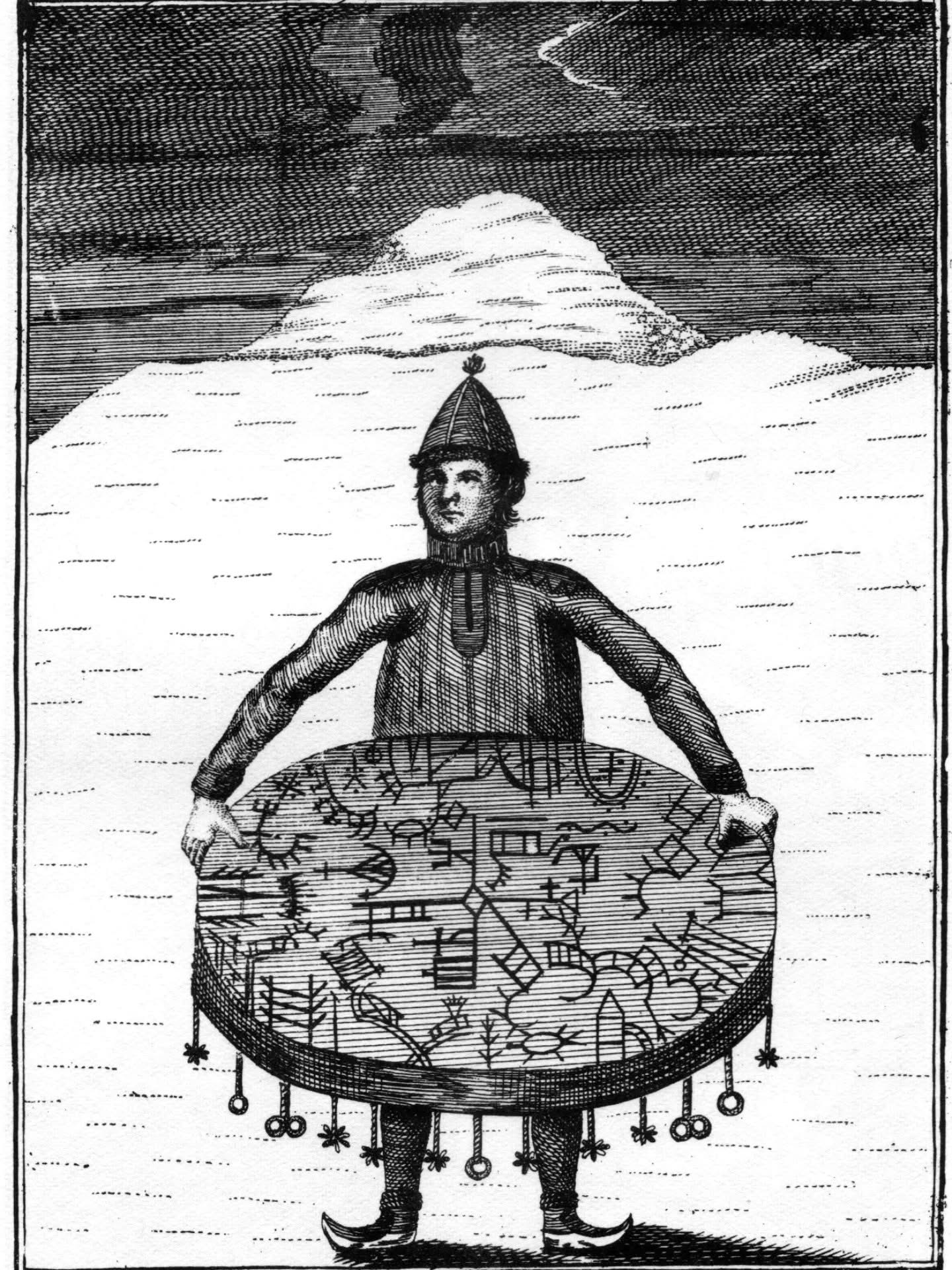
Starting in 1609, owning this drum was a crime punishable by death in the Kingdom of Denmark-Norway. In 1767, while hundreds of them were being thrown into the fire, a Norwegian priest sketched and documented one.
When the Norwegian priest and linguist Knud Leem (1697-1774) arrived in Finnmark (Northern Norway) as a missionary in 1725, he formed a deep bond with the Sámi people.He wore their clothes and learned their language.For years,he observed shamanic sessions and personally drew what he saw.
The engraver O.H.von Lode transferred these drawings onto copper plates. Published in Copenhagen in 1767, the book contained over 600 pages of parallel Danish-Latin text and 100 copperplate engravings. It's the most comprehensive Sámi ethnography published in Northern Europe in the 18th century.
The symbols on the drum's membrane were drawn with a red dye made from alder bark. This color symbolized blood. A single drum could hold up to 150 symbols. The noaidi (shaman) would place a brass ring called a 'vuorbi' on the membrane and beat the drum.The symbol where the ring stopped was the answer to the question asked: the location of a lost reindeer, the luck of a hunt, or which sacrifice to offer...
On Northern Sámi drums, the membrane was divided into three tiers by horizontal lines: the upper tier was the realm of the gods, the middle tier was the human world, and the lower tier was the realm of the dead. In 1692, an almost 100-year-old Sámi shaman named Anders Poulsen had his drum confiscated and stood trial for witchcraft in Vadsø (Northern Norway).
Poulsen played his drum in court. He called out to his gods, asking them not to be afraid of the Norwegians in the courtroom. In his 16-page testimony, he explained every single symbol on the membrane one by one. Before he was convicted, he was murdered in his cell with an axe by a mentally ill person named Villum Gundersen. He became the last victim of the Finnmark witch trials.
Missionary Thomas von Westen had about 100 drums collected all by himself. He sent them all to Copenhagen. In the Great Fire of Copenhagen in 1728, 70 of them burned to ashes. Today, only 71 original Sámi drums are preserved worldwide.