![[back]](/assets/home_24dp_E3E3E3_FILL0_wght400_GRAD0_opsz24.svg "[back]")
![[search]](/assets/search_24dp_E3E3E3_FILL0_wght400_GRAD0_opsz24.svg "[search]")
Manna
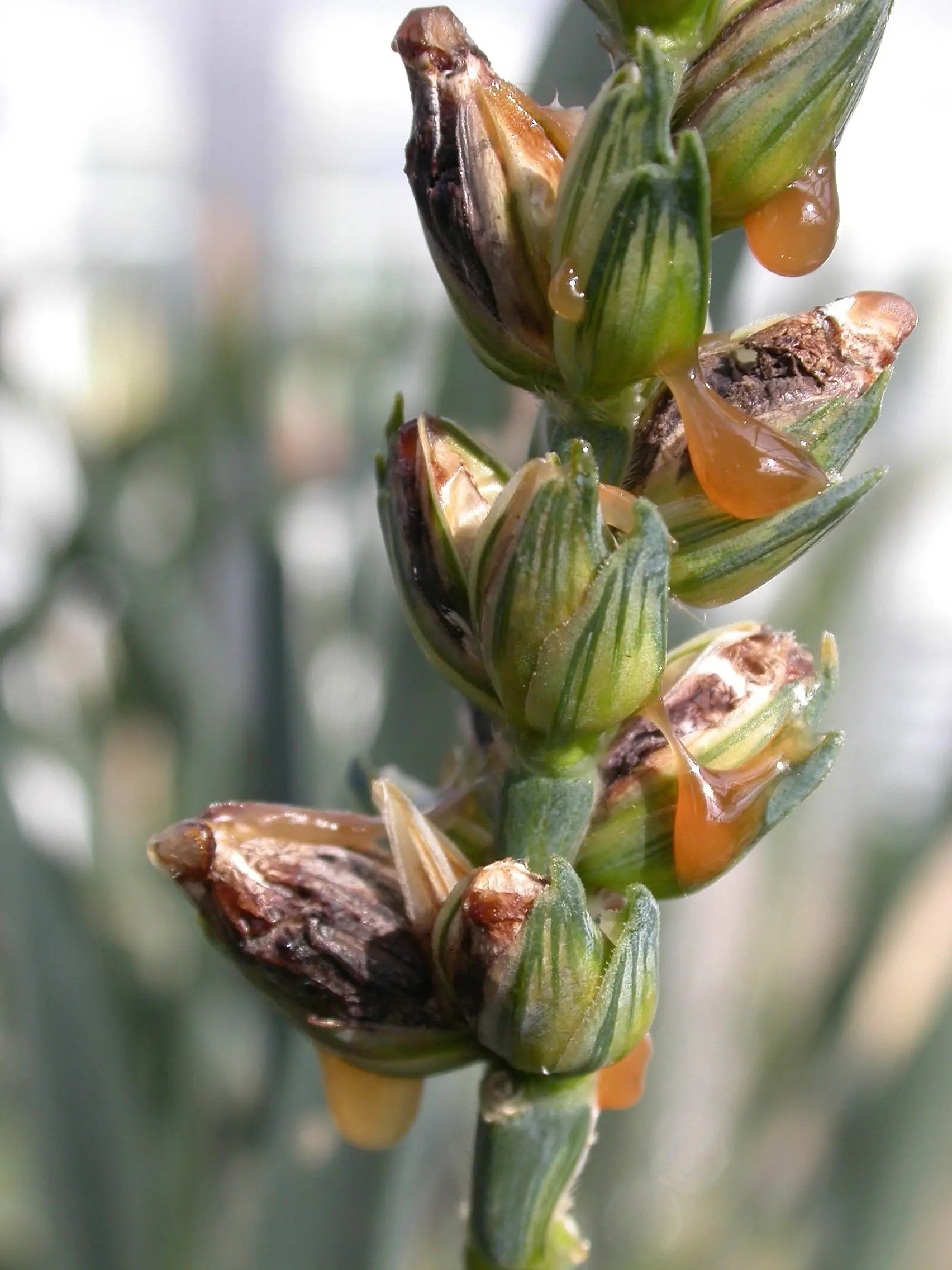
Ergot in Honey Dew stage, on Wheat
Manna is one of those substances that we are unsure what it is.
But it's use sounds like it may be Ergot.
In Ancient Greek Texts
Eleusinian Kykeon
Famously, presented in Road to Eleusis, as an additive to Kykeon. The sclerotia's purple matches the purple color of Demeter.
In The Road to Eleusis (1978), R. Gordon Wasson, Albert Hofmann, and Carl A. P. Ruck advanced the hypothesis that the kykeon consumed during the Eleusinian Mysteries may have contained ergot (Claviceps purpurea) infecting barley. Their argument rests on several converging lines of evidence. First, the Homeric Hymn to Demeter explicitly names barley (κριθή) and water as the core components of kykeon, with mint (γλήχων) added. Barley is one of the principal hosts of ergot. When infected, the fungus replaces the grain with dark, elongated sclerotia that can contain psychoactive ergot alkaloids. Hofmann, who had synthesized LSD from ergot derivatives decades earlier, argued that certain ergot strains — particularly those infecting Mediterranean cereals — could produce compounds capable of inducing visionary or altered states without the severe vasoconstrictive toxicity associated with later medieval ergotism outbreaks.
Second, the ritual context of Eleusis aligns with a carefully controlled, initiatory experience rather than random poisoning. The Mysteries culminated in what ancient sources describe as overwhelming revelation (ἐποπτεία), involving light, vision, and a transformative encounter with the divine. Participants consistently reported a profound change in their understanding of life and death. Wasson and colleagues proposed that a purified or selectively prepared ergot extract added to kykeon could plausibly account for the intensity and uniformity of these experiences across centuries. The secrecy of the rite, combined with the agricultural setting of Demeter’s cult, provides a setting in which knowledge of grain infection and preparation could have been ritually preserved.
Finally, the visual symbolism has often been noted: the mature sclerotia of Claviceps purpurea are dark violet to purple. Purple is strongly associated with Demeter and Persephone in later iconography and ritual textiles, and the color symbolism of grain transformed into something dark and potent fits the mythic cycle of death and rebirth embedded in the Mysteries. While direct archaeochemical proof from Eleusis remains elusive, the convergence of barley-based ritual drink, known ergot-host relationships, alkaloid psychoactivity, and the visionary climax of the rite forms the evidentiary chain that made the ergot-kykeon hypothesis both influential and enduring in classical scholarship.
How possible was an ergot kykeon?
A long-standing objection to the ergot-kykeon hypothesis has been simple: if ergot were present in barley, it would have been dangerously toxic. Medieval outbreaks of ergotism — marked by convulsions and gangrene — seem to make the idea of a controlled, visionary sacrament implausible. But a recent 2026 study published in Scientific Reports revisited that assumption by experimentally testing whether ergot’s chemical profile could be transformed under conditions achievable in antiquity.
In the study, researchers subjected ergot-contaminated barley (ὄλυρα) to alkaline treatment using lye solutions comparable to wood-ash filtrate — a substance well known in the ancient Mediterranean for food preparation, textile processing, and cleaning. Under sustained alkaline conditions (around pH 12.5 for approximately two hours), advanced chemical analysis (¹H-NMR and UHPLC/Q-TOF-HRMS) revealed a marked shift in alkaloid composition. The complex ergopeptide alkaloids most associated with vasoconstriction were no longer detected after full alkaline treatment, while lysergic acid amides such as LSA and iso-LSA appeared in measurable quantities (roughly 0.5 mg per gram).
In practical terms, this suggests that alkaline processing — a technique entirely within ancient technological capability — can significantly alter ergot’s toxicological profile. It does not prove that the Eleusinian priests performed such a transformation, nor does it reconstruct the exact preparation of kykeon. But it directly challenges the assumption that any ergot presence would necessarily result in catastrophic poisoning.
Chemically speaking, a processed ergot kykeon is no longer implausible.
In the biblical texts
Manna is one of the more elusive plant food substances described in the biblical record. Early descriptions portray it as a kind of residue associated with grain or bread. In Numbers 11:7, manna is compared to coriander seed and said to resemble resin in appearance.
ἦν δὲ τὸ μάννα ὡσεὶ σπέρμα κορίου, καὶ τὸ εἶδος αὐτοῦ ὡσεὶ κρύσταλλος.
“And the manna was like coriander seed, and its appearance was like crystal (resin-like).”
- krustallos (κρύσταλλος) - clear ice / rock crystal / translucent crystalline mineral
Exodus 16:14–16, however, presents a different image. There, manna appears after the morning dew lifts, described as a fine, frost-like layer covering the ground:
καὶ ἐγένετο ὡς ἀνεβίβασεν ἡ δρόσος, καὶ ἰδοὺ ἐπὶ προσώπου τῆς ἐρήμου λεπτόν, λεπτόν, ὡσεὶ πάχνη ἐπὶ τῆς γῆς.
“And it came to pass when the dew had lifted, and behold, upon the face of the wilderness a fine thing, fine as frost upon the ground.”
καὶ εἶπαν πρὸς ἀλλήλους· τί ἐστι τοῦτο; ὅτι οὐκ ᾔδεισαν τί ἦν.
“And they said to one another, ‘What is this?’ for they did not know what it was.”
εἶπεν δὲ Μωυσῆς πρὸς αὐτούς· τοῦτο τὸ ἄρτον ὃν ἔδωκεν Κύριος ὑμῖν φαγεῖν.
“And Moses said to them, ‘This is the bread which the Lord has given you to eat.’”
- pachne (πάχνη) = frost
Upon seeing this unfamiliar substance, Moses tells the Israelites, “This is the bread which the Lord hath given you to eat.” The text frames it not merely as food, but as divinely provided sustenance.
Some modern interpreters, most notably Danny Nemu, have suggested that the reverence surrounding manna may reflect a naturally occurring fungus such as ergot. Ergot is known as a source of ergotamine, the compound from which Albert Hofmann later synthesized LSD. While this hypothesis connects manna to a psychoactive fungus, it remains speculative and has not gained broad acceptance among mainstream scholars.
See Also
- Pharmakon
- The Mystery of Manna - a book that digs into the uses of manna in the bible, making the case for Ergot