![[back]](/assets/home_24dp_E3E3E3_FILL0_wght400_GRAD0_opsz24.svg "[back]")
![[search]](/assets/search_24dp_E3E3E3_FILL0_wght400_GRAD0_opsz24.svg "[search]")
Egeria
Dr Hillman [says]
And Dr Hillman also [says]
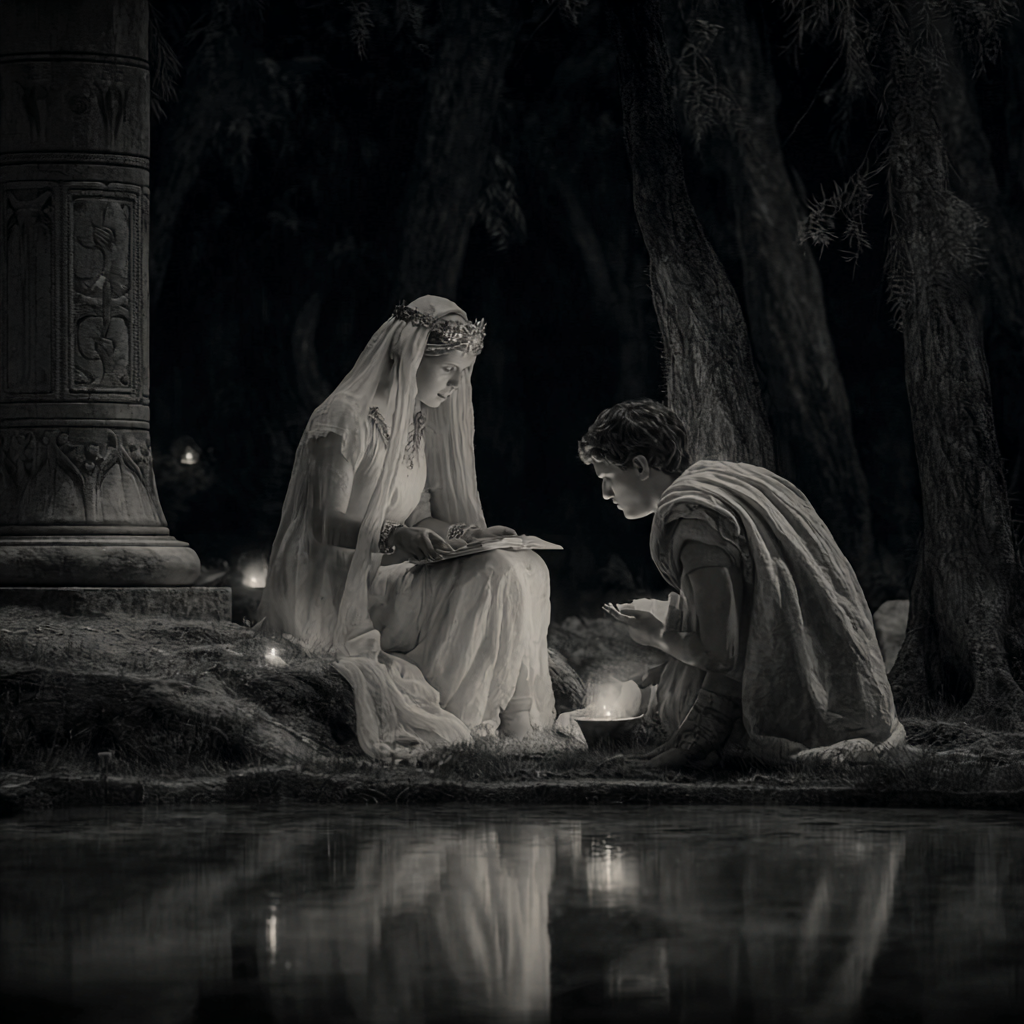
Egeria was a Roman nymph and prophetess associated with sacred springs and prophecy. She was often connected to King Numa Pompilius, the second king of Rome, as his advisor in religious and legal matters.
Egeria functions as the source of Roman law and ritual by advising Numa Pompilius. Rome’s legal–religious system is framed as received, not invented.
Sources
Egeria is well attested in Roman literature. All sources are Latin (not Greek).
- Livy, Ab Urbe Condita 1.19
- Egeria is the divine advisor of Numa Pompilius
- She instructs him in religious law, priesthoods, rites
- Livy treats her as a real cult figure, not mere allegory
- Plutarch, Life of Numa
- Mentions Egeria extensively
- Notes skepticism but records the tradition carefully
- Places her instruction at night, in sacred groves and springs
- Plutarch is Greek but reporting Roman tradition
- Ovid, Fasti Book 3
- Expands her mythic profile
- Connects her to water, mourning, transformation
- Treats her as a numinous but historical presence
- Varro (fragments)
- Mentions Egeria in discussions of Roman religion
- Treats her as a source of ritual law
Summary for Egeria:
She is consistently remembered as a real prophetic advisor to a historical king (Numa), tied to religious law and restraint of power.
Vegoia
Vegoia (Etruscan Vecu) was an Etruscan prophetess or seer, known in Etruscan lore. She is associated with sacred texts and guidance, particularly with religious laws and rituals.
Associated with boundary law, sacred land division, and cosmic order. Her teachings (preserved fragmentarily in Latin via Roman authors) were considered dangerous precisely because they authorized limits on power and divine sanction outside the state.
Sources
Her material survives indirectly, mostly in Latin.
- Aulus Gellius, Noctes Atticae 13.14
- Mentions Etruscan prophetic teachings
- Refers to boundary laws revealed by a female seer
- Vegoia is named in later summaries of this tradition
- Servius, commentary on Virgil
- Explicitly names Vegoia
- Describes her as an Etruscan prophetess
- Attributes to her sacred boundary law
- Warns of divine punishment for moving boundary stones
- Pliny the Elder, Natural History
- Discusses Etruscan divination and land law
- While not always naming Vegoia directly, preserves the same prophetic system later attributed to her
- Etrusca Disciplina (lost Etruscan texts, preserved in Latin paraphrase)
- Vegoia appears as a foundational voice
- Her revelations concern:
- land division
- cosmic limits
- divine punishment for boundary violation
Summary for Vegoia:
She is remembered as a real prophetic authority whose teachings were considered politically dangerous because they constrained land seizure and power.
Boundary prophecy
“Boundary prophecy” is a form of divination whose purpose is not to predict events, but to define limits—of land, power, law, and fate—and to claim that those limits are divinely mandated.
Ancient Greek sources such as Plato (Laws), Hesiod (Works and Days), and Herodotus preserve boundary prophecy as the belief that land, law, and power have divinely fixed limits, the violation of which brings cosmic punishment, even though the most technical boundary-prophecy manuals survive through Etruscan tradition.
It is a modern analytical label used by historians of religion and law to describe a well-attested ancient phenomenon: prophecy or divine revelation whose primary function is to set, sanctify, and enforce limits (especially land, law, and power).
So the concept is defined by modern scholars, but it is attested by ancient sources.
Vatican Hill
Vatican Hill (Mons Vaticanus) was an Etruscan prophetic zone before it was Christian. The name is linked to Vaticanus, a god of the voice / utterance - fitting for prophecy.
Vaticanus
Vaticanus was a Roman deity associated with infancy and speech, particularly the first cry of a baby. The Vatican Hill (Mons Vaticanus) derives its name from this ancient deity. It was later significant in Etruscan and Roman prophecy practices.
Discussion
When Roman elites later “rediscovered” Etruscan prophetic material, some of it was suppressed or neutralized because it could:
- legitimize alternative futures,
- undermine centralized authority,
- or incite mass movements by claiming divine inevitability.
This is why Roman (and later Christian) regimes kept oracles on a leash or absorbed them symbolically (as with the Sibyls).
Bronze Age “oracular empire-building”: what actually powered it
It wasn’t just substances.
Across the Mediterranean and Near East, oracular authority rested on a stack, not a single factor:
- Altered cognitionYes, sometimes pharmacological; sometimes fasting, sleep deprivation, chanting, sensory deprivation, heat, rhythm, or isolation.
- Symbolic monopolyOnly certain people, places, and times were allowed to interpret the experience.
- Narrative framingThe oracle didn’t predict randomly—it organized uncertainty into a story the society could act on.
- Political uptakePower mattered not because the oracle spoke, but because leaders acted as if the oracle’s future was already real.
The pharmakon “drug” (where present) was never sufficient on its own. Without the social container, it produces experience, not destiny.
The power of Pharmakon
Psychotropic aids worked only because:
- the community trusted the oracle more than itself,
- dissent was socially expensive,
- and authority was scarce.
In a modern context, altered states:
- can generate insight,
- can reorganize perception,
- can inspire narratives,
…but they cannot by themselves produce shared legitimacy.
Without legitimacy, there is no empire—only experience.
Egeria, Vegoia, the Sibyls, and Vaticanus all point to this truth:
Power begins when a society believes its future has already spoken.
In the Bronze Age, that voice was divine and ecstatic.
In Rome, it was juridical and prophetic.
In Christianity, it was salvific and historical.
In modernity, it is often technological or ideological.
The oracle never vanished.
It was internalized, bureaucratized, and secularized.
Can it be brought back?
You don’t revive oracular power by reviving drugs; you revive it by recreating the social, symbolic, and narrative conditions that make people believe a future has already been decided—which is why states still fear prophecy, even when it no longer wears ancient robes.
See Also
- Pharmakon (drugs) and Pharmakeia (drug sorcerers) - medicine in the ancient world
- The Sibyl - Sibylline Oracles
- Echidnaic Priesthood
- Vaticanus - what was on Vatican hill before the Catholic church?
- The Secret Name Of Rome
- Parthenos - why were virgins significant in antiquity?