![[back]](/assets/home_24dp_E3E3E3_FILL0_wght400_GRAD0_opsz24.svg "[back]")
![[search]](/assets/search_24dp_E3E3E3_FILL0_wght400_GRAD0_opsz24.svg "[search]")
Easter
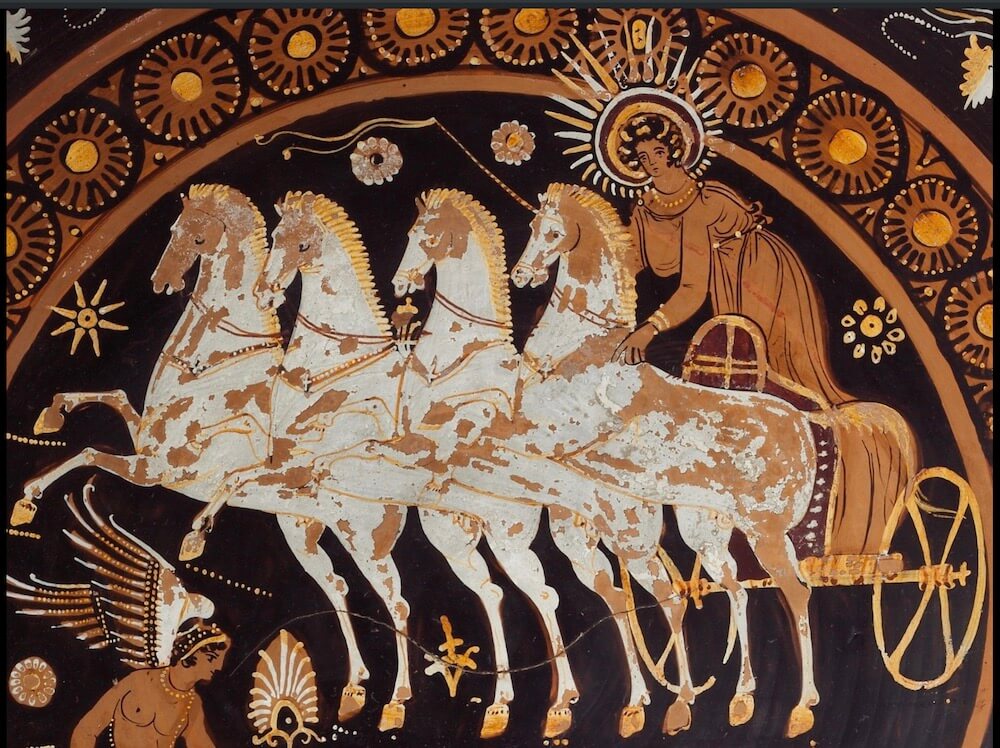
This artwork is a Greek terracotta lekanis lid depicting the goddess of dawn, Eos, driving a chariot.
Eos is shown with a solar halo, driving four white horses across the sky.
The piece dates to the late 4th century BC and is currently held by the Metropolitan Museum of Art.
In the bottom left corner, the god of love, Eros, is visible.
Easter. For some, it's a time to hunt for eggs and talk about bunnies. For others, it's a time to come together with family and friends "to celebrate the crucifixion and resurrection of our Lord and Savior Jesus Christ". Well, that is what Christianity has had us believing since the early days of the Christian Church. However, upon doing some thorough research, Easter appears to have far deeper roots than our Church Fathers would like us to believe.
The etymology of ‘Easter’ gives us a basic understanding of the origins of the word Easter. The benchmark here is the word ‘Eos’ who is known as The Greek Goddess of the Dawn. Hesiod’ Theogony tells us the origins of Eos;
Eos, a goddess bedded in love with a god, bore to Astraeus the strong-spirited winds, clear Zephyrus and swift-pathed Boreas and Notus; and after these the Early-born one22 bore the star, Dawn-bringer, and the shining stars with which the sky is crowned. (Hesiod 376-380)
Old English Easterdag, "Easter day," from Eastre (Northumbrian Eostre), from Proto-Germanic *austron-, "dawn," also possibly the name of a goddess whose feast was celebrated in Eastermonad (the Anglo-Saxon month corresponding with April), from *aust- "east, toward the sunrise" (compare east), from PIE root *aus-(1) "to shine," especially of the dawn.
Bede writes that Anglo-Saxon Christians adopted her name for their Mass of Christ's resurrection. Almost all neighboring languages use a variant of Latin Pascha to name this holiday (see paschal).
When we think of ‘Dawn’, statements like: beginning anew, a brand new day and a fresh start, come to mind. A new birth per se. Although Pythagoras gave us this concept & later immortalized by Aristotle, Democritus also mentions;
“...in man, is a small world.”
ἐν τῷ ἀνθρώπῳ μικρῷ κόσμῳ ὄντι κατὰ τὸν Δημόκριτον.(Democritus VII D225)
This community of nature between God and the human soul implied an analogy between macrocosm and microcosm; the same principle of order constitutes the essential nature of the universe (considered as a living organism) and of the particular creature. (Aristotle xv)
Using this Analogy we can start to align numerous parallels including Easter. For example a normal gestation period for a pregnant woman is two hundred and eighty days. From the Birth of the Sun on December 25 to the Vernal equinox on March 25 is two hundred and eighty days also. I make a point of this because birth is everything. Obviously birth is linked to fertility from women to apples to flowers to lambs. That earthly, primal, feminine power of birthing ripples throughout the entire cosmos. That fertile power, the fertility of existence is celebrated when our Sun comes up through those dark waters, the womb of Pisces, through the Vesica Pisces into the dawn of Spring of Aries. The Earth gives birth to the Sun. This is
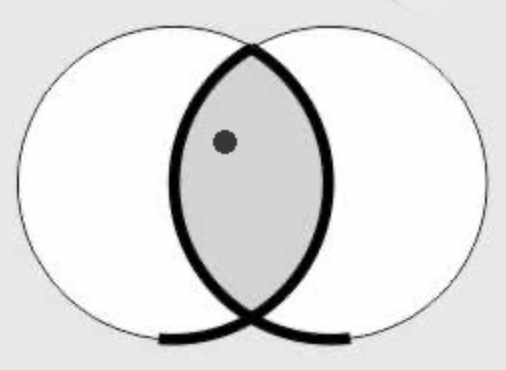
The Vesica Pisces
the commencement of a new cycle. The first full paschal Moon, the Vernal equinox. That moment of equilibrium. The Sun is a baby here; fresh, young, pure. He is the product of the scared union between
| Festival | Goddess/God | Area | Season | Month | Moon |
| Akitu Anthesteria Munichia Shemu Passover Beltane Imbolc Eosturmonab Nawruz Easter | Ishtar Dionysus Artemis Isis God Freya Brigid Eostre (Ostara) Ahura Mazda Jesus | Mesopotamia Greece Athens Egypt Semitic peoples Gaelic Gaelic Anglo Saxon Persian Rome & beyond | Spring Spring/Summer Spring Spring Spring Spring/Summer Spring/Summer Spring Spring Spring | All occur around the Vernal equinox. Beltane starts at the midpoint between here & the summer solstice | The first full Moon of Spring is always the pascha Moon. Pascha = Πάσκα = passover. The Sun has passed over the equinoxal point. |
- Easter: The death and resurrection of Jesus. Gross… FML they made us worship a man who goes around saving and healing with little kids, pirates them, trafficks them, molests them and gives them drugs. Drugs that are purple & you take these drugs to send you into the Aion. To the outside of Kronos. To the outside of space and time. This is where we have gone horribly wrong. Jews and so on are still celebrating passover.
- Judaism: The creator God: The ultimate sole authoritative figure. He is a jealous, vain and wrathful God
- Islam: Allah. Similar to the God above. Also in the Christian Church.
Conclusion
Easter stands within a much older framework. Anchored in the Vernal equinox, activated by the paschal Moon, echoing the rise of Aries at the head of the Zodiac. What appears as a religious celebration is also a continuation of ancient cosmology, a reflection of humanity's long observations of the heavens and the recognition of spring being the moment when the world comes into balance.