![[back]](/assets/home_24dp_E3E3E3_FILL0_wght400_GRAD0_opsz24.svg "[back]")
![[search]](/assets/search_24dp_E3E3E3_FILL0_wght400_GRAD0_opsz24.svg "[search]")
Bes Vase
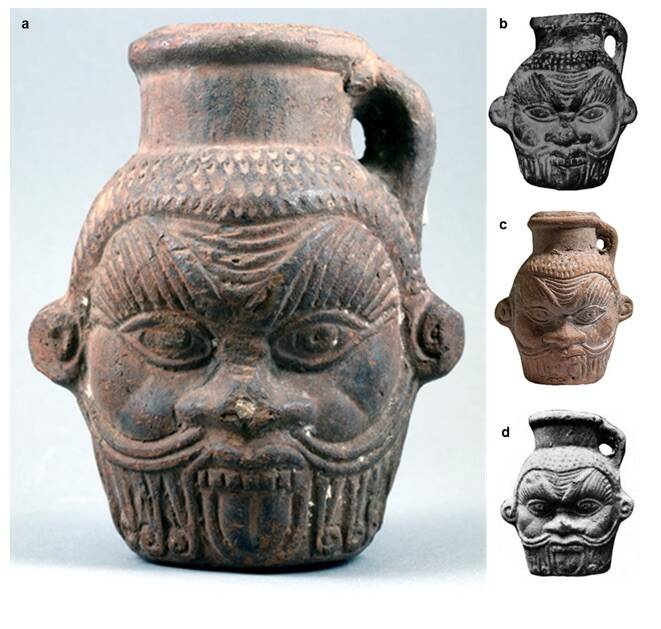
An Egyptian drinking vessel from 300BCE - 300CE
Syrian Rue, Blue Lotus, Cleome, Wine, Blood, Vaginal or Oral Mucus, Breast Milk, Sesame, Licorice, Royal Jelly
a) Drinking vessel in shape of Bes head from the El-Fayūm Oasis, Egypt, courtesy of the Tampa Museum of Art, Florida. b) Bes mug from the Ghalioungui collection. c) Bes mug from the Allard Pierson Museum, courtesy of the Allard Pierson Museum, Amsterdam, photo by Stephan van der Linden. d) Bes mug from El-Fayum. Photo: USF
An Ancient Egyptian Mug at the Tampa Museum of Art Once Held Psychotropic Drugs, Human Blood, and Bodily Fluids, Research Reveals (article)
Summary
Researchers analyzing residue from a small ceramic Bes-headed ritual mug in the collection of the Tampa Museum of Art discovered evidence that it once contained a complex psychoactive and bodily mixture used in ritual contexts.
Using proteomics, metabolomics, genetic assays, and synchrotron-based FTIR spectroscopy, the team identified:
- Psychoactive plants (notably Peganum harmala and Nymphaea nouchali var. caerulea)
- Fermented fruit liquid (likely grape-based yeast water)
- Human biological materials (blood, mucus consistent with oral or vaginal origin, and breast milk)
- Supplementary ritual substances (sesame, licorice, royal jelly)
The vessel dates to the Ptolemaic–Roman period (ca. 3rd c. BCE – 3rd c. CE) and was reportedly found in the El-Fayum Oasis, an area well known for hybrid Egyptian–Greek religious practices.
The authors argue the mug was not decorative but actively used in ritual ingestion, most likely in ceremonies associated with Bes, a household protector, childbirth guardian, and apotropaic figure who became increasingly ritualized and deified in late Egyptian religion.
The study was published as a preprint on Research Square and has not yet undergone formal peer review.
Reconstructed ritual contents
(descriptive reconstruction — not a recipe or instructions)
Based solely on residue analysis, the ritual mixture appears to have included:
1. Psychoactive / entheogenic components
- Peganum harmala (Syrian rue)Source of harmala alkaloids (MAO-inhibiting, visionary, trance-inducing)
- Blue lotus (Nymphaea nouchali var. caerulea)Mildly narcotic, euphoric, dream-enhancing; well attested in Egyptian ritual art
- Cleome speciesMedicinal / bioactive plant used in antiquity, possibly synergistic
2. Fermentation & solvent medium
- Fruit-derived yeast water (likely grape)A low-alcohol carrier capable of extracting and preserving alkaloids
3. Human biological substances (symbolic + pharmacological)
- Human blood
- Mucosal secretions (oral or vaginal)
- Breast milk
These are consistent with sympathetic, reproductive, protective, and initiatory symbolism in Egyptian ritual medicine rather than culinary or casual use.
4. Supporting ritual additives
- Sesame (oil/fat carrier)
- Licorice (flavor, medicinal synergy)
- Royal jelly (fertility, vitality symbolism)
Important: The study does not claim standardized proportions, preparation steps, or frequency—only that these substances were present together in at least one vessel.
Why Bes? Ritual logic
Bes is not a distant cosmic god but a threshold guardian:
- Protector of childbirth and infants
- Apotropaic figure against malevolent forces
- Associated with music, altered states, and liminality
- Common in domestic shrines and ingestive rituals
A Bes-shaped drinking vessel strongly implies:
- Embodied protection during vulnerability (birth, trance, initiation)
- Ingestion as ritual action, not symbolic offering alone
- Controlled altered states rather than recreational intoxication
Additional research context (beyond the article)
1. This is not an isolated case
- Blue lotus appears repeatedly in banquet, funerary, and priestly iconography
- Harmala alkaloids are attested across Egypt, Persia, and the Levant
- Egyptian medical papyri frequently blur medicine, magic, and ritual
2. Biological fluids in ancient ritual
- Blood, milk, and sexual fluids appear in:
- Egyptian medical-magical texts
- Greco-Egyptian magical papyri (PGM)
- Mediterranean initiation rites tied to fertility and protection
- These substances functioned as potent symbolic carriers, and/or may indicate results from a sexual rite
3. Faiyum as a syncretic hotspot
- Strong Greek–Egyptian religious blending
- Cult activity persisting into Roman rule
- Ideal environment for hybrid pharmaco-ritual traditions
4. Scholarly significance
This study is important because:
- It provides direct chemical evidence, not iconographic inference
- It confirms intentional psychoactive ingestion
- It challenges the idea that Egyptian religion was purely symbolic or non-experiential
Bottom line
This Bes mug almost certainly functioned as a ritual ingestion vessel containing a carefully composed psychoactive and symbolic mixture used in protective, reproductive, or initiatory ceremonies.
It supports a growing scholarly view that ancient Egyptian religion included controlled altered-state practices, integrating pharmacology, bodily symbolism, and ritual guidance into a unified system.