![[back]](/assets/home_24dp_E3E3E3_FILL0_wght400_GRAD0_opsz24.svg "[back]")
![[search]](/assets/search_24dp_E3E3E3_FILL0_wght400_GRAD0_opsz24.svg "[search]")
As Above So Below
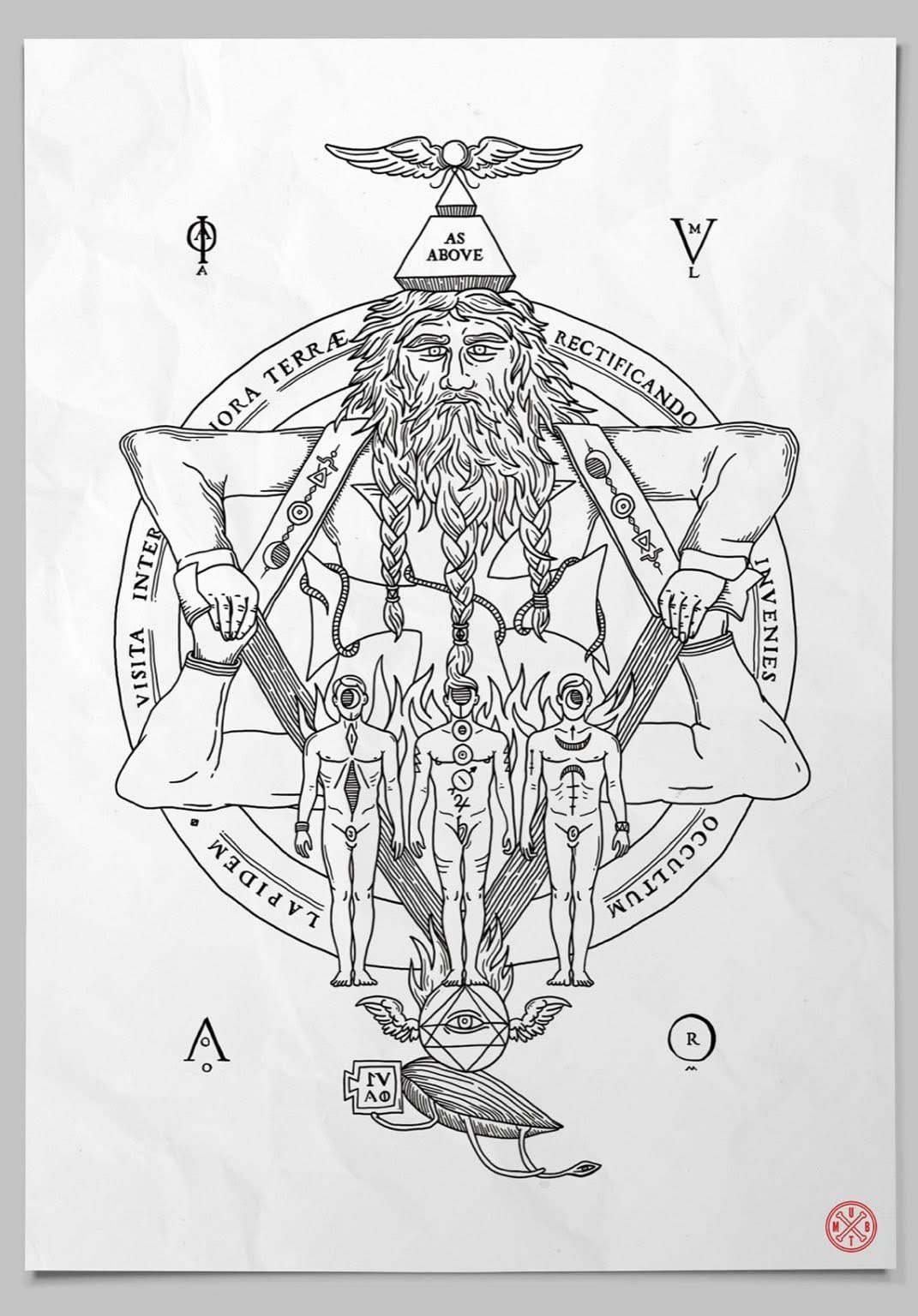
This image is a single diagram explaining how perception organizes reality.
The vertical axis is the key. At the top, “As Above” represents ordered intelligence: coherence, logos (logic), pattern-recognition. At the bottom, “So Below” represents raw instinct: fear, drive, narrative identity. Nothing here is moralized. These are modes, not values.
The large central figure is the mediating mind — the faculty that can operate in either mode. When perception is ordered, the world appears as a system of roles, problems, and coordination. When perception is reactive, the same world collapses into enemies, obstacles, and saviors. The world itself does not change; the grammar used to interpret it does.
The three human figures below show this triadic structure repeating. Below the line, perception organizes experience into hero–villain–victim stories. Above the line, the same structure resolves into functional differentiation and cooperation. This is “as above, so below” in action: the same pattern expressed at different levels of order.
The serpent and fire at the bottom signify raw energy and instinct. They are not eliminated by ascent; they are integrated. The wings and crown above signify perspective and coherence, not escape from embodiment.
In short: this image says that when the mind crosses from narrative fear into structural clarity, the cosmos reorganizes from conflict into coordination — not because reality changes, but because perception does.
Deep dive
That was just one dimension. Perception. Here's all three dimensions:
- cosmological
- perceptual
- ego-mechanics
At the cosmological level, the model describes how reality itself remains stable while order emerges through differentiation. “Above” refers to ordered intelligibility: pattern, law, constraint, and coherence. “Below” refers to generative force: energy, motion, conflict, growth, decay. The cosmos is not a battle between them; it is their interlock. When order and generation are aligned, reality appears as a coordinated system. When they are misaligned, reality appears chaotic or violent—but the cosmos itself has not changed. Only the mode of organization has. The hexagram expresses this: two triangles, neither sufficient alone, producing structure only when locked together.
⸻
At the perceptual level, the same structure governs how experience is interpreted. Being below the line means perception is dominated by threat detection and narrative compression. The world is read as a story of heroes, villains, and victims because that is the fastest way a nervous system can make sense of danger. Being above the line means perception shifts into structural recognition. The same people and events are no longer characters in a drama but functions in a system: constraints, resources, pressures, roles. Reality does not change; the grammar used to parse it does. This is why perception “changes reality” without violating physics — it changes what is salient, actionable, and meaningful.
⸻
Importantly, the perceptual level is dynamic, not a permanent state. You move above and below the line constantly. Awareness of where you are is the skill. When you know you are below the line, you stop trusting the story your mind is telling. When you are above the line, you gain access to cooperation, problem-solving, and coordination — not because you became nicer, but because fear stopped running the interpretive engine.
⸻
At the ego-mechanics level, the same pattern operates inwardly. Below the line, inner forces appear as identities: “I am afraid,” “I am lazy,” “I am driven,” “I am broken.” These identities fight for control, and the psyche feels fragmented. Above the line, those same forces are recognized as parts with functions. Fear becomes a capacity signal. Pressure becomes a constraint signal. Creativity becomes an option-generating function. Nothing is eliminated; everything is reassigned.
Here two triads become operational. Above the line The Creative is the part that generates possibilities and movement. The Coach is the part that monitors load, safety, and capacity. The Challenger is the part that applies pressure and enforces limits. Below the line, these appear as hero, victim, and villain and sabotage each other. Above the line, inner archtypes / personas / parts cooperate because their roles are differentiated and respected. Inner alignment happens not by silencing parts, but by letting each part do the job it evolved to do.
----
What ties all three levels together is this: the pattern does not change across scales. The cosmos, perception, and psyche are organized by the same structural logic. “As above, so below” is not a mystical slogan; it’s a statement about recursion. Order is not imposed from outside. It emerges when differentiation is clear and cooperation becomes possible.
⸻
So the image is not teaching transcendence or escape. It is teaching coordination. At the cosmological level, coordination produces order. At the perceptual level, it produces clarity. At the ego level, it produces alignment. The work is the same everywhere: recognize the mode you are in, differentiate roles instead of moralizing identities, and let structure replace story.